
By Pascal Burke, Licensed Insurance Broker (CA License #6015321 / TX License #3305690), Founder of ContractorsInsured.net Last updated: [05/06/2026]
Editorial note: This article is educational and intended for California roofing contractors and the professionals who advise them. ContractorsInsured.net is a licensed California insurance brokerage (CA License #6015321), not a law firm, the Contractors State License Board (CSLB), the California Department of Industrial Relations (DIR), or a tax advisor. California workers’ compensation rates, WCIRB class code rules, SB 216 phase-in details, and underwriting guidelines change as the legislature acts and as carriers update their appetites. Always confirm specific compliance, rating, and coverage requirements directly with CSLB, DIR, your broker, qualified counsel, and your tax advisor before binding coverage or making decisions about your business structure.
TLDR: California Roofing Insurance in One Glance
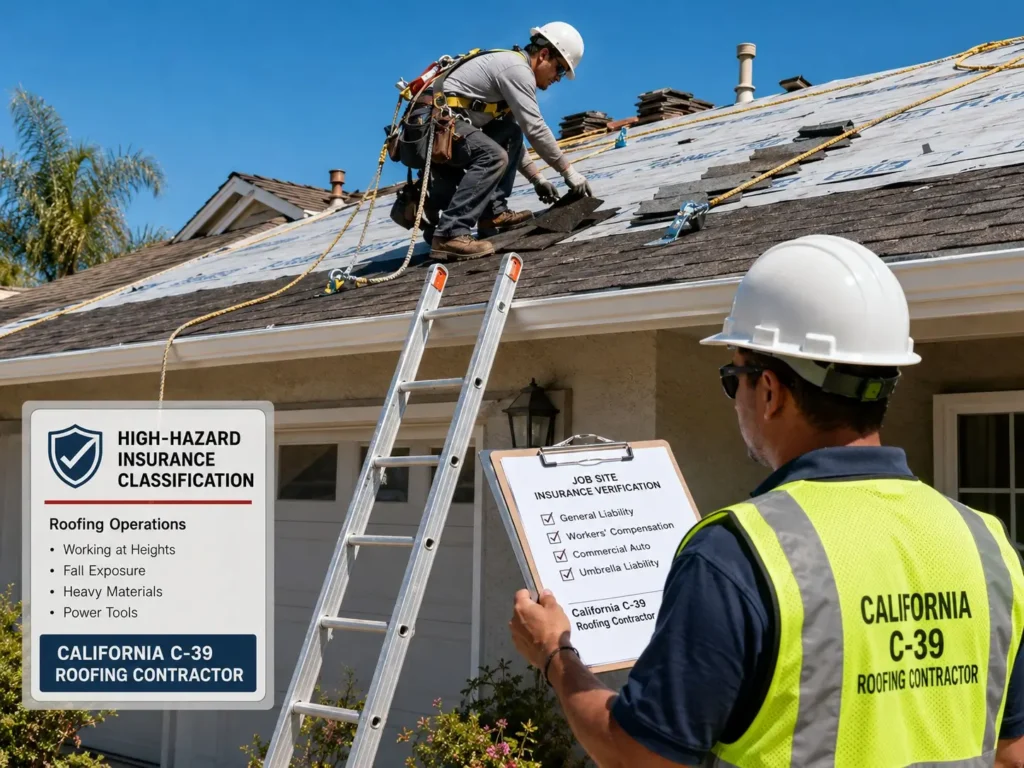
California roofing insurance is expensive because C-39 work sits at the top of most carrier risk models. You are dealing with heights, tear-offs, hot surfaces, and high claim severity. Most California roofers carry General Liability, Workers’ Compensation, and Commercial Auto, with optional inland marine (tools) or umbrella coverage layered on top.
Crew Size | Typical Annual Total |
Sole-owner stack | $6,000 to $15,800 |
Small crew (2-5 employees) | $15,000 to $60,000+ |
Mid-size crew (6-15 employees) | $50,000 to $200,000+ |
Most variation comes from payroll, claims history, and class code exposure tied to roofing operations.
The Three Policies Every California Roofer Needs (And How They Stack)
General Liability (GL)
GL covers third-party property damage and bodily injury tied to your roofing work. In California, carriers rate roofing contractors using high-hazard assumptions due to fall and water intrusion risk.
Workers’ Compensation (Required Today Under SB 216)
Roofing falls under mandatory coverage rules for licensed contractors under California law, including SB 216 and Business & Professions Code §7125. SB 216 phased in expanded WC requirements for licensed contractors regardless of employee status. References:
Confirm current SB 216 application to your specific business structure with CSLB and your broker.
Commercial Auto
Most roofing claims start or end with vehicles. Trucks hauling ladders, materials, and crews are heavily scrutinized by underwriters, and severity claims involving vehicles can dwarf typical liability incidents.
Optional but Often Worth It
- Inland Marine for tools and equipment
- Umbrella / excess liability when GC contracts require higher limits
- Builder’s risk for larger projects
Why California Roofing Premiums Are Higher Than Most Trades
Roofing is one of the highest-risk classifications in California insurance rating systems, including WCIRB data sets.
Heights, Falls, and the Class Code Consequences
Roofing exposures involve elevated work environments, which increase claim severity, not just frequency. A single fall claim can produce six-figure or seven-figure costs.
California’s Hard Market
Carrier reinsurance costs, wildfire exposure across portfolios, and reduced appetite for construction risk all push premiums higher statewide. For broader hard market context, see our California hard market contractor insurance renewal guide.
Tear-Off, Hot Work, and the Risk Stack
Tear-offs, torch-down systems, and membrane installations increase both claim frequency and severity. Hot work is consistently flagged by underwriters as a higher-rated operation.
How California carriers rate roofing operations relative to each other:
Operation | Severity Profile | Underwriting Tier | Premium Impact |
Residential repair | Lower frequency, lower severity | Standard | Baseline C-39 rate |
Residential reroofing (asphalt shingle) | Moderate frequency and severity | Standard | Baseline to modest uplift |
New construction | Lower water-intrusion frequency, moderate severity | Standard | Often more favorable than re-roof |
Commercial tear-off | Higher frequency and severity | Stricter | Material premium uplift |
Hot work (torch-down, membrane) | Fire and burn severity | High-hazard | Highest rated, strict carrier appetite |
Sub Use and the Ghost-Sub Audit Problem
Improperly documented subcontractors are one of the most common audit adjustments in roofing. For more on subcontractor compliance and the ghost policy issue specifically in Texas, see our Texas ghost policy guide, California roofers working across state lines often face similar documentation pressure.
💬 Broker’s Note (Pascal Burke): Most roofers assume residential reroofing and commercial tear-off are rated the same way. They are not. A commercial tear-off job can push a file into a completely different underwriting tier because the severity curve changes. That is often where the premium jumps come from, not the carrier itself.
How a California C-39 GL Premium Is Actually Calculated
Receipts as the Premium Base
Carriers use projected and audited gross receipts to estimate GL exposure.
Operations Description (Tear-Off, New Construction, Repair)
“Roofing contractor” alone is not enough. Underwriters break operations down into:
- Tear-off work (highest rated)
- New construction
- Repair work
- Subcontracted work
Claims History
Loss runs heavily influence renewal pricing and carrier eligibility. A three-year clean loss history is one of the strongest pricing factors a roofing contractor can offer at submission.
Limits and Deductibles
Higher limits and lower deductibles increase premium. GC contract requirements often determine the floor.
How a California C-39 WC Premium Is Actually Calculated
Class Code 5552 (Roofing)
Roofing is rated under WCIRB Class Code 5552, one of the highest-rated construction classifications in California.
Payroll as the Base
WC is priced per $100 of payroll, and roofing carries among the highest rates in California. Rates vary by carrier and renewal year, confirm current rates with your broker.
Experience Modifier (Ex-Mod)
Your ex-mod adjusts premium based on prior claims experience. An ex-mod above 1.0 increases premium; below 1.0 decreases it.
SB 216 Impact
Certain licensed contractors must maintain active WC coverage depending on classification and structure, including roofing operations. SB 216 expanded requirements significantly. For broader California WC compliance context, see our California Workers’ Comp 2028 guide.
💬 Broker’s Note (Pascal Burke): Most contractors misunderstand their experience modification factor. You can actually verify your ex-mod directly through WCIRB filings, and many roofers discover their rating is higher due to a single older claim that is still influencing pricing. Pulling and reviewing your ex-mod worksheet is one of the most underused diagnostic moves in California roofing insurance management.
2026 Cost Ranges: What California Roofers Are Actually Paying
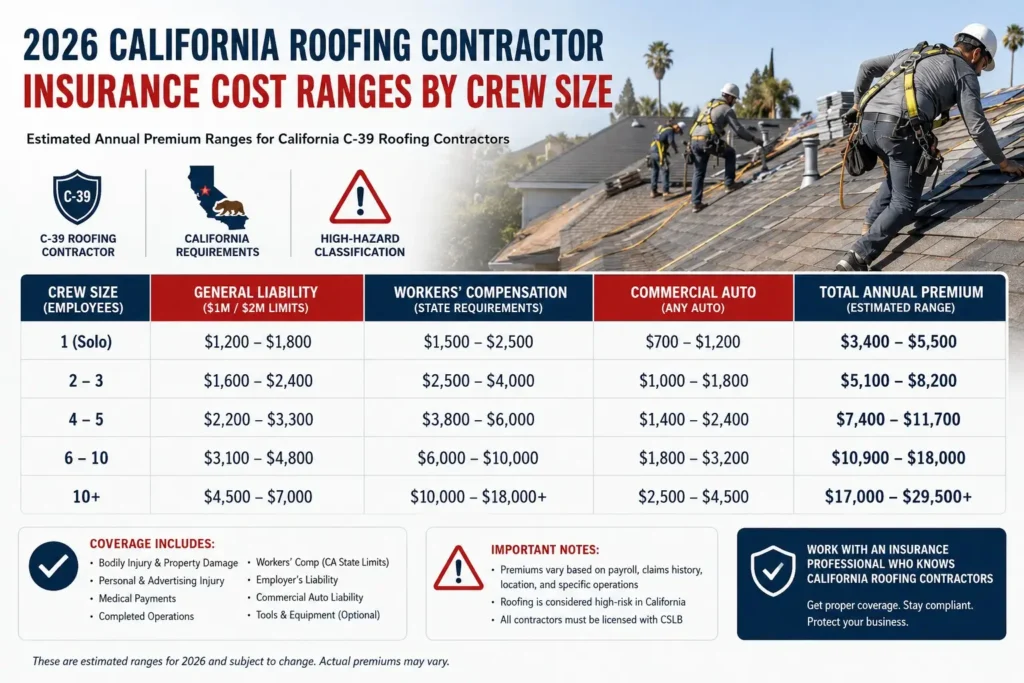
2026 California roofing contractor insurance cost ranges by crew size showing general liability workers compensation and commercial auto premiums]
Sole-Owner C-39
Coverage | Typical Annual Range |
General Liability | $2,400 to $5,500 |
Workers’ Compensation | $1,800 to $5,500+ |
Commercial Auto | $1,800 to $4,800 |
Total | $6,000 to $15,800 |
Small Crew (2 to 5 Employees)
Coverage | Typical Annual Range |
General Liability | $4,000 to $12,000 |
Workers’ Compensation | Approximately $30 to $60 per $100 of payroll (varies by year and carrier) |
Commercial Auto | $4,000 to $10,000 |
Total | $15,000 to $60,000+ |
Mid-Size Crew (6 to 15 Employees)
Coverage | Typical Annual Range |
General Liability | $10,000 to $30,000+ |
Workers’ Compensation | Heavily payroll-driven (often largest cost) |
Commercial Auto | $8,000 to $25,000+ |
Total | $50,000 to $200,000+ |
Get a California C-39 Quote
Send your CSLB license, payroll, vehicles, and current dec page. We shop multiple admitted carriers and return options in 24 to 48 hours.
Eight Levers That Lower California Roofing Insurance Premiums
Eight underwriting levers California roofing contractors can pull:
- Fall protection program, Documented Cal/OSHA-compliant training improves underwriting outcomes and unlocks credits with most carriers. See Cal/OSHA / DIR.
- Clean loss runs, A three-year clean loss history is one of the strongest pricing factors at submission.
- Accurate class splits, Admin payroll should not sit inside roofing class code exposure.
- Subcontractor compliance, Missing COIs are reclassified into payroll at audit, producing retroactive premium charges.
- Proper limits structure, Higher limits are required by many GCs and must be balanced against premium impact.
- Audit accuracy, Receipts and payroll mismatches cause large retroactive audit adjustments.
- Renewal timing, Renewing during clean-loss windows materially improves offers.
- Independent broker market access, Shopping multiple carriers changes outcomes more than any single underwriting credit.
💬 Broker’s Note (Pascal Burke): The single highest-value credit in roofing underwriting is a documented fall protection program. Not verbal policies. Written, trained, and recorded systems with sign-in sheets and training dates. We have seen double-digit percentage improvements when fall protection is properly documented and consistently enforced. The investment in formalizing it is small compared to the premium impact at renewal.
The Subcontractor and 1099 Trap
Carriers frequently reclassify uninsured or poorly documented subcontractors into payroll during audits. Under IRS common law rules, classification depends on control, not tax form.
If a subcontractor behaves like an employee in practice, set hours, employer-provided tools, direct supervision, carriers may treat the exposure as payroll for WC rating purposes regardless of how the contractor is paid. The result at audit is often a significant retroactive premium charge that catches the contractor mid-cash-flow.
For more on what GCs actually require from subcontractors at the endorsement level, see our Additional Insured, Primary & Noncontributory, and Waiver of Subrogation guide.
Three California Roofing Scenarios
The following are illustrative scenarios drawn from typical California C-39 roofing situations. Specific premiums depend on payroll, vehicles, claims history, current market conditions, and underwriting profile.
Scenario 1: Sole-Owner Long Beach Roofer
- High GL baseline due to C-39 classification
- WC inclusion required depending on business structure under SB 216
- Minimal auto exposure (one truck)
- Estimated total: lower end of sole-owner range
Scenario 2: Six-Person Sacramento Residential Roofer
- Payroll drives WC cost (often the largest line item)
- Subcontractor compliance becomes critical at audit
- Multiple trucks expand commercial auto exposure
- Estimated total: middle of small crew range
Scenario 3: San Diego Commercial Tear-Off Contractor
- Highest GL severity profile due to tear-off and hot work operations
- Stricter underwriting and stronger audit scrutiny
- Often requires umbrella coverage for GC contract compliance
- Estimated total: upper end of small/mid crew range
Renewal Strategy: How to Shop Without Burning Your Carrier
Roofing insurance is sensitive to how often you move markets. We recommend structured shopping windows tied to renewal, not reactive mid-term switching unless coverage is at risk.
Frequent mid-term switching can affect underwriting perception across the broader carrier ecosystem, since loss runs and submission histories follow a contractor between markets. The cleanest renewal strategy is:
- 90 to 120 days before renewal, request loss runs and exposure schedules
- Allow your broker time to shop multiple admitted carriers
- Compare quotes on apples-to-apples basis (limits, deductibles, endorsements)
- Move only when there is a meaningful improvement in coverage or cost
Schedule a Renewal Strategy Call
Send your current dec page, loss runs, and renewal date. We map the shopping window and identify which credits and class splits to address before submission.
How ContractorsInsured.net Approaches California Roofing Coverage
We work as an independent brokerage reviewing multiple California-admitted markets, aligning:
- CSLB classification (C-39)
- WCIRB Class Code 5552 exposure
- GL operations breakdown (tear-off, new construction, repair, sub-out)
- Subcontractor compliance structure
- Cal/OSHA fall protection documentation
- Premium impact of GC-required endorsements
For California-specific roofing coverage pages, see our California roofing contractors GL page and California roofing contractors WC page.
California Roofing Insurance Glossary
Quick definitions for the terms used throughout this guide:
- C-39 license: The CSLB roofing contractor classification required to perform roofing work in California.
- WCIRB Class Code 5552: The California workers’ compensation classification for roofing contractors. It carries one of the highest rates in the state and is applied per $100 of payroll.
- Experience modification factor (ex-mod): A multiplier applied to a contractor’s WC premium based on prior loss history. Above 1.0 increases premium; below 1.0 decreases it.
- SB 216: California legislation that expanded workers’ comp coverage requirements for licensed contractors in high-risk classifications, including roofing, regardless of employee status.
- Certificate of Insurance (COI): Proof-of-coverage document issued by an insurer. Missing or invalid subcontractor COIs trigger payroll reclassification at audit.
- Additional Insured / Primary & Non-Contributory / Waiver of Subrogation: Standard endorsement package most general contractors require from roofing subs before allowing work onsite.
- Loss runs: Insurer-issued reports of a contractor’s prior claims history, used by underwriters to set renewal pricing.
- Hard market: An insurance market cycle marked by reduced carrier appetite, stricter underwriting, and higher premiums, California has been in this state for construction risk since 2020.
Frequently Asked Questions
How much does roofing contractor insurance cost in California?
California roofing contractor insurance costs $6,000 to $15,800 per year for sole owners, $15,000 to $60,000+ for crews of 2 to 5 employees, and $50,000 to $200,000+ for crews of 6 to 15. Premiums are driven by WCIRB Class Code 5552, payroll, vehicle count, claims history, and admitted-carrier appetite.
Why is California roofing insurance so expensive compared to other trades?
California roofing insurance is more expensive than most trades because WCIRB Class Code 5552 carries one of the highest workers’ comp rates in the state. Heights, tear-offs, hot work, and severe injury claims drive both frequency and severity. California’s hard insurance market and reduced carrier appetite for construction risk add further pricing pressure on GL and WC.
Do California roofers need workers' compensation under SB 216?
Yes. SB 216 expanded California workers’ compensation requirements so that licensed contractors in high-risk classifications, including roofing, must carry active WC coverage regardless of employee status. Confirm specifics for your business structure with CSLB and your broker.
What is class code 5552 and how does it affect my premium?
WCIRB Class Code 5552 is the California workers’ compensation classification for roofing contractors. It is one of the highest-rated construction class codes in the state and is applied per $100 of payroll, making it the largest single driver of WC premium for most roofing operations.
What is the experience modifier and how do I lower mine?
The experience modification factor (ex-mod) is a multiplier applied to a roofing contractor’s WC premium based on prior loss history. An ex-mod above 1.0 increases premium; below 1.0 decreases it. Lower yours by reducing claim frequency and severity, closing open claims faster, and pulling your ex-mod worksheet from WCIRB to correct rating errors that are inflating your premium.
Can a documented fall protection program lower my California roofing insurance?
Yes. A documented Cal/OSHA-compliant fall protection program is one of the highest-impact underwriting credits available to California C-39 contractors. Written procedures, dated training records, sign-in sheets, and equipment inspection logs frequently produce double-digit percentage improvements at renewal versus verbal-only policies.
How does subcontractor insurance compliance affect my California GL premium?
Subcontractor compliance directly drives audit outcomes. Missing or invalid certificates of insurance (COIs) cause carriers to reclassify subcontractor payments as payroll, producing retroactive GL and WC charges that frequently land as five- and six-figure audit bills.
What limits do California GCs typically require for roofing subs?
Most California GCs require $1M per occurrence and $2M aggregate on general liability, additional insured (ongoing and completed operations), primary & non-contributory wording, and waiver of subrogation. Larger commercial projects frequently require a $2M to $5M umbrella on top. Specific requirements vary by GC and project.
How do I shop my California roofing insurance without burning my current carrier?
Shop on renewal, not mid-term. Request loss runs and exposure schedules 90 to 120 days before renewal, give your broker time to market the account across multiple admitted carriers, and compare quotes on apples-to-apples limits, deductibles, and endorsements. Move only when coverage or cost improves meaningfully, frequent mid-term switching can hurt underwriting perception across the carrier ecosystem.
Does ContractorsInsured.net place insurance for California roofing contractors?
Yes. ContractorsInsured.net is a California-licensed brokerage (CA License #6015321) that places GL, workers’ compensation, commercial auto, and umbrella coverage for C-39 roofing contractors across multiple admitted carriers. Complete submissions are typically quoted within 24 to 48 hours.
Key Takeaways
- WCIRB Class Code 5552 is the primary cost driver for California roofing insurance premiums.
- Workers’ compensation is the largest single line item for most California C-39 contractors with employees.
- A documented Cal/OSHA fall protection program is one of the highest-value underwriting credits in California roofing.
- Subcontractor compliance and valid COIs directly determine audit outcomes and retroactive premium adjustments.
- Independent broker market access, shopping multiple admitted carriers, moves pricing more than any single underwriting credit.
- SB 216 expanded California workers’ comp requirements to most licensed contractors regardless of employee status.
- Commercial tear-off and hot-work operations rate higher than residential reroofing and shift files into stricter underwriting tiers.
- Pulling and reviewing your ex-mod worksheet from WCIRB catches rating errors that are inflating your workers’ comp premium.
Get a California Roofing Insurance Quote
California C-39 roofing GL, WC, and commercial auto. Independent broker shopping multiple admitted carriers.
Request a California Roofing Quote
CA License #6015321. Quotes returned within 24 to 48 hours when a complete submission is provided. Send your CSLB license, payroll, vehicles, and current dec page.
This guide is educational and not legal, tax, or compliance advice. California workers’ compensation rates, WCIRB class code assignments, SB 216 implementation details, and carrier underwriting evolve and change over time. Always confirm specific rating, classification, and coverage decisions with the Contractors State License Board (CSLB), the California Department of Industrial Relations (DIR), WCIRB, your broker, qualified counsel, and your tax advisor before binding coverage or making decisions about your business structure.
This page covers California C-39 specifics. For national benchmarks across every state, see how much roofing insurance costs nationally.
California roofing cover
Get the policy behind the number: California roofing contractor general liability and California roofing contractor workers compensation.
Next steps for California roofing contractors
Roofing is one of California’s 16 dual wage classifications. On September 1, 2026 the roofing threshold rises from $31 to $33 an hour, which decides whether your payroll is rated under class code 5552 or the cheaper 5553. See the full table and what to check before renewal.