

Quick answer: If you hold C-39 Roofing, C-8 Concrete, C-20 HVAC, C-22 Asbestos Abatement, or D-49 Tree Service, California requires workers’ compensation today even with zero employees under SB 216. All other CSLB classifications must comply by January 1, 2028 under SB 1455.
Reviewed by Pascal Burke, Licensed CA Insurance Broker — May 7, 2026.
By Pascal Burke, Licensed Insurance Broker (CA License #6015321 / TX License #3305690), Founder of ContractorsInsured.net Last updated: 05/07/2026
Editorial note: This article is educational and intended for California CSLB-licensed contractors and the professionals who advise them. ContractorsInsured.net is a licensed California insurance brokerage (CA License #6015321), not a law firm, the Contractors State License Board (CSLB), the California Department of Industrial Relations (DIR), or a tax advisor. California contractor licensing and workers’ compensation requirements have evolved through multiple bills and amendments since 2022, and specific trade-by-trade timing may vary based on subsequent legislation and CSLB guidance. Always confirm specific compliance requirements directly with CSLB, DIR, qualified counsel, and your CPA before making decisions about your license, business structure, or insurance coverage.
TLDR: Find Your Class Code in One Glance
If you hold a CSLB license in California, whether you need workers’ compensation with zero employees generally depends on your classification.
Right now:
- Specific high-risk trades must carry WC even with no employees, under California legislation including SB 216
By January 1, 2028:
- All CSLB classifications are scheduled to require WC even with no employees, under California legislation including SB 1455
Most contractors generally fall into one of two situations:
- You either need WC today because of your class code
- Or you are preparing for mandatory coverage by 2028
For specific CSLB filing requirements, see the CSLB Workers’ Compensation Insurance page.
SB 216 vs SB 1455 at a Glance
| SB 216 (Today) | SB 1455 (By Jan 1, 2028) | |
|---|---|---|
| Effective | In effect now (phased since 2023) | Full effect by January 1, 2028 |
| Who is affected | Specific high-risk CSLB classifications | All CSLB classifications |
| Trades cited | C-39 Roofing, C-8 Concrete, C-20 HVAC, C-22 Asbestos Abatement, D-49 Tree Service | B General Building, C-9, C-10, C-27, C-33, C-35, C-36, and all other classifications |
| No-employees exemption | Removed for listed classifications | Removed for all CSLB classifications |
| Source | SB 216 bill text | California Legislative Information |
Always confirm specific application with CSLB and your broker before relying on this comparison.
The Two Rules That Determine Whether You Need WC
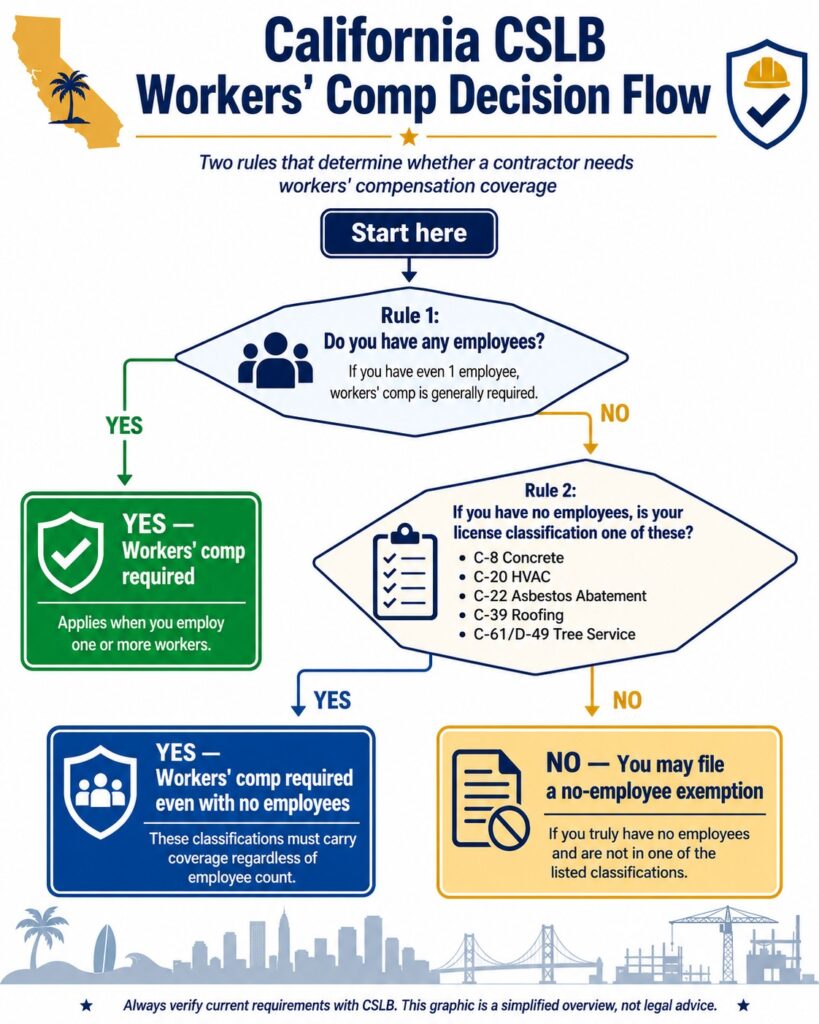
Rule 1: If You Have Employees (Any Trade)
If you have even one employee in California, workers’ compensation is generally required regardless of trade classification. This is enforced through California labor and insurance rules administered by the California Department of Industrial Relations (DIR).
Rule 2: If You Have No Employees (Class-Code-Specific)
If you are a sole owner with no employees, WC requirements generally depend on your CSLB classification.
Some trades already require it under California legislation including SB 216. Others are scheduled to require it under SB 1455 by January 1, 2028. For the broader 2028 picture, see our SB 1455 California Workers’ Comp 2028 guide for contractors.
Trades Required to Carry WC Today
The following CSLB classifications are commonly cited as already subject to WC requirements even with no employees, under California legislation including SB 216 and related implementation:
CSLB Code | Trade | Generally Required Since |
|---|---|---|
C-39 | Roofing | 2023 |
C-8 | Concrete | 2023 (or per applicable rule) |
C-20 | HVAC | 2023 (or per applicable rule) |
C-22 | Asbestos Abatement | 2023 (or per applicable rule) |
D-49 | Tree Service | 2023 (or per applicable rule) |
Important: Specific trade-by-trade application and effective dates depend on the actual bill text, subsequent amendments, and CSLB implementation guidance. Confirm your specific classification’s current WC requirement directly with CSLB and your broker before relying on this list. Legislative reference: SB 216 bill text.
For roofing-specific C-39 cost and compliance detail, see our California C-39 roofing insurance guide.
💬 Broker’s Note (Pascal Burke): Even today, we still see C-39 roofers and C-22 asbestos contractors operating without realizing they fall under expanded CSLB WC coverage rules. The confusion usually comes from assuming “no employees means no WC,” which is not true for these classifications. The first place to verify is your CSLB record, not anecdotal advice from another contractor.
Trades Required by January 1, 2028
By January 1, 2028, WC requirements are scheduled to expand to all CSLB classifications under California legislation including SB 1455. This means every classification listed below will generally need WC coverage even with zero employees:
- B — General Building
- C-9 — Drywall
- C-10 — Electrical
- C-27 — Landscaping
- C-33 — Painting and Decorating
- C-35 — Lathing and Plastering
- C-36 — Plumbing
- All other CSLB classifications
This generally means the “no employees exemption” effectively disappears for licensing purposes over the SB 1455 implementation window. Legislative reference: California Legislative Information.
How to Find Your Class Code (And Confirm What Applies to You)
CSLB License Lookup
You can confirm your classification directly through the CSLB official license database.
Reading Your License Record
Your license will list one or multiple classifications (for example, B General Building + C-10 Electrical).
When You Hold Multiple Classifications
If any classification you hold requires WC, your overall licensing requirement may be affected depending on structure and enforcement interpretation.
💬 Broker’s Note (Pascal Burke): One of the most common mistakes we see is dual classification confusion. For example, a contractor holding B + C-10 assumes only the “main” classification matters. In practice, the stricter classification often drives the workers’ comp requirement, especially during CSLB renewals or carrier filings. If you hold two classifications and one is on the SB 216 list, treat the WC requirement as active even if the other classification would not require it on its own.
Sole Owner vs Employee: When Each Rule Kicks In
Sole Proprietor With No Employees
Coverage requirement generally depends on classification — SB 216 today for the trades listed above, SB 1455 expansion by 2028 for all other classifications.
Sole Proprietor With Even One Helper
Once you add labor, even informally, you are typically subject to standard WC rules under California labor classification standards regardless of how the worker is paid (W-2 vs 1099).
LLC, Corporation, or Partnership Structures
Entity type does not generally remove WC classification requirements if employees or regulated classifications apply. The classification requirement attaches to the license, not the entity structure.
💬 Broker’s Note (Pascal Burke): The “I’ll just 1099 my helper” approach does not work for California WC compliance. If the worker behaves like an employee in practice — set hours, your tools, your direction — California labor enforcement and your carrier will treat them as an employee for WC purposes regardless of how they are paid. This is the same control test that applies in IRS classification, and it generally lands the same way under California enforcement.
Cost Ranges by CSLB Classification (2026)
Workers’ comp pricing is generally heavily influenced by WCIRB classification data. Ranges below are illustrative for sole-owner inclusion scenarios and vary by carrier and current market conditions.
Hazard Tier | Example Classifications | Annual Range (sole-owner inclusion) |
|---|---|---|
High-hazard | C-39, C-8, C-22, D-49 | $1,400 to $5,500+ |
Mid-hazard | C-20, C-36, C-9, C-27 | $900 to $2,800 |
Lower-hazard | C-10, C-33, B | $700 to $1,800 |
Confirm specific quote ranges with your broker, since rates vary by year, carrier, and current WCIRB filings.
Get a CSLB-Ready WC Quote
Send your CSLB license number. We’ll identify your classification, confirm WC requirements, and return a quote typically within 24 to 48 hours.
License Consequences of Missing the WC Filing
Suspension at Renewal
CSLB generally requires proof of WC filing where applicable before license renewal is processed. A lapse close to renewal can delay or block renewal entirely.
Bid and Permit Implications
Many general contractors and permitting authorities require active WC verification before allowing work to proceed. A missing WC filing can stall projects mid-bid or cause subcontractor removal from approved bidder lists.
For more on what GCs require beyond WC at the endorsement level (Additional Insured, Primary & Noncontributory, Waiver of Subrogation), see our AI/PNC/WOS endorsement guide.
How to File WC With CSLB
The Carrier Files, Not You
In most cases, your insurance carrier generally submits proof of coverage directly to CSLB after binding. Contractors do not file separately.
What to Verify After Binding
You should generally confirm:
- CSLB license status is updated
- Carrier has submitted active proof
- Policy classification matches your CSLB classification
How to Confirm Active License Status
Check CSLB status here: CSLB License Lookup.
Three CSLB Compliance Scenarios
The following are illustrative scenarios drawn from typical California CSLB compliance situations. Specific outcomes for any contractor depend on classification, business structure, employee status, and current legislation.
Scenario 1: C-39 Roofer (Long Beach, SB 216 Today)
- Must carry WC even with no employees due to roofing classification
- WC inclusion scenario priced under WCIRB Class Code 5552 (highest construction tier)
- Carrier files directly with CSLB to maintain license active status
Scenario 2: C-10 Electrician (Sacramento, SB 1455 Preparation)
- No WC generally required today as a sole owner with no employees
- Will require coverage under SB 1455 expansion by January 1, 2028
- Renewal cycle planning matters for cost-effective binding before mandatory date
The full C-10 picture — the $25,000 bond, the exemption rules, and what California electricians pay for general liability — is in our guide to electrician insurance in California.
Scenario 3: B + C-10 Contractor (Riverside, Dual Classification)
- May be pulled into WC requirement depending on classification interpretation
- Stricter classification generally drives the requirement during CSLB review
- Worth confirming with CSLB and broker before assuming exemption applies
Confirm My CSLB WC Requirement
Send your CSLB license number and we’ll confirm whether your specific classification requires WC today or under SB 1455 expansion. Typical response within one business day.
How ContractorsInsured.net Approaches CSLB WC Filings
We help California contractors:
- Confirm classification-specific WC obligations under current legislation
- Bind coverage aligned with CSLB requirements
- Coordinate carrier filings directly with CSLB
- Prevent lapse-related license issues during renewal cycles
Specific resources:
Frequently Asked Questions
Which California contractor classifications require workers' compensation today?
Yes. As of 2026, C-39 Roofing, C-8 Concrete, C-20 HVAC, C-22 Asbestos Abatement, and D-49 Tree Service must carry workers’ compensation in California even with zero employees under SB 216. Confirm your specific classification’s current requirement with CSLB and your broker before relying on this list.
Does a C-39 roofing contractor in California need workers' comp with no employees?
Yes. A C-39 roofing contractor in California must carry workers’ compensation even with no employees under SB 216. C-39 is one of the strictest enforced classifications and CSLB will block license renewal if the WC filing is missing.
Which California contractor trades will need workers' comp by 2028?
By January 1, 2028, all CSLB classifications will be required to carry workers’ compensation under SB 1455 — including B General Building, C-9 Drywall, C-10 Electrical, C-27 Landscaping, C-33 Painting, C-35 Lathing/Plastering, C-36 Plumbing, and every other classification. The no-employees exemption effectively disappears for licensing purposes.
How do I find my CSLB classification?
Use the official CSLB License Lookup at cslb.ca.gov to confirm your classification. Your license record lists every classification you hold (for example, B General Building + C-10 Electrical); the stricter classification generally drives your WC obligation.
What happens if I hold multiple CSLB classifications and one requires WC?
The stricter classification controls. If any classification you hold is on the SB 216 list, treat the workers’ comp requirement as active for the whole license, even if your other classification would not require it on its own. Confirm with CSLB during renewals or carrier filings.
Do sole proprietors with no employees in non-SB-216 trades need WC today?
Generally no, not today. Sole proprietors with zero employees in classifications outside the SB 216 list (C-39, C-8, C-20, C-22, D-49) do not need WC right now. However, SB 1455 expands the requirement to all CSLB classifications by January 1, 2028, so plan binding before your renewal cycle crosses that date.
How much does workers' comp cost by CSLB classification in California?
Sole-owner workers’ comp typically runs $700–$1,800 for lower-hazard trades (B, C-10, C-33), $900–$2,800 for mid-hazard (C-20, C-36, C-9, C-27), and $1,400–$5,500+ for high-hazard (C-39, C-8, C-22, D-49) as of 2026. Final pricing varies by carrier, WCIRB class code, and current market conditions.
How does the CSLB workers' comp filing process work?
The carrier files, not you. In most cases your insurance carrier submits proof of WC coverage directly to CSLB after binding, and CSLB updates your license status. You should verify the policy classification matches your CSLB classification and that the filing is active.
What happens to my CSLB license if my WC policy lapses?
CSLB will suspend license renewal or block new permits. A lapsed WC filing close to your renewal date can delay or block renewal entirely, remove you from approved bidder lists, and stall projects mid-bid. Reinstating coverage and refiling with CSLB is required to restore active status.
Does ContractorsInsured.net handle CSLB workers' comp filings for California contractors?
Yes. ContractorsInsured.net helps California contractors confirm classification-specific WC obligations, bind coverage that matches CSLB requirements, coordinate carrier filings directly with CSLB, and prevent lapse-related license issues during renewal cycles.
Key Takeaways
- WC requirements depend on CSLB classification and employee status
- California legislation including SB 216 already requires WC for specific high-risk trades
- California legislation including SB 1455 expands WC requirements to all CSLB classifications by January 1, 2028
- C-39 roofing is generally one of the most strictly enforced classifications today
- Carrier filing accuracy is critical to maintaining active license status
- WCIRB class codes directly influence pricing across all trades
- Dual classifications generally require treating the stricter requirement as active
- Entity structure (LLC, corp, partnership) does not generally remove classification-based WC requirements
Get a CSLB-Ready Workers’ Comp Quote

Request a CSLB-Ready Quote
Send your CSLB license number. We identify your classification, confirm WC requirements under current legislation, and return a quote typically within 24 to 48 hours. CA License #6015321.
This guide is educational and not legal, tax, or compliance advice. California contractor licensing and workers’ compensation requirements evolve as the legislature acts and CSLB issues guidance. Specific bill applications, effective dates, and trade-by-trade requirements may vary based on current legislation and amendments. Always confirm specific compliance requirements with the Contractors State License Board (CSLB), the California Department of Industrial Relations (DIR), WCIRB, qualified counsel, and your CPA before making decisions about your license, business structure, or insurance coverage.