By Pascal Burke, Licensed Insurance Broker (CA License #6015321 / TX License #3305690), Founder of ContractorsInsured.net Last updated: May 5, 2026
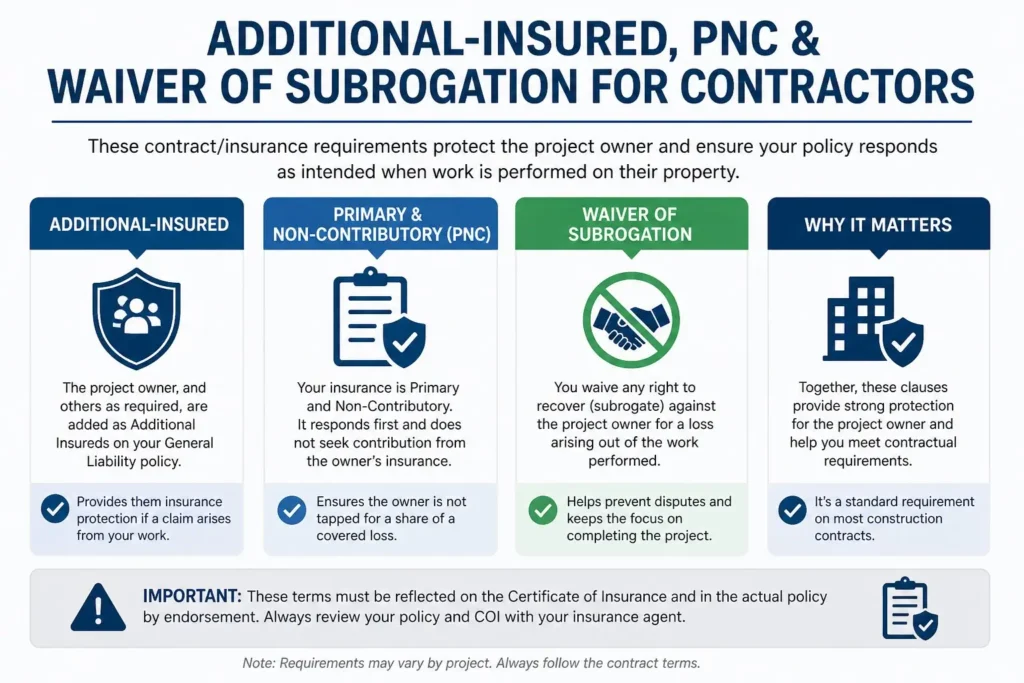
Short answer: When a general contractor asks for AI, PNC, and WOS, they are asking you to add three specific endorsements to your General Liability policy: Additional Insured (typically ISO forms CG 20 10 / CG 20 37), Primary and Noncontributory (CG 20 01), and Waiver of Subrogation (CG 24 04), so your insurance responds first to claims arising from your work, and your carrier waives its right to recover from the GC after paying that claim.
ContractorsInsured adds these endorsements for contractors in California and Texas and issues same-day certificates. Call (949) 522-3284.
Reviewed by Pascal Burke, Licensed Commercial Insurance Broker (CA #6015321, TX #3305690) · Last reviewed: May 17, 2026 · Sources: ISO, IRMI, Insurance Information Institute
On This Page
- TLDR: The Three Endorsements in One Glance
- Why GCs Demand These Three Endorsements
- Additional Insured (AI), Explained
- Primary and Noncontributory (PNC), Explained
- Waiver of Subrogation (WOS), Explained
- How These Three Endorsements Work Together
- COI vs Endorsement: What Your GC Actually Needs
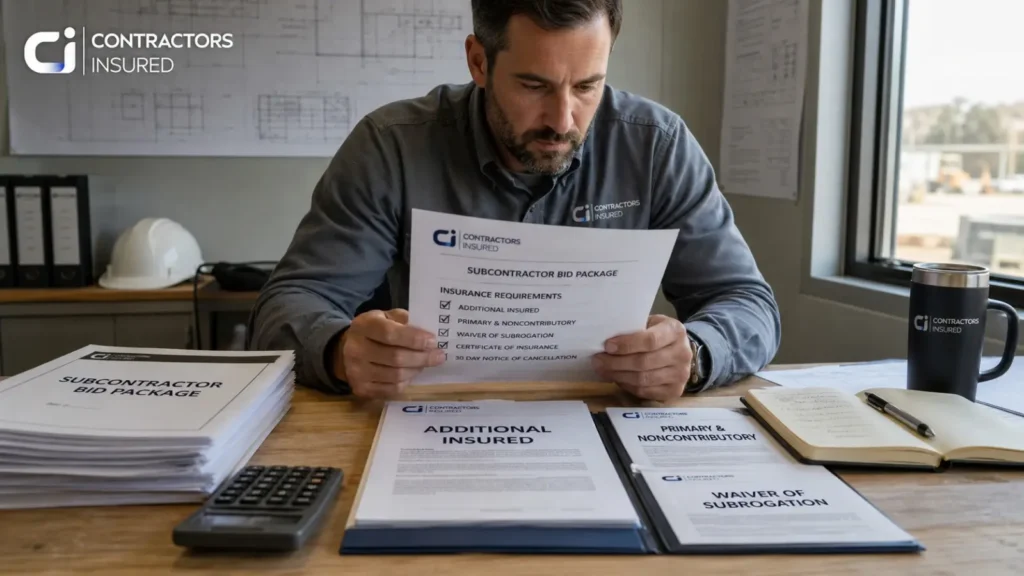
- GC Bid Packet Decoder
- What These Endorsements Cost
- Three Subcontractor Scenarios
- Quick Answers to Common Endorsement Questions
- Frequently Asked Questions
- Key Takeaways
| Endorsement | Common ISO Form | What It Does (One Sentence) | Typical Annual Cost |
|---|---|---|---|
| Additional Insured (AI) | CG 20 10 (ongoing) / CG 20 37 (completed) | Adds the GC or owner to your General Liability policy so it can respond to claims arising from your work. | $50 to $300 |
| Primary and Noncontributory (PNC) | CG 20 01 | Makes your policy pay first and stops the GC’s carrier from being asked to share the loss. | $0 to $200 |
| Waiver of Subrogation (WOS) | CG 24 04 | Prevents your carrier from pursuing the GC for reimbursement after paying a claim tied to your work. | $50 to $250 |
Costs are illustrative ranges and vary by carrier, class code, state, and underwriting profile.
TLDR: The Three Endorsements in One Glance
When a general contractor asks for “AI, PNC, and WOS,” they are not speaking insurance jargon to confuse you. They are asking for three specific risk-transfer tools:| Endorsement | What It Does |
| Additional Insured (AI) | Adds the GC to your policy so your insurance can respond to claims tied to your work |
| Primary and Noncontributory (PNC) | Your policy pays first, not the GC’s |
| Waiver of Subrogation (WOS) | Your carrier gives up the right to sue the GC after paying a claim |
Why GCs Demand These Three Endorsements
Risk Transfer in the Subcontract
Every subcontract is a risk transfer agreement. The GC is generally trying to ensure that if something goes wrong on your scope of work, your insurance responds first, not theirs. That structure is standard across commercial construction contracts.How a GC’s Insurance Stack Actually Works
A GC typically relies on:- Their own General Liability policy
- Project-level risk controls
- Subcontractor insurance requirements
Why a Plain COI Isn’t Enough
A Certificate of Insurance (COI) only shows coverage exists. It generally does not confirm:- Who is insured beyond the named insured
- Which policy responds first
- Whether the GC is protected under your policy
💬 Broker’s Note (Pascal Burke): The COI vs endorsement confusion is the single most common gap I see in bid review. A contractor sends in a COI showing the GC as Certificate Holder and assumes that satisfies the “additional insured” requirement. It does not. The Certificate Holder line is informational only. The actual additional insured status comes from the endorsement attached to the policy, and the COI should reference that endorsement form by number.
Additional Insured (AI), Explained
What “Additional Insured” Actually Means on Your Policy
Additional Insured generally means the GC or owner is added to your General Liability policy for liability arising out of your work. It is typically issued through ISO forms such as:- CG 20 10 (ongoing operations)
- CG 20 37 (completed operations)
Blanket vs Scheduled AI Endorsements
- Blanket AI: Automatically covers qualifying contract parties under defined criteria (typically “as required by written contract”)
- Scheduled AI: Requires naming each GC or project specifically
Ongoing Operations vs Completed Operations
- Ongoing operations: Work currently in progress
- Completed operations: Liability after the job is finished
Common AI Endorsement Forms
| Form | Coverage |
| CG 20 10 | Adds AI during active work (ongoing operations) |
| CG 20 37 | Extends AI to completed operations |
| Custom blanket forms | Carrier-specific blanket AI structures |
What Your AI Endorsement Should Say
Most GCs are looking for language confirming:- “Additional Insured status for ongoing and completed operations”
- “Per written contract” or similar wording tied to the subcontract agreement
💬 Broker’s Note (Pascal Burke): The most common mistake I see is contractors assuming “additional insured” is one universal form. It is not. CG 20 10 covers ongoing operations, but if your contract requires completed operations and you only have CG 20 10, you may still be noncompliant even though your COI looks correct.
Primary and Noncontributory (PNC), Explained
What “Primary” Means
Primary generally means your insurance responds first in a claim involving your work. The GC’s policy does not step in until your limits are exhausted.What “Noncontributory” Means
Noncontributory generally means:- The GC’s insurance does not share the loss payment
- Your policy does not “split” the claim with theirs
Why GCs Want Both Together
GCs want clean separation:- Your work = your insurance
- Their policy = last resort only
How PNC Shows Up on Your Policy
PNC is typically added through:- ISO CG 20 01 form
- Carrier-specific endorsement wording
Waiver of Subrogation (WOS), Explained
What “Subrogation” Actually Is
Subrogation is the right of your insurance carrier to recover money from a responsible third party after paying a claim.How a Waiver Limits Your Carrier’s Recovery Rights
A Waiver of Subrogation generally means your carrier agrees not to pursue the GC or project owner after paying a claim related to your work.Why GCs Want WOS in the Subcontract
GCs generally want to avoid being pulled into:- Carrier reimbursement claims
- Cross-litigation between insurers
- Recovery actions after jobsite incidents
Blanket vs Scheduled Waivers
- Blanket WOS: Applies to all contracts automatically under defined criteria
- Scheduled WOS: Applies only to named parties or projects
ISO Form Reference
- CG 24 04 is a common ISO Waiver of Subrogation form for General Liability
- Workers’ compensation waivers are governed separately by state rules and require carrier filing
💬 Broker’s Note (Pascal Burke): A key misunderstanding is assuming Waiver of Subrogation works the same across all policy types. It does not. On General Liability, it is contract-driven through forms like CG 24 04. On Workers’ Compensation, it is regulated at the state level and requires separate carrier filing. That difference is where many contractors get confused during bid review, where they have a GL waiver in place and assume it covers WC, when in fact a separate WC waiver may be needed.
How These Three Endorsements Work Together
Quick Answers to Common Endorsement Questions
What is the difference between CG 20 10 and CG 20 37?
CG 20 10 adds the general contractor or project owner as an Additional Insured on your General Liability policy during ongoing operations, the active phase of your work on the project. CG 20 37 extends Additional Insured status to completed operations, which is the liability tail after your work is finished and the project is in service. Many GCs require both forms, especially on commercial projects, because a defect or injury can be discovered months or years after the job is complete.
Does a General Liability Waiver of Subrogation cover Workers’ Compensation claims?
No. A Waiver of Subrogation on a General Liability policy (typically ISO CG 24 04) only waives the GL carrier’s recovery rights for GL claims. Workers’ Compensation waivers are governed by state insurance regulations and require a separate state-filed endorsement through the Workers’ Compensation carrier. If your subcontract requires WOS for both lines of coverage, you generally need two distinct endorsements, one on the GL policy and one on the WC policy.
What is a blanket Additional Insured endorsement and when is it preferred?
A blanket Additional Insured endorsement automatically extends Additional Insured status to any party the named insured is required by written contract to add, without listing each party individually on the policy. Blanket AI is generally preferred by subcontractors working multiple jobs because it eliminates the administrative burden of scheduling each GC, and it ensures coverage is in place as soon as the subcontract is signed. Availability, wording, and cost vary by carrier and underwriting class.
What happens if my subcontract requires AI, PNC, and WOS but my current policy does not support all three?
If your existing carrier cannot issue one or more of the required endorsements, options generally include: requesting an alternate endorsement form that achieves equivalent coverage, negotiating a contract amendment with the GC, moving the policy to a carrier that supports the required structure, or restructuring the policy at renewal. Walking away from a job over a single endorsement gap is rarely necessary if the issue is identified early; bring the bid packet to your broker before signing the subcontract so alternatives can be explored. ContractorsInsured.net specializes in exactly this move: we shop carriers whose GL forms include blanket AI, PNC, and WOS, can often quote the same business day, and issue the compliant COI right after binding.
Can I buy a GL policy that already includes AI, PNC, and WOS?
Yes. Many carriers offer blanket endorsements built into the policy, which is why new policies ContractorsInsured.net places for CA and TX contractors are structured bid-ready from day one, so the COI can go out same day instead of waiting on endorsement approvals. Get quoted fast.
A Real-World Subcontract Example
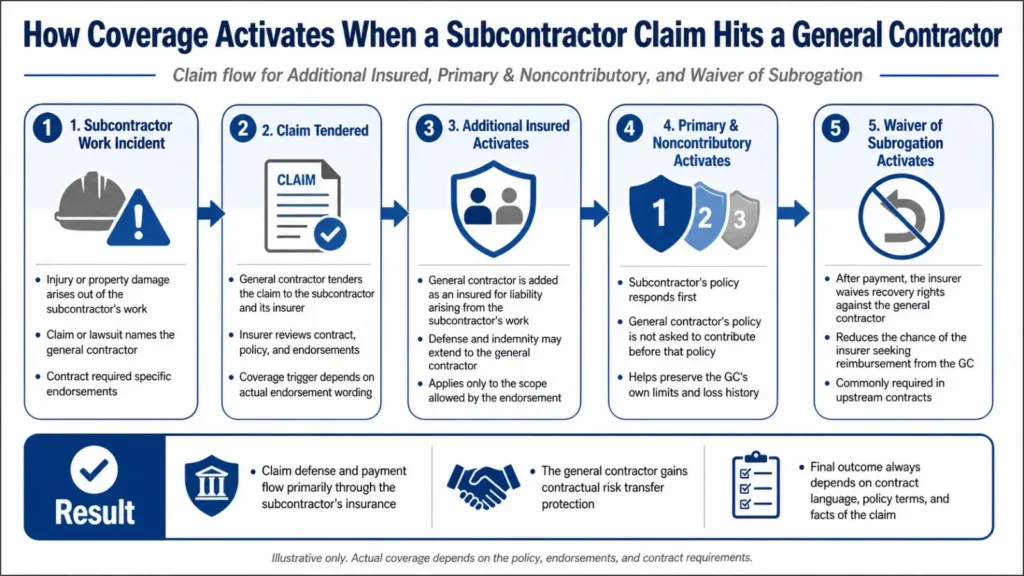
You are a roofing subcontractor on a commercial project:
- A worker drops material damaging HVAC equipment
- The GC gets named in a claim
- Your policy is triggered
The Order of Coverage When a Claim Hits
Step | Endorsement | What Happens |
1 | PNC | Your General Liability policy responds first |
2 | AI | GC is covered as Additional Insured under your policy |
3 | WOS | Your carrier cannot recover from GC after paying |
What Goes Wrong When Even One Is Missing
- No AI: GC may not be covered under your policy at all
- No PNC: GC’s policy may be pulled into the claim alongside yours
- No WOS: Your carrier may pursue recovery from GC after settlement
COI vs Endorsement: What Your GC Actually Needs
Why a COI Alone Doesn’t Prove AI/PNC/WOS
A COI is informational only. It is generally not the legal contract language. The actual coverage comes from the endorsement attached to the policy, not the certificate.
Industry reference: Insurance Information Institute.
The Endorsement Forms That Back the COI
Your broker generally must verify actual policy endorsements such as:
- CG 20 10 / CG 20 37 for AI (ongoing and completed operations)
- CG 20 01 for PNC structures
- CG 24 04 for WOS
How to Verify Your Endorsements Match the COI
Always confirm:
- COI wording matches endorsement schedule
- Endorsements are attached to the active policy (not lapsed or expired)
- Named insured matches contract entity (LLC vs DBA vs individual)
For broader subcontractor compliance guidance, see our subcontractor insurance compliance overview.
GC Bid Packet Decoder: Common Contract Language
The phrases you’ll see in bid packets and what they actually require:
Bid Packet Language | What It Generally Means |
“Additional Insured Including Completed Operations” | Generally CG 20 37 or equivalent required |
“Primary, Noncontributory, and Non-Excess” | PNC language requiring your policy to respond first |
“Waiver of Subrogation in Favor of [GC/Owner]” | Generally CG 24 04 or blanket WOS wording required |
“Per-Project, Per-Location Aggregate” | May require policy restructuring or endorsement adjustments |
“30-Day Notice of Cancellation” | Some carriers may not provide exact wording depending on policy form; confirm with broker |
💬 Broker’s Note (Pascal Burke): The “30-day notice of cancellation” requirement is one of the most common bid packet items I see push back on. Most standard ACORD COI forms include language stating that the issuing insurer “will endeavor to mail” notice, but this is not a contractual obligation in the policy itself. If a GC’s contract requires a stronger notice provision, it generally needs to be addressed at the policy level through an endorsement, not just on the COI. Bring this to your broker before signing.
What These Endorsements Cost
Endorsement | Typical Annual Cost | Notes |
AI Endorsement | $50 to $300 | Or included in blanket forms |
PNC Endorsement | $0 to $200 | Often included with blanket AI |
WOS Endorsement | $50 to $250 | Or included in blanket options |
When all three are required together on a contractor GL policy, the total impact is generally 5% to 15% of annual premium depending on classification, risk profile, and carrier, though this varies meaningfully based on the underwriting profile.
For broader GL policy structure, see our General Liability page.
Already covered? Get a COI with AI, PNC, and WOS →
Need a GL policy that includes blanket AI, PNC, and WOS? Get quoted fast →
Send your bid packet, contract holder requirements, and scope of work. We confirm what your policy supports and issue the COI when available. 24-hour turnaround when complete information is provided.
When the GC’s Request Goes Beyond What’s Standard
Unusual Wording or Custom Endorsements
Some contracts request:
- Non-ISO proprietary endorsements
- Modified indemnity structures
- Expanded completed operations terms
- Specific edition dates of ISO forms (e.g., “CG 20 10 04 13 specifically”)
Endorsements That Don’t Exist on Your Policy Form
Not all carriers support every form structure. Some requirements may not be available exactly as written, especially in hard market conditions where carriers tighten endorsement availability.
For more on hard market dynamics, see our California hard market renewal guide . Endorsement availability narrows when carriers are under capacity pressure.
How to Negotiate the Subcontract Without Losing the Job
At this stage, it is usually a coordination issue between:
- Your broker
- The GC’s risk manager
- Contracting counsel
The fix is generally either an alternate endorsement form that achieves equivalent coverage, or a written amendment to the subcontract. Walking away from the job before exploring alternatives is rarely the right answer.
Contact ContractorsInsured.net when you need help reviewing bid packet language before signing.
Three Subcontractor Scenarios
The following are illustrative scenarios drawn from typical subcontractor situations. Specific endorsement availability and cost depend on carrier, policy form, classification, and current market conditions.
Scenario 1: Roofer Adding GC as AI for a Single Job
- Single project, contract requires AI for ongoing operations only
- Generally requires CG 20 10 and certificate holder update
- May be issued same-day with carrier approval
Scenario 2: Plumbing Sub With Blanket AI/PNC/WOS for MSA
- Master Services Agreement covering ongoing work for one GC
- Generally requires policy-level blanket endorsement structure, not per-job changes
- Premium impact applied at policy level rather than per-project basis
Scenario 3: GC Sub Whose Policy Doesn’t Support PNC
- Contract requires PNC; current carrier does not offer that endorsement structure
- Often requires carrier change or policy restructure before bidding further work
- Bid timing and renewal cycle alignment becomes a planning issue
What to Send Your Broker (And What to Ask For)
Send your broker:
- Full subcontract or bid packet
- Certificate holder requirements
- Scope of work description
- Required endorsement list with form numbers when specified
Ask your broker:
- Which endorsements are currently on file
- Whether they are blanket or scheduled
- Whether completed operations are included
- Whether your current policy form supports all required endorsements
- What the premium impact would be if endorsements need to be added
How ContractorsInsured.net Handles AI/PNC/WOS Requests
We review:
- Contract language line by line
- Existing policy endorsement structure
- Carrier compatibility with ISO forms and proprietary alternatives
- Whether your current policy form can support the requested combination
- Premium and underwriting impact of adding endorsements at renewal vs mid-term
Specific compliance and policy resources:
Send Your Bid Packet for Endorsement Review →
Hiring soon and need GL built bid-ready? Get quoted fast →
We review your full subcontract or bid packet against your current policy and confirm which endorsements are in place, which need to be added, and what the premium and underwriting impact would be. Typical response within one business day.
Frequently Asked Questions
What does Additional Insured mean on a contractor's insurance policy?
Additional Insured generally means a third party, usually a GC or project owner, is added to your General Liability policy so it may respond to claims arising from your work. This is typically done through ISO forms such as CG 20 10 or CG 20 37, depending on whether ongoing or completed operations coverage is required.
What is the difference between a COI and an endorsement?
A COI is a summary document showing insurance exists. An endorsement is the actual policy amendment that changes coverage terms. GCs typically rely on endorsements, not COIs alone, to confirm Additional Insured, PNC, or Waiver of Subrogation status.
What does Primary and Noncontributory mean?
Primary and Noncontributory generally means your insurance policy responds first in a claim and the GC’s policy does not contribute. This prevents shared liability between insurers and is typically required in commercial subcontract agreements.
What is a Waiver of Subrogation in a contractor's GL policy?
A Waiver of Subrogation limits your insurance carrier’s ability to recover claim payments from a GC or owner. It is commonly added using ISO form CG 24 04 or equivalent blanket endorsements depending on policy structure.
Why does my GC require all three endorsements?
GCs typically require AI, PNC, and WOS together to fully transfer risk away from their policy and avoid shared liability exposure. This combination generally helps ensure your insurance responds first and limits inter-policy disputes after a claim.
How much do AI, PNC, and WOS endorsements cost?
Costs vary by carrier and policy form. AI is often $50 to $300 annually, PNC may be $0 to $200, and WOS may be $50 to $250. Bundled requirements can generally increase overall General Liability premiums by about 5% to 15% depending on classification.
What endorsement form should my GC's Additional Insured be on?
Most GCs request ISO standard forms such as CG 20 10 for ongoing operations and CG 20 37 for completed operations. These forms generally define how and when the GC is covered under your policy. Specific edition dates may also be required.
Can my carrier issue a Waiver of Subrogation on my Workers' Comp policy?
Workers’ compensation Waiver of Subrogation is governed by state rules and carrier filings. Availability varies by state and carrier approval, and is structurally different from General Liability waiver endorsements like CG 24 04. Always confirm WC waiver availability separately from GL waiver requirements.
What if my current policy doesn't support these endorsements?
If your current policy cannot issue required endorsements, options may include adjusting endorsements, changing carriers, or restructuring policy terms depending on underwriting approval and contract requirements.
Can ContractorsInsured.net issue a COI with AI, PNC, and WOS today?
Yes. ContractorsInsured.net works with contractors to issue COIs with AI, PNC, and WOS when supported by the underlying policy and carrier. Same-day or 24-hour issuance is generally possible when complete contract information is provided.
Key Takeaways
- AI, PNC, and WOS are three distinct risk-transfer endorsements: Additional Insured (CG 20 10 / CG 20 37), Primary and Noncontributory (CG 20 01), and Waiver of Subrogation (CG 24 04), not interchangeable paperwork.
- A Certificate of Insurance (COI) alone does not prove compliance with a GC’s contract requirements; the actual coverage lives in the endorsements attached to the policy, not on the certificate.
- The ISO form numbers matter: CG 20 10 covers Additional Insured for ongoing operations, CG 20 37 extends it to completed operations, CG 20 01 establishes Primary and Noncontributory status, and CG 24 04 waives subrogation rights.
- Missing even one of the three endorsements can shift claim exposure back to the subcontractor, because the GC’s policy may then be pulled into the loss or the subcontractor’s carrier may pursue recovery from the GC.
- Compliance depends on both the contract wording and the carrier’s form support; some carriers offer blanket endorsements that satisfy multiple GCs automatically, while others require scheduling each project individually.
- Waiver of Subrogation on Workers’ Compensation is regulated separately from General Liability WOS and typically requires a state-level filing through the carrier; a GL waiver does not cover WC.
- Hard market conditions narrow endorsement availability: when carriers tighten capacity, blanket AI, PNC, and WOS may be restricted, schedule-only, or unavailable on certain class codes.
- Send your broker the full bid packet, not just the certificate holder line, so the broker can verify form numbers, edition dates, ongoing vs completed operations, and blanket vs scheduled wording before binding.
- Typical annual cost for AI, PNC, and WOS combined is roughly 5%–15% of GL premium, depending on class code, state, carrier appetite, and whether the endorsements are blanket or scheduled.
- Always verify endorsement edition dates (e.g., CG 20 10 04 13 vs 12 19) because ISO updates change coverage terms and may affect whether your policy meets contract requirements.
Already covered? Request a COI with AI, PNC, and WOS →
Need a GL policy built bid-ready? Get quoted fast →
24-hour turnaround when complete information is provided. Licensed brokerage, CA #6015321 / TX #3305690.
This guide is educational and not legal, contracts, or compliance advice. Endorsement availability, ISO form editions, wording, carrier underwriting requirements, and state regulatory rules vary by carrier, policy form, state, and contract, and change over time. Always confirm specific endorsement language, current ISO edition dates, contract requirements, and state-specific rules with your broker, qualified counsel, the relevant carrier, and applicable state insurance department before binding coverage or signing a subcontract.
Get these endorsements on your policy