

Editorial disclosure: This article is educational and intended for Texas contractors and the professionals who advise them. ContractorsInsured.net is a licensed Texas insurance brokerage (TX License # 3305690), not a law firm, the Texas Department of Insurance (TDI), the Texas Department of Licensing and Regulation (TDLR), or a tax advisor. Texas workers’ compensation is elective for most private employers, but contract requirements, license rules, and carrier underwriting evolve. Always confirm specific compliance and contract requirements directly with TDI, your GC, qualified counsel, and your CPA before making decisions about your coverage, business structure, or contracts.
Published: May 4, 2026 · Last updated: June 19, 2026 · 20-minute read
10+ admitted carriers · Same-day Certificates of Insurance · Texas, California, and all 50 states.
Quick Answer
A Texas ghost policy is a minimum-premium workers’ compensation policy filed with zero payroll that lets a solo contractor issue a Certificate of Insurance (COI) to a general contractor. It typically costs $600–$2,800 per year and satisfies most GC compliance requirements. However, it only covers you while you remain solo. Hiring even one helper (including a 1099 day laborer) can void effective coverage. That’s the “one-employee trap.”
Texas Ghost Policy: At a Glance
- Coverage type: Workers’ compensation, minimum-premium
- Payroll reported: $0
- Typical cost (TX): $600–$2,800 per year
- Who it’s for: Texas sole proprietors with no helpers
- Primary purpose: Issue a Certificate of Insurance to a general contractor
- Biggest risk: The one-employee trap: hiring any helper (W-2 or 1099) can void effective coverage
- Turnaround: Same-day to 48-hour COI when contractor info is complete
⚠️ California contractors: California does not have a direct ghost-policy equivalent. If you are looking at California workers’ comp requirements, see our companion guide on SB 1455 and California’s 2028 contractor workers’ comp mandate.
TLDR: Ghost Policy in One Glance
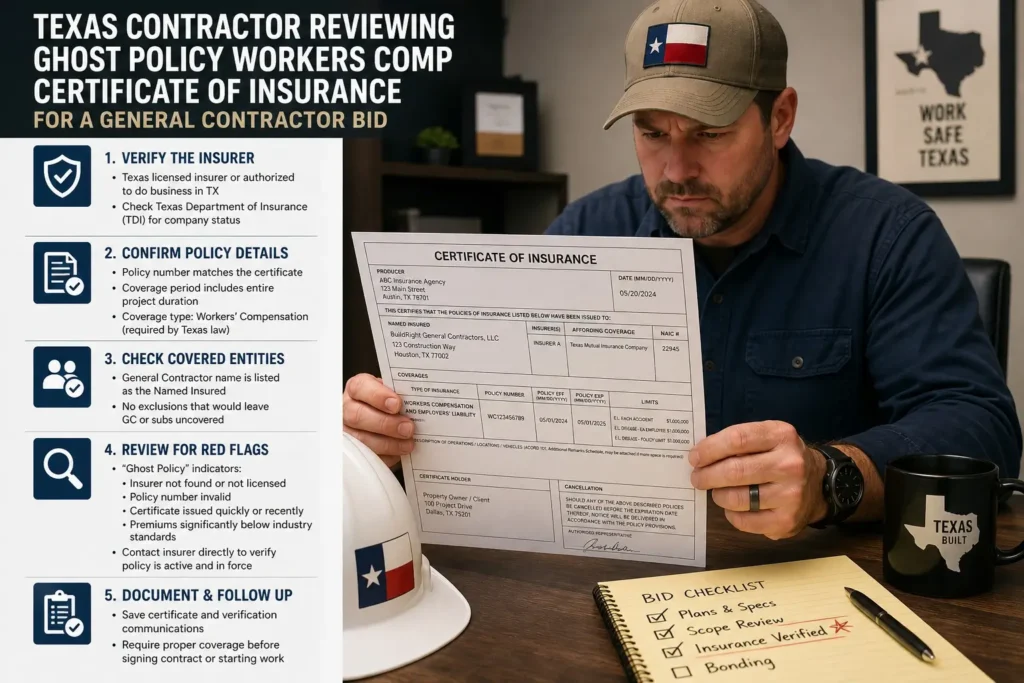
A ghost policy in Texas is a workers’ compensation policy with no payroll reported, typically used by sole proprietors to generate a Certificate of Insurance (COI) for general contractors who require one as a condition of bidding or onboarding.
It can help you get on a job fast. It can also collapse the moment you hire help, even informally. The biggest risk is not the policy itself. It is the “one-employee trap,” where a helper quietly turns your ghost policy into an uncovered claim exposure.
What a Ghost Policy Actually Is in Texas
A ghost policy is not a special insurance product in Texas law. It is a minimum-premium workers’ compensation policy structured for contractors who report no employees or payroll. Texas is unique because workers’ compensation is generally elective for most private employers.
Official references:
The Texas WC Election Rule (Why Ghost Policies Exist)
Texas allows most private employers to opt in or opt out of workers’ compensation coverage. Employers who opt out are called “non-subscribers” and lose certain common-law liability defenses in employee injury cases, which is one reason general contractors typically require WC coverage from their subs.
Because of the elective framework, many sole proprietors technically do not need WC for themselves, but still need:
- A Certificate of Insurance (COI)
- Proof of coverage for general contractors
- Contract compliance in bid packages
That gap is where ghost policies exist.
How a Ghost Policy Is Structured
A ghost policy typically includes:
- A workers’ compensation policy filed with zero payroll
- An owner-only coverage structure (sometimes excluded depending on carrier)
- A Certificate of Insurance issued to the GC
- No active employees listed
What the Ghost Policy Pays (And Doesn’t Pay)
A ghost policy generally:
- Does not function as meaningful wage replacement coverage for employees you hire later
- May exclude or limit owner benefits depending on structure
- Does typically satisfy COI requirements for many GCs
It is a compliance tool first, not a full risk-protection system.
💬 Broker’s Note (Pascal): Most contractors think a ghost policy is “coverage.” In reality, it is a documentation structure. It exists to satisfy a general contractor’s file requirements, not to protect a growing crew. The gap between those two ideas is where most problems start.
Why GCs Demand a WC Certificate Even When Texas Doesn’t Require One
Even though Texas workers’ compensation is elective, general contractors often require proof of coverage as a condition of bidding or onboarding.
Risk Transfer in the Subcontract
GCs use insurance requirements to shift jobsite liability away from themselves. A COI showing WC coverage is part of that risk-transfer structure. If a sub’s worker is injured and the sub has no coverage, the claim and defense cost can fall back on the GC’s policies.
Master Service Agreement and Bid Packet Requirements
Many Texas GCs include language requiring:
- WC coverage or approved election status
- Additional insured endorsements
- Specific Certificate of Insurance holder naming conventions
When the GC’s Carrier Audits the Sub Roster
Large projects may trigger carrier audits that require:
- Verification of subcontractor coverage
- Payroll consistency checks
- Classification review of subs
When a Ghost Policy Works for You
A ghost policy works for you when you are a true sole owner with no helpers, you need a Certificate of Insurance to satisfy a general contractor’s bid or onboarding requirement, and you do not anticipate hiring W-2 or 1099 labor during the policy term.
True Sole Owner With Zero Helpers
If you are genuinely working alone, a ghost policy is often aligned with:
- Bid requirements
- COI requests
- Short-term subcontracting work
Short-Duration GC Engagement
Some contractors use ghost policies for:
- Single-project bids
- Small residential subcontracting
- Trial GC relationships
Bid Deadline Pressure With No Employees in Sight
If the GC requires a COI immediately, a ghost-style minimum-premium policy can often be issued quickly when the contractor information is complete.
Get a Ghost Policy Quote
Send your trade, class code, and GC certificate holder details. We typically return COIs within 24 to 48 hours of complete information.
When a Ghost Policy Burns You
A ghost policy burns you when your real operations stop matching what is filed with the carrier, most often the day you bring on a helper, even an informal 1099 or cash day-laborer. Below are the four specific failure modes that cause uninsured-employee exposure for Texas sole proprietors.
The One-Employee Trap
This is the most important risk in Texas ghost policy use. If you hire even one helper, your ghost policy may no longer reflect your actual operations. That includes:
- Cash-paid day laborers
- Temporary 1099 helpers
- Friends helping for “a few days”
The Misclassified 1099 Trap
A 1099 contractor is not automatically excluded from workers’ comp exposure. Both the IRS Common Law Test and Texas common-law classification standards examine control, direction, and independence. If the helper functions like an employee, they may be reclassified at audit.
The Audit Discovery Problem
Carriers may review:
- Jobsite photos
- Payroll records
- Subcontractor invoices
If inconsistencies appear between what the policy reflects and what operations actually look like, classification may be adjusted retroactively. See our premium audit guide for more detail on how audits work.
Coverage Response Risk
This is not about intent. It is about whether the policy as written matches the operation as run. If payroll or labor structure does not match the policy at the time of a claim, the policy may not respond as expected. That can leave the contractor personally exposed for medical costs, wage replacement, and legal defense related to an injured worker.
💬 Broker’s Note (Pascal): The most common failure point I see is a contractor who starts solo, then brings in “just one guy” to finish a job faster. That single decision changes the entire insurance structure. Most problems do not come from full crews. They come from that first helper no one thought would matter.
The One-Employee Trap, Explained
The one-employee trap is what happens when a sole-proprietor contractor with a ghost policy hires even one helper (including a 1099 day-laborer or a friend) and the policy, which was filed with zero payroll, no longer matches actual operations. If that helper is injured, the carrier may treat the worker as an uninsured employee.
What “Employee” Actually Means for WC in Texas
For workers’ comp purposes, an employee can include:
- W-2 workers
- 1099 labor that, on the facts, functions like an employee under direction and control
- Regular day laborers working under your supervision
Texas classification generally follows common-law principles. References:
How a 1099 Helper Becomes an Uninsured Employee
If you control:
- Work schedule
- Job methods
- Tools or supervision
That worker may, depending on the facts, be treated as an employee in a WC audit or a claim review.
What Happens If That Helper Gets Hurt
If there is no valid WC coverage applicable to that worker classification, potential consequences include:
- Claims becoming direct employer liability
- The GC pushing indemnification back to the subcontractor
- Legal and medical exposure shifting to the contractor
1099 vs W-2 Helpers in Texas: When the Line Crosses
The Common Law Test in Texas
Both federal IRS guidance and Texas workforce standards evaluate:
- Behavioral control
- Financial control
- Relationship structure
References: IRS | Texas Workforce Commission
Common Mistakes Texas Contractors Make
- Paying workers cash without documentation
- Calling employees “subs” without contracts
- Using daily labor without tracking hours
How Carriers Reclassify at Audit
Carriers may reassign classification if:
- Payroll patterns suggest ongoing labor
- Job duties match employee roles
- Subcontractor documentation is missing
Ghost Policy Cost in Texas
Texas ghost policy cost typically ranges from $600 to $2,800 per year depending on trade classification, carrier minimums, owner inclusion, and claims history. The pricing reflects carrier minimum-premium rules, not active payroll.
Minimum Premium Ranges
Ghost policies generally sit at minimum-premium levels. Carrier minimums vary, which is why placement matters.
Class Code Impact
Trade / Class | Typical Texas ghost policy annual range |
|---|---|
Roofing | $1,200 to $2,800 |
Plumbing | $700 to $1,800 |
HVAC | $700 to $1,800 |
Electrical | $600 to $1,400 |
General contractor (no field labor) | $600 to $1,400 |
Painting | $700 to $1,600 |
Concrete / masonry | $1,000 to $2,400 |
These ranges are illustrative. Actual quotes depend on carrier appetite, owner inclusion or exclusion, claims history, and operational facts.
What Drives Cost Up or Down
- Trade risk classification
- Carrier underwriting appetite
- Prior claims history
- Audit classification adjustments
Why “Cheap” Ghost Policies Should Be Verified
If pricing looks unusually low, it is often because:
- Coverage is restricted
- Owner exclusions are broad
- Audit exposure is not clearly structured
💬 Broker’s Note (Pascal): If you see extremely low ghost policy pricing online, it is worth slowing down. In most cases, the issue is not fraud. It is incomplete understanding of what the policy actually includes or excludes at audit time. The cheapest filed policy can become the most expensive one if it does not match how you actually run your work.
Ghost Policy vs Full WC vs No WC: A Comparison
Element | Ghost Policy | Full WC | No WC |
|---|---|---|---|
Texas legal status | Allowed | Allowed | Legal for most private employers (elective) |
Covers sole owner injury benefits | No (unless owner inclusion elected) | Optional inclusion | No |
Covers helpers/employees | No | Yes | No |
Satisfies GC’s COI request | Typically yes | Yes | Often no |
Typical annual premium | Minimum-premium range | Based on payroll × class code | $0 |
Risk if you hire (even 1099) | High: uninsured employee exposure | Covered if added | High: uninsured employer exposure |
Recommended for | True sole owner, no helpers, GC-driven COI need | Any contractor with employees or 1099 helpers | Not generally recommended when GCs require COIs |
How to Get a Ghost Policy in Texas Fast
What We Need to Quote
- Trade classification
- Estimated payroll (even if zero)
- GC certificate holder details
- Business entity type
- TDLR or other applicable trade license number where required
Same-Day vs 24-48 Hour COI
Depending on underwriting, COIs may be issued:
- Same day in straightforward sole-owner cases when complete information is provided
- 24 to 48 hours under standard underwriting review
Turnaround depends on carrier rules, the specific endorsements requested, and the completeness of the contractor’s information.
What the GC’s Certificate Holder Block Should Say
The certificate holder block typically includes:
- GC legal name (exactly as written in the bid packet)
- Project or master contract reference
- Additional insured wording if required
For more detail on the COI itself, see our Certificate of Insurance overview.
Three Texas Scenarios
The following are illustrative scenarios drawn from typical patterns we see, not specific named clients.
Scenario 1: Solo Roofer, Dallas
Works alone, needs COI for a GC bid (typical for Texas roofing contractors). A ghost policy fits well if no helpers are used and the GC accepts ghost-policy COIs. Confirm GC bid-packet requirements before binding.
Scenario 2: Houston Plumbing Sub With One Helper
Higher-risk scenario. The presence of one helper, even a 1099 helper hired week-to-week, may push the operation outside what a ghost policy is designed to cover. A full WC policy for Texas plumbing contractors aligned with the helper’s payroll exposure is typically the correct structure.
Scenario 3: Two-Person LLC, Austin
Generally not suitable for a ghost policy. Full WC is typically required for actual payroll exposure, with appropriate officer inclusion or exclusion election based on entity structure.
When You Need to Move From Ghost to Full WC
The First Hire Trigger
The moment you bring on:
- A W-2 employee
- A regular 1099 helper under supervision and direction
The Project Scope Trigger
Larger jobs may require:
- Verified payroll structure
- Broader liability coverage
- More specific endorsement wording
The Bid-Limit Trigger
Some GCs will not accept ghost policies above certain contract values or for certain project types.
Moving to full workers’ compensation in Houston? See workers’ compensation for Houston general contractors · workers’ compensation for Houston roofers.
Already Hired? Get a Full WC Quote
If you have added a helper (W-2 or 1099), the ghost policy may no longer be enough. Send payroll details and we will quote a real WC policy fast.
How ContractorsInsured.net Handles Ghost Policies in Texas
We are a Texas-licensed insurance brokerage (TX License # 3305690) founded by Pascal Burke in 2017. We structure ghost policies and full workers’ compensation around:
- GC compliance requirements
- Carrier underwriting rules
- Audit-ready documentation
Related guides:
- workers comp ghost policy guide
- General Liability Insurance for Contractors
- Workers’ Compensation Insurance Overview
- Texas General Contractors Workers’ Compensation
- Texas Service Area
- Texas Roofing Contractors WC
- Texas Plumbing Contractors WC
- Subcontractor Insurance Compliance
About the Author

Pascal Burke, Founder, ContractorsInsured.net
Licensed Texas Insurance Broker (TX License #3305690) and California Insurance Broker (CA License #6015321). Licensed in all 50 U.S. states.
Pascal specializes in workers’ compensation, general liability, commercial auto, and contractor coverage for sole proprietors and small contractors across Texas, California, and nationwide. He places coverage with 10+ admitted carriers and issues same-day Certificates of Insurance.
This guide was written and last reviewed by Pascal Burke in May 2026.
Frequently Asked Questions
What is a ghost policy in Texas?
Do I need workers' comp as a sole proprietor in Texas?
Workers’ compensation is generally elective for most Texas private employers, including most sole proprietors. You can choose whether to carry coverage on yourself. However, many GCs may require a Certificate of Insurance showing WC coverage as a condition of bid eligibility or onboarding, which is why ghost policies exist.
Can a ghost policy satisfy my GC's certificate of insurance request?
A ghost policy typically satisfies many general contractor COI requirements in Texas. However, acceptance depends on the GC’s specific contract terms, whether additional insured or other endorsements are required, and whether the GC’s own carrier accepts ghost-policy COIs from subs at the contract value involved.
How much does a ghost policy cost in Texas?
Ghost policy costs typically range from about $600 to $2,800 annually depending on trade classification and risk. Roofing and concrete tend to fall toward the higher end, while electrical and general contracting (no field labor) often fall toward the lower end. Pricing depends on carrier minimums, owner inclusion or exclusion, and claims history.
What happens if I hire one helper while I have a ghost policy?
Potential consequences include uninsured-employee claims exposure if the helper is hurt, audit reclassification of payroll, and the policy not responding as expected at claim time. Depending on how the helper is classified and supervised, the carrier may treat them as an employee requiring full workers’ compensation coverage. This is the “one-employee trap” most contractors do not see coming.
Is a 1099 contractor covered by my ghost policy?
A 1099 contractor is generally not directly covered under a ghost policy. However, depending on actual working conditions, the 1099 helper may be reclassified as an employee during a workers’ compensation audit under IRS Common Law and Texas common-law classification standards. If they function like an employee, the carrier may treat them like one.
Can I get a ghost policy and a COI the same day in Texas?
In many sole-owner cases, a ghost policy and matching COI can be issued same-day or within 24 to 48 hours when complete information is provided. Turnaround depends on carrier underwriting rules, the specific endorsements the GC requires, and whether the contractor’s information package is complete at submission.
What is the difference between a ghost policy and a full workers' comp policy?
A ghost policy is filed at minimum premium with no payroll and is mainly used to satisfy CSLB filing or GC certificate requirements. A full workers’ comp policy is rated on actual payroll and class code, covers employees, and responds to jobsite injuries subject to policy terms. The structures look similar on a COI but behave very differently when a claim occurs.
When should I move from a ghost policy to full WC coverage?
You should typically move to full workers’ compensation when you hire employees, regularly use 1099 helpers under direction and supervision, expand beyond sole-proprietor work, or take on projects above bid limits where GCs require full coverage. The first hire is usually the trigger.
Does ContractorsInsured.net place ghost policies for Texas contractors?
Yes. ContractorsInsured.net is a Texas-licensed insurance brokerage (TX License # 3305690) and we place ghost policies and full workers’ compensation coverage for Texas contractors based on classification and GC requirements. Send your trade, class code, and GC certificate holder details to request a quote with same-day or 24 to 48 hour COI turnaround depending on underwriting.
Is a ghost policy legal in Texas?
Do major general contractors like Home Depot or national builders accept ghost policies?
Ghost policy vs occupational accident insurance: what is the difference?
Do I still need general liability insurance if I have a ghost policy?
Key Takeaways
- Ghost policies exist to satisfy GC certificate requirements, not to replace full coverage
- Texas allows elective workers’ compensation for most private employers, which is why ghost policies are a Texas-specific tool
- The biggest risk is the one-employee trap: the moment you hire any helper, the policy may not match your actual operations
- 1099 helpers may still be reclassified as employees under audit using IRS Common Law and Texas common-law standards
- Proper structuring matters more than price alone. Extremely cheap ghost policies often signal narrow coverage or audit exposure
- California does not have a direct ghost-policy equivalent; California contractors should consult our SB 1455 guide instead
Get a Ghost Policy Quote (Or a Full WC Quote If You’ve Already Hired)
If you are bidding jobs in Texas and need a Certificate of Insurance quickly, or if your crew has grown beyond solo work, we can structure coverage based on your real operating setup.
Request a Texas Ghost Policy Quote
Same-day or 24 to 48 hour COI available depending on underwriting. TX License # 3305690.
This guide is educational and intended for Texas contractors and their professional advisors. It is not legal, tax, or compliance advice. Texas insurance regulations and carrier underwriting evolve, and contract requirements vary by GC and project. Always confirm specific compliance requirements directly with the Texas Department of Insurance, your contracting party, qualified counsel, and your CPA before making decisions about your coverage, business structure, or contracts.
Ghost policy, in full
For the general rules on a workers comp ghost policy, including who qualifies and what it costs, see our full guide.