
The bottom line: If your work injures someone or damages their property, GL responds. If the project itself burns, blows over, or is stolen, Builder’s Risk responds. Verify both are in place before you break ground.
ContractorsInsured writes both builders risk and general liability for contractors in California and Texas. Call (949) 522-3284.
- TLDR: The Two Policies in One Glance
- The Core Difference (In One Sentence)
- What General Liability (GL) Actually Covers
- What Builder’s Risk Actually Covers
- A Side-by-Side Comparison
- The Coverage Gap That Costs Contractors the Most
- Who Buys Builder’s Risk: Owner, GC, or Sub?
- Builder’s Risk Limits, Term, and Cost
- Common Loss Scenarios: Which Policy Pays?
- Three Real-World Project Scenarios
- How to Make Sure You Have Both Where You Need Them
- How ContractorsInsured.net Approaches Builder’s Risk Coverage
- Frequently Asked Questions
- Key Takeaways
Editorial note: This article is educational and intended for contractors, owners, and the professionals who advise them. ContractorsInsured.net is a licensed insurance brokerage (CA License #6015321; TX License #3305690), not a law firm or claims adjuster. Coverage outcomes depend on the specific policy form, endorsements, exclusions, and the facts of any given loss. ISO standard form coverage and exclusions vary by edition date and carrier. Always confirm specific coverage questions with your broker, the carrier, qualified counsel, and the project’s insurance requirements before binding or signing a contract.
Table of Contents
- TLDR: The Two Policies in One Glance
- The Core Difference (In One Sentence)
- What General Liability (GL) Actually Covers
- What Builder’s Risk Actually Covers
- A Side-by-Side Comparison
- The Coverage Gap That Costs Contractors the Most
- Who Buys Builder’s Risk: Owner, GC, or Sub?
- Builder’s Risk Limits, Term, and Cost
- Common Loss Scenarios: Which Policy Pays?
- Three Real-World Project Scenarios
- How to Make Sure You Have Both Where You Need Them
- How ContractorsInsured.net Approaches Builder’s Risk Coverage
- Frequently Asked Questions
- Key Takeaways
- Get a Builder’s Risk Quote Alongside Your GL
TLDR: The Two Policies in One Glance
If you only remember one thing, remember this:- General Liability (GL) pays when your work causes injury or damage to someone else’s property or person
- Builder’s Risk pays when the project itself gets physically damaged during construction
Want this gap closed on your next project?
Send us your contract and project details. We coordinate Builder’s Risk and GL together so contract requirements are met without coverage gaps. Typical response in 24 to 48 hours.
The Core Difference (In One Sentence)
General Liability protects you from lawsuits by others, while Builder’s Risk protects the structure you are building.What General Liability (GL) Actually Covers

Third-Party Bodily Injury
If someone outside your crew is injured because of your work, GL responds. Example: A pedestrian trips over your materials left near a sidewalk.Third-Party Property Damage
If you damage property that does not belong to you or is not part of your work, GL responds. Example: Your backhoe cracks a neighbor’s driveway.Products and Completed Operations
If your completed work later causes damage, GL may respond depending on timing and policy form. Example: A plumbing install leaks after project completion and damages a tenant space. For more on GL endorsements GCs typically require (Additional Insured, Primary & Noncontributory, Waiver of Subrogation), see our AI/PNC/WOS endorsement guide.What GL Does Not Cover (Including Damage to the Project Itself)
This is where most confusion happens. GL excludes:- Damage to the structure you are building
- Your own work being repaired or replaced
- Property in your care, custody, or control
💬 Broker’s Note (Pascal Burke): The most expensive misunderstanding I see is contractors assuming GL will respond to a fire, theft, or storm loss on the project itself. In almost every case, GL is designed to respond to third-party claims, not construction property losses. That gap is exactly why Builder’s Risk exists.
What Builder’s Risk Actually Covers
Talk to Pascal → Have a project where the contract is unclear on Builder’s Risk? Ask a broker before you sign.
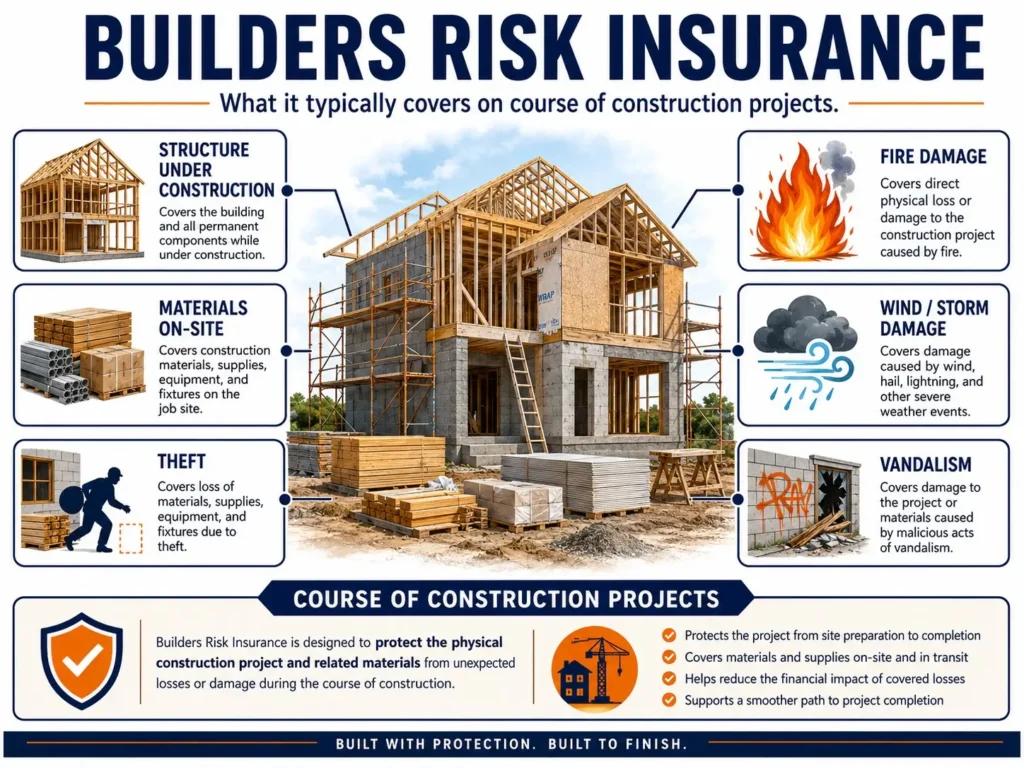
The Structure Under Construction
It covers the building itself while it is being built or renovated.Materials On-Site, In Transit, and Off-Site
Depending on the policy:- Lumber stored on site
- Fixtures waiting for installation
- Sometimes materials in temporary storage
Common Covered Causes of Loss
Policies typically respond to:- Fire
- Wind
- Theft
- Vandalism
What Builder’s Risk Typically Excludes
Common exclusions include:- Faulty workmanship
- Design errors
- Normal wear and tear
- Earth movement (unless endorsed)
- Flood (unless endorsed)
- War and nuclear events
A Side-by-Side Comparison
| Element | General Liability (GL) | Builder’s Risk |
|---|---|---|
| Who’s covered | The named insured (you) and the additional insureds | First-party: covers the project property itself |
| What’s covered | Third-party bodily injury and property damage your work causes | Direct physical loss to the structure under construction and materials |
| Common covered losses | A worker hurt on adjacent property; damage to neighbor’s building from your work | Fire, wind, theft, vandalism affecting the project itself |
| Common exclusions | Damage to “your work,” care/custody/control of property | Faulty workmanship (most policies), wear and tear, war, earthquake/flood (often endorseable) |
| Trigger | A claim or lawsuit against you by a third party | Direct physical loss to the insured project |
| Term | Annual, renews with your business | Course of construction (typically 6 to 24 months for the project) |
| Premium basis | Annual receipts/payroll × class code | Percentage of completed project value |
| Who buys it | The contractor (you) | Owner, GC, or sub depending on the contract |
The Coverage Gap That Costs Contractors the Most
The biggest gap is simple:- GL excludes damage to your work
- Builder’s Risk covers the structure itself
Why GL Excludes Damage to “Your Work”
Most GL policies follow standard ISO exclusions for “your work” and “your product.” This generally prevents contractors from turning liability insurance into a warranty policy.Why GL Excludes Care, Custody, or Control
If you are working on it, you are generally legally responsible for it. Insurers typically do not want GL to function as property insurance for the jobsite.Why Builder’s Risk Fills the Gap
Builder’s Risk exists specifically to insure:- The building while it is being built
- Materials waiting to be installed
- Certain construction-related property exposures
Who Buys Builder’s Risk: Owner, GC, or Sub?
When the Owner Buys It
Common in:- Ground-up residential builds
- Lender-financed commercial projects (is required by the lender)
When the GC Buys It
Common in:- Large commercial projects
- Design-build contracts
When the Sub Is Named or Listed as Insured
Less common, but sometimes required contractually. Subs may be named insureds on an owner’s or GC’s Builder’s Risk policy rather than maintaining their own.When Nobody Clearly Owns It
This is a real-world problem. If the contract is unclear about who is responsible for binding Builder’s Risk, coverage gaps happen, and they are typically discovered after a loss occurs.💬 Broker’s Note (Pascal Burke): The most common contract issue I see is when the agreement mentions Builder’s Risk but does not clearly assign who is responsible for purchasing it. On paper it looks covered. In practice, nobody binds the policy until a loss happens, and that is when disputes start. The fix is asking three questions before you sign: who buys it, what limit, and is the contractor named as an insured.Get a Broker Review → Want help drafting those three questions for your contract?
Builder’s Risk Limits, Term, and Cost
How the Limit Is Set
Builder’s Risk is based on:- Completed project value (not current stage of construction)
Policy Term
Usually:- 6 to 24 months
- Extendable if construction delays occur (extension generally requires carrier approval)
Typical Premium Ranges
| Project Type | Typical Premium Range |
|---|---|
| Residential projects | Approximately 0.5% to 3% of completed value |
| Commercial projects | Approximately 1% to 4% of completed value |
What Drives Cost
- Location (storm exposure, theft exposure, wildfire exposure)
- Construction type (frame vs masonry vs steel)
- Project duration
- Security on site (fencing, lighting, monitoring)
- Coverage extensions (soft costs, ordinance/law, earthquake, flood)
Get a Builder’s Risk Quote Alongside Your GL
Send your project details, completed value estimate, construction type, and start date. We coordinate Builder’s Risk and GL coverage so contract requirements are met without coverage gaps. Typical response within 24 to 48 hours.
Common Loss Scenarios: Which Policy Pays?
| Loss | GL pays? | Builder’s Risk pays? | Notes |
|---|---|---|---|
| Fire burns down half-built structure | No (your work / care-custody) | Yes | This is the classic Builder’s Risk loss |
| Sub’s worker falls on adjacent property and sues | Yes | No | Third-party bodily injury claim |
| Theft of lumber/copper from job site | No | Yes | Builder’s Risk usually covers materials on-site |
| Pipe burst damages building next door | Yes | No | Damage to third-party property |
| Faulty workmanship damages owner’s adjacent wing | Often excluded by both | Typically excluded (faulty workmanship) | Common gap; verify both policies |
| Wind blows off partially-installed roof | Often excluded by GL | Yes (wind covered) | Verify wind/named storm endorsements |
| Worker steals materials from site | No | Sometimes excluded (employee theft) | Verify employee theft coverage with broker |
| Subcontractor’s tools stolen from site | No | Generally no (sub’s own coverage) | Inland marine on sub’s policy responds |
Three Real-World Project Scenarios
The following are illustrative scenarios drawn from typical construction project insurance situations. Specific outcomes generally depend on policy form, contract structure, and loss facts.Scenario 1: Custom Home Build (California)
- Owner carries Builder’s Risk (is required by lender)
- GC carries GL
- Subs carry their own GL with the GC named as Additional Insured
- Losses to structure during construction fall under Builder’s Risk
- Third-party claims fall under GL
Scenario 2: Commercial Tenant Improvement (Texas)
- GC coordinates Builder’s Risk for the TI scope
- GL handles third-party injury claims and damage to landlord property outside the TI scope
- Existing building owner’s property coverage responds to losses outside the construction zone
- Coordination between policies critical at scope boundaries
Scenario 3: Multi-Unit Residential Addition (California)
- Complex contracts split responsibility between owner, GC, and existing building’s master policy
- Increased need for careful contract review before binding
- Existing structure damage during construction can fall into gaps if not clearly assigned
- Recommended: Builder’s Risk policy that explicitly covers the addition and any existing-structure damage caused by construction operations
How to Make Sure You Have Both Where You Need Them
Reading the Insurance Section of the Contract
Look for:- Builder’s Risk responsibility clause (who buys, what limit)
- Additional insured requirements
- Waiver of subrogation terms
- Notice of cancellation requirements
- Whether the contractor must be named insured on the Builder’s Risk policy
Confirming the Other Party’s Coverage
Never assume. Request:- Certificate of Insurance showing active Builder’s Risk
- Policy type confirmation (Course of Construction vs commercial property)
- Confirmation the project address and value match the policy
When to Add a Builder’s Risk Policy of Your Own
Consider it when:- No clear owner or GC policy exists
- You are storing materials off-site
- You have financial exposure to delays
- You are a GC on a project where the owner does not carry coverage
💬 Broker’s Note (Pascal Burke): The most dangerous assumption in construction insurance is that “someone else is covering it.” Builder’s Risk is often listed in contracts but never actually bound. When a loss happens, that assumption becomes expensive quickly. The fix is verification before mobilization, never trust that another party has bound coverage based on contract language alone.
How ContractorsInsured.net Approaches Builder’s Risk Coverage
We help contractors:- Identify who is actually responsible for Builder’s Risk under the contract
- Match GL and Builder’s Risk so there are no gaps at policy boundaries
- Align insurance requirements with contract language before binding
- Coordinate Additional Insured and Waiver of Subrogation requirements across both policies
For specific resources, see our Builder’s Risk policy page, General Liability policy page, and Certificate of Insurance compliance overview.
Verify My Project Coverage → Verify the coverage before mobilization. Don’t assume.
Coordinate My Builder’s Risk and GL
Send your contract, project details, and current GL dec page. We review coverage alignment and identify any gaps before you sign or break ground.
Frequently Asked Questions
What is the difference between builder's risk and general liability?
Builder’s risk covers physical damage to a construction project, while general liability covers third-party injury and property damage claims. GL protects against lawsuits, while builder’s risk protects the building itself during construction, depending on policy form and exclusions.
Does my contractor general liability policy cover damage to the project itself?
General liability does not cover damage to the structure you are building. Most policies generally exclude “your work” and property in your care, custody, or control, as referenced in standard ISO forms.
Who buys builder's risk insurance: the owner, the GC, or the sub?
Builder’s risk is typically purchased by the project owner or GC, depending on contract structure. Responsibility should be clearly defined in the construction agreement to avoid coverage gaps.
How much does builder's risk insurance cost?
Builder’s risk typically costs between 0.5% and 4% of the completed project value depending on project type, location, duration, and risk exposure. Confirm specific quotes with your broker.
Does builder's risk cover theft of materials from the job site?
Builder’s risk covers theft of materials on-site, though coverage generally depends on policy terms, security conditions, and deductibles.
Does builder's risk cover faulty workmanship?
Builder’s risk excludes faulty workmanship, though limited endorsements may exist. Coverage depends on policy form and should be reviewed with your broker.
What is the typical term of a builder's risk policy?
Builder’s risk policies typically run for the duration of construction, often 6 to 24 months, and may be extended if the project is delayed. Extension generally requires carrier approval before the original term expires.
Do I need builder's risk if I already have general liability?
Yes, in many projects both are generally needed. GL covers third-party claims, while builder’s risk covers damage to the structure itself. They serve different functions and are not interchangeable.
What happens if a fire destroys a project I'm building?
Coverage generally depends on who holds the builder’s risk policy and the terms of the contract. Without builder’s risk, losses to the structure may not be covered under GL.
Does ContractorsInsured.net place builder's risk for contractors?
Yes. ContractorsInsured.net helps contractors coordinate builder’s risk and general liability coverage together to align with contract requirements. Request a quote through our contact form.
Key Takeaways
- GL and Builder’s Risk solve completely different problems
- GL does not rebuild your project
- Builder’s Risk does not cover liability lawsuits
- Most jobsite gaps come from assuming “one policy covers everything”
- Contract language determines who is actually responsible for Builder’s Risk
- The Builder’s Risk limit should reflect completed project value, not current construction stage
- Coordination between GL and Builder’s Risk at policy boundaries prevents gaps
- Verification before mobilization protects against unbound-coverage assumptions
Get a Builder’s Risk Quote Alongside Your GL
Ready to coordinate Builder’s Risk and GL?
A licensed broker (CA #6015321 / TX #3305690) will review your contract, identify gaps, and align your coverage before you break ground.

If you want your coverage aligned with your contract before you sign or start work, we coordinate Builder’s Risk and GL together so contract requirements are met without coverage gaps.
Request a Builder’s Risk + GL Quote
CA License #6015321 / TX License #3305690. Send your contract, project details, and current GL dec page. Typical response within 24 to 48 hours.
This guide is educational and not legal, claims, or coverage advice. Coverage outcomes generally depend on the specific policy form, endorsements, exclusions, and loss facts. ISO standard form coverage and exclusions vary by edition date and carrier. Always confirm specific coverage questions with your broker, the carrier, and qualified counsel before relying on any information in this article.
Cover the rest of the job