
Texas does not require most private employers to carry workers compensation insurance. Your general contractor very often will. That is the whole answer in one sentence, and it is why most Texas contractors end up carrying coverage anyway: the contract is the real mandate, not the statute. If you do opt out, you become a “non-subscriber,” which carries filing duties with the state and, more importantly, strips away three legal defences you would otherwise have if an employee sues you. Texas advisory loss costs, the industry benchmark carriers file against, fell by an average 3.8 percent on July 1, 2026, which is not the same as a cut to anyone’s premium. ContractorsInsured.net is Pascal Burke Insurance Brokerage, Inc., licensed in California (#6015321) and Texas (#3305690). We place workers comp for Texas contractors, quote fast, and issue the certificate right after binding.
Is workers comp required in Texas?
In brief: No, not for most private employers. Texas is the only state in the country where carrying workers compensation is generally optional for private businesses. That does not mean it is optional in practice, because the general contractors and project owners you work for can and do require it by contract.
The Texas Department of Insurance states plainly that Texas does not require most private employers to have workers compensation insurance coverage. That single fact is where most guidance on this topic stops, and stopping there is what gets contractors into trouble.
There are situations where coverage stops being optional:
- Government contract work. Contractors working on public projects are generally required to carry workers compensation for employees on that project.
- Any contract you sign that requires it. This is the big one. If your subcontract agreement says you will maintain workers compensation coverage, that obligation is now yours, and breaching it can cost you the job and expose you to the general contractor’s claim.
So the honest framing for a Texas contractor is not “is this required by law.” It is “who is going to ask me for a certificate, and what happens if I cannot produce one.”
If you opt out: the Texas non-subscriber rules
In brief: Choosing not to carry workers compensation in Texas makes you a “non-subscriber,” and that status comes with paperwork. You must notify the state on a specific form, on a specific schedule, and you must post notice for your employees in the workplace.
The duties, per the Texas Department of Insurance and its Division of Workers’ Compensation, are:
- File DWC Form-005, the Non-subscriber notice to Division of Workers’ Compensation.
- File it on this schedule: within 30 days of hiring your first employee; within 10 days of terminating existing coverage; within 10 days of a request from DWC; and annually between February 1 and April 30.
- Post DWC Notice 5, the notice of no coverage, conspicuously at each workplace where employees regularly see it, in English, Spanish, and any other language as needed for your workforce.
- Give written notice to each new employee at hiring, and to existing employees no later than 15 days after coverage terminates.
- If you have five or more non-exempt employees, file DWC Form-007 reporting specified work-related injuries, illnesses, and deaths, by the seventh day of the following month.
Certain workers are exempt from coverage, including some domestic workers and some farm and ranch workers, and if all of your workers fall into an exempt category the filing duty may not apply. Check your specific situation against the current DWC guidance rather than assuming.
None of that paperwork is difficult. The reason it matters is that it is evidence. A business that skipped the filings and skipped the posted notice is a business whose decision-making looks careless when it is examined later, which brings us to the part that actually costs money.
The part most contractors miss: you give up your legal defences
In brief: A Texas employer without workers compensation loses three standard legal defences if an injured employee sues. Contributory negligence, assumption of the risk, and the fellow servant rule are all unavailable to a non-subscriber, which changes the arithmetic of going bare far more than the premium saving does.
Workers compensation is a trade. An employer gives up the right to fight about fault, and in exchange gets the “exclusive remedy” protection: an injured employee is generally limited to workers compensation benefits and cannot sue for pain and suffering. A Texas employer who opts out gives up that protection.
Under the Texas Labor Code, a non-subscribing employer sued by an injured employee cannot argue:
-
Contributory negligence. Normally, an employee’s own carelessness reduces or defeats a claim. Not here.
-
Assumption of the risk. The argument that the worker knew the job was dangerous and accepted it is off the table.
-
The fellow servant rule. The argument that a coworker, not the employer, caused the injury is unavailable.
Strip those three away and a jobsite accident becomes an ordinary negligence lawsuit in which the employer starts from a much weaker position. Two honest qualifiers: losing those defences is not the same as automatic liability, because section 406.033(d) still requires the employee to prove that negligence by the employer or its agent caused the injury; and while damages are no longer limited to workers compensation benefits, other applicable Texas limits, such as caps on exemplary damages, can still apply.
One nuance matters here, and it is commonly stated wrongly. Because section 406.033 removes those defences, a non-subscriber generally cannot reduce or defeat the claim by arguing that the worker was careless. What a non-subscriber may still do, under Chapter 33 of the Civil Practice and Remedies Code, is point to responsible third parties and seek to have fault allocated to them. Those are different things, and Texas courts have continued to refine the boundary. Treat this section as background, not as legal advice, and speak to a Texas attorney about your own situation.
The practical point is unchanged: the employer has traded a predictable, insured cost for an unpredictable one that the workers compensation benefit schedule no longer limits. Other Texas limits can still apply, including the statutory caps on exemplary damages, so this is not the same as saying exposure is limitless.
“Contractors tell me they are saving money by going without workers comp in Texas. What they are actually doing is keeping the premium and taking the lawsuit personally. Those are not the same decision, and the difference rarely gets explained.” Pascal Burke, Licensed Insurance Broker
No policy yet but a GC wants your certificate?
That is exactly what we do. We quote Texas workers comp fast and issue the certificate right after binding.
Why your general contractor requires it anyway
In brief: General contractors require subcontractor workers compensation because an uncovered sub’s injured employee becomes the general contractor’s problem, and the general contractor’s insurance problem. That is why the certificate request arrives before you are allowed on site.
Three things are usually happening when a general contractor asks for your certificate:
-
They are protecting their own policy. If your injured employee has nowhere else to turn, the claim tends to find its way to the general contractor.
-
They want a waiver of subrogation. This endorsement gives up your insurer’s right to recover from the general contractor after paying a claim, for the parties and operations the endorsement describes and where a written contract requires it. It is a common request on construction subcontracts. Some policies already carry a blanket waiver, so check before assuming a specific one has to be added. For how this fits with the other endorsements you will be asked for, see our guide to additional insured, primary and noncontributory, and waiver of subrogation.
-
They are thinking about their audit. At the general contractor’s annual insurance audit, payroll paid to uninsured subcontractors can be charged to the general contractor’s own policy. That is a direct cost to them, which is why the certificate requirement is enforced rather than merely stated.
If you want the mechanics of the document itself, our certificate of insurance guide covers what a COI does and does not prove.
How much does workers comp cost a Texas contractor in 2026?
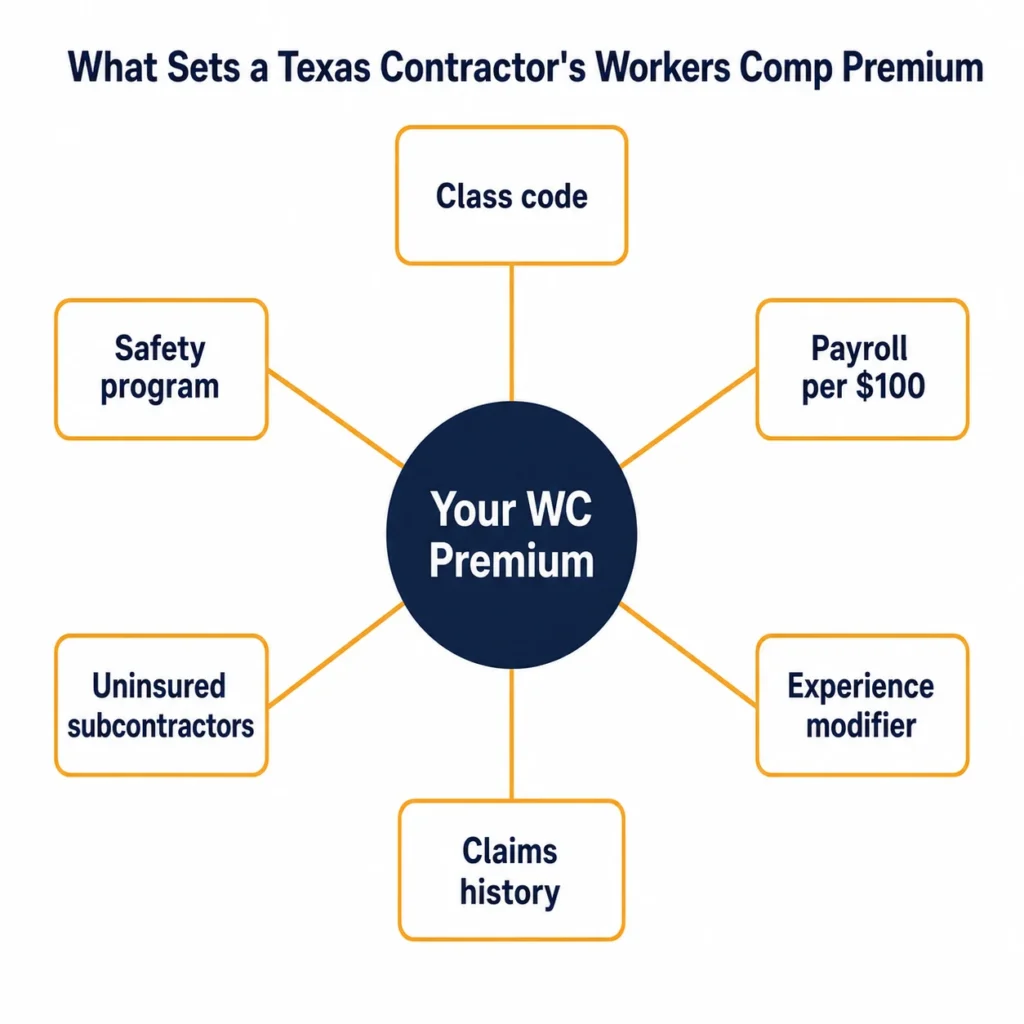
In brief: Workers compensation is priced per $100 of payroll, by class code, then adjusted by your experience modifier. Construction trades sit well above clerical ones because the injuries are more severe, but the actual number depends on your carrier’s own filed rates rather than on any published range.
This is the single biggest difference between workers comp and general liability, and it is where contractors get confused. General liability is usually rated on revenue. Workers comp is rated on payroll, in hundreds of dollars, per class code. If your payroll doubles, your workers comp premium roughly doubles. Revenue is not the driver.
The rough formula is:
(Payroll ÷ 100) x class code rate x experience modifier = premium
Some useful 2026 context on Texas rates:
-
Advisory loss costs are falling slightly, which is not the same as your premium falling. The Texas Department of Insurance accepted an average 3.8 percent decrease in advisory loss costs effective July 1, 2026. That is the industry-wide building block. Individual carrier rates and your own premium can still move the other way depending on your class codes, payroll and claims.
-
Advisory loss cost is not your rate. Texas carriers must price off either their own filed classification relativities or the NCCI advisory loss costs, so the advisory figure is a benchmark rather than a universal starting point. Where a carrier does use it, the rate is the loss cost multiplied by that carrier’s loss cost multiplier, with experience and schedule factors then adjusting the premium. That is why a quoted rate can sit well above the advisory figure. Where it applies, ask what multiplier a carrier is using, not just what the loss cost is.
-
Trade bands. As a general planning guide, lighter trades such as flooring, tile, painting, electrical, HVAC, and landscaping tend to land in the lower single-digit percentages of payroll, while concrete, rough carpentry, drywall, millwork, trim, and siding tend to run higher. Roofing and other work at height sits at the top.
Texas Mutual is the largest workers compensation writer in the state and is often the reference point for Texas contractors, but it is one market among several, and appetite for construction classes varies considerably between carriers.
Texas vs California: the same crew, two different rulebooks
In brief: If you work both states, you are operating under two different systems. California requires workers compensation of essentially every employer, and for several licensed contractor classifications the requirement applies whether or not you have employees. Texas generally leaves the choice to you.
|
|
Texas |
California |
|---|---|---|
|
Required by the state? |
Generally no, for most private employers |
Yes, for essentially every employer with employees |
|
If you have no employees |
Generally no requirement |
Several licensed contractor classifications must carry it regardless |
|
Opting out |
Allowed, with filing and posting duties |
Not an option once you have employees. A licensee with no employees outside the classifications listed below may still file an exemption |
|
What drives the decision |
Your contracts |
The law, then your contracts |
The California detail worth knowing if you cross the border: the C-8 concrete, C-20 warm-air heating and air conditioning, C-22 asbestos abatement, C-39 roofing, and C-61/D-49 tree service classifications must carry workers compensation regardless of whether they employ anyone. Other licensees with no employees can still file an exemption for now. California is moving toward requiring coverage of every licensed classification, and Senate Bill 1455 pushed that date to January 1, 2028. Confirm the current position with the CSLB before you rely on it, and do not assume the Texas answer travels with you.
Who counts as your employee: subcontractors, 1099s, and owners
In brief: Calling someone a 1099 subcontractor does not automatically remove him from your payroll for insurance purposes. If you hire subcontractors who carry no coverage of their own, their pay can be treated as your payroll at audit and charged to your policy.
This is where contractors get an unpleasant bill twelve months after they thought they had saved money. A few practical rules:
-
Collect a certificate from every subcontractor, every time. The rule turns on producing satisfactory evidence that the sub carried coverage. With no evidence at all, the auditor can charge you additional premium for that work, calculated from whatever payroll and subcontract records are available.
-
Keep the certificates for the audit period. A certificate that existed but cannot be produced is the same as no certificate.
-
Owners and certain officers may be able to exclude themselves from coverage, which changes the payroll base. The rules are specific, so confirm your situation rather than assuming.
-
Worker classification is not yours to decide unilaterally. Labelling someone a contractor does not settle the question if the working relationship looks like employment.
“The expensive surprise is rarely the premium. It is the audit. A contractor uses a few uncovered helpers for a season, cannot produce certificates for any of them, and that payroll gets added to the policy after the fact. He budgeted for one number and was billed another.” Pascal Burke, Licensed Insurance Broker
What to have ready before you request a quote
In brief: Workers comp submissions are payroll documents. The more precisely you can describe who does what and for how much, the closer your quote will be to your final audited premium.
-
Payroll by class code, split by the actual work performed
-
Employee count, and whether any are clerical or outside sales
-
Subcontractor spend, and whether those subs carry their own coverage
-
Claims history and your experience modifier if you have one
-
The states you work in
-
The certificate and endorsement requirements written into your contracts, especially any waiver of subrogation
Frequently asked questions
Is workers comp required in Texas?
No, not for most private employers. The Texas Department of Insurance states that Texas does not require most private employers to carry workers compensation coverage, which makes Texas the only state where it is generally optional. Public project work is treated differently, and any contract you sign that requires coverage creates a binding obligation. In practice most Texas contractors carry it because general contractors demand proof before allowing them on site.
What is a Texas non-subscriber?
A non-subscriber is a Texas employer that has chosen not to carry workers compensation insurance. Non-subscribers must file DWC Form-005, the Non-subscriber notice to Division of Workers’ Compensation, within 30 days of hiring a first employee, within 10 days of terminating coverage, within 10 days of a DWC request, and annually between February 1 and April 30. They must also post notice of no coverage in the workplace in English and Spanish.
What happens if a non-subscriber employee gets hurt?
The employee can sue the employer directly for negligence, and the employer loses three defences it would normally have: contributory negligence, assumption of the risk, and the fellow servant rule. There is also no workers compensation cap on damages. A non-subscriber generally cannot argue that the worker’s own carelessness reduces the claim, although it may seek to allocate fault to responsible third parties. The practical effect is that a predictable insured cost becomes an unpredictable uninsured one.
How fast can ContractorsInsured get a Texas contractor covered for workers comp?
We move fast on workers comp and issue the certificate right after binding. ContractorsInsured.net is Pascal Burke Insurance Brokerage, Inc., licensed in California (#6015321) and Texas (#3305690), and we shop multiple carriers rather than returning a single quote, because appetite for construction class codes varies a lot between markets. If a general contractor is holding up your start date over a certificate, tell us the requirements and we will work to your deadline.
Does my general contractor require workers comp in Texas?
Almost certainly yes. General contractors require subcontractor workers compensation because an uninsured sub’s injured employee tends to become the general contractor’s problem, and because uninsured subcontractor payroll can be charged to the general contractor’s own policy at audit. Most subcontracts also demand a waiver of subrogation endorsement on your workers comp policy. Read the insurance exhibit of your subcontract before you price the job, not after.
How much does workers comp cost in Texas?
Workers comp is priced per $100 of payroll by class code, then adjusted by your experience modifier. Construction trades sit well above clerical ones, and roofing is among the more expensive construction classifications, though it is not the highest rated class in Texas: the July 2026 advisory loss cost for roofing code 5551 is 1.946 and several other classifications sit above it. Advisory loss costs are easing slightly, with the Texas Department of Insurance accepting an average 3.8 percent decrease effective July 1, 2026, although that industry-wide building block does not mean your own premium falls by the same amount.
Do I need workers comp for 1099 subcontractors in Texas?
Calling someone a 1099 subcontractor does not automatically keep him off your policy. If you hire subcontractors who carry no coverage of their own, their pay can be treated as your payroll at your annual audit and charged to your policy. The protection is simple and administrative: collect a current certificate of insurance from every subcontractor before they start, and keep it for the audit period.
Do I need workers comp if I have no employees in Texas?
Generally no. Texas does not require most private employers to carry workers compensation, and with no employees there is usually no statutory obligation. Two things still catch solo contractors out: a general contractor may demand proof of coverage before letting you on site regardless of your headcount, and owner or officer inclusion rules can affect how a policy is written. If you work in California as well, the answer changes there.
Get Texas workers comp coverage
If a general contractor is asking for a certificate, or you are weighing whether going bare is worth it, we can price the coverage properly against your actual payroll and class codes. We are a licensed brokerage in Texas and California, we shop multiple carriers for construction risks, and we issue the certificate right after binding. You can also read our overview of workers compensation for contractors or compare general liability for Texas contractors.
This guide is general information for Texas contractors, not legal advice. Non-subscriber obligations and liability exposure depend on your own facts, and you should speak to a Texas attorney about your situation.
Written and reviewed by Pascal Burke, Licensed Insurance Broker and founder of ContractorsInsured.net. Insurance brokerage services are provided by Pascal Burke Insurance Brokerage, Inc., licensed in California (#6015321) and Texas (#3305690).