

Last updated: August 2026
Most McKinney general contractors typically pay $150 to $400 per month ($1,800 to $4,800 per year) for a standard $1M per occurrence / $2M aggregate general liability policy, with roofers, structural trades, and contractors on larger Collin County commercial or municipal projects often paying more. As ContractorsInsured.net (TX Lic #3305690), we shop multiple Texas-admitted carriers for McKinney contractors, quote the same business day, and issue the COI right after binding.
McKinney’s position as the Collin County seat, combined with continued residential expansion in communities such as Stonebridge Ranch, Trinity Falls, Tucker Hill, and Adriatica Village, creates steady demand for contractor insurance. Most small and mid-sized contractors remain near standard Texas pricing ranges, while firms working on larger commercial projects, municipal contracts, or higher-risk trades can expect higher premiums. This guide explains current McKinney pricing, coverage limits, contract requirements, certificates of insurance, and the factors insurers use when underwriting contractor risks in North Texas.
What general liability insurance covers
In brief: General liability insurance protects contractors against third-party bodily injury, third-party property damage, and personal and advertising injury claims arising from business operations.
General liability insurance is a third-party liability policy that responds to claims arising from a business’s operations, including bodily injury to non-employees, property damage to third parties, and personal and advertising injury. For contractors, it is the most commonly required coverage in contracts, leases, vendor portals, and city permit packets.
According to the Texas Department of Insurance, commercial general liability coverage is designed to help pay for covered claims involving injury or damage caused to others during the course of business operations. Contractors throughout McKinney, Allen, Prosper, Princeton, Melissa, and Collin County commonly need proof of coverage before beginning work on residential, commercial, or municipal projects.
Many project owners also require contractors to carry coverage before issuing permits, approving subcontractors, or granting site access. This is why understanding both coverage and cost is critical before bidding new work.
Scenario 1: Delivery driver injured at a McKinney tract-housing project
A delivery driver walks through an active residential construction site in Trinity Falls, trips over unsecured material, and suffers a broken ankle. The contractor is accused of failing to maintain safe site conditions. General liability coverage may help pay covered legal defense costs, settlements, or judgments.
Scenario 2: Property damage during a Stonebridge Ranch remodel
A plumbing contractor working inside a Stonebridge Ranch residence accidentally cracks imported tile flooring while moving equipment. The homeowner files a claim for repair costs. General liability may respond to covered third-party property damage claims.
Scenario 3: Copyright claim involving marketing materials
An Allen subcontractor uses a copyrighted jobsite photograph on a company website without permission. The photographer files a copyright-related claim. Personal and advertising injury coverage may help defend covered allegations.
Scenario 4: Completed operations claim after a roofing project
A Prosper roofing contractor completes a project. Six months later, water intrusion allegedly causes interior property damage. Depending on the circumstances and policy language, completed operations coverage may respond to covered claims arising after work has been finished.
Scenario 5: Lawsuit involving subcontractor work
A Princeton general contractor is named in a lawsuit alleging construction defects caused by a subcontractor. Even if allegations are ultimately unfounded, legal defense costs can be substantial. General liability policies typically provide defense for covered claims.
Contractors looking for a broader overview of coverage requirements can review our comprehensive guide to general liability insurance for contractors.
How much does general liability insurance cost in McKinney?
In brief: Most McKinney contractors should expect to pay between $150 and $400 per month for standard general liability coverage, while higher-risk trades often pay significantly more.
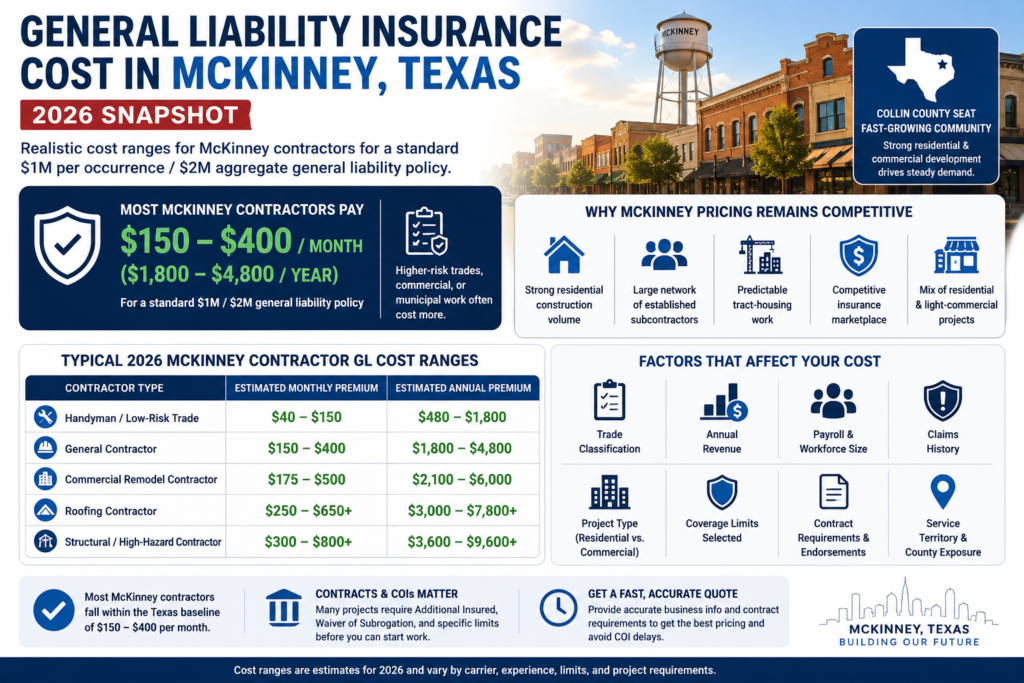
Most McKinney general contractors typically pay $150 to $400 per month ($1,800 to $4,800 per year) for a standard $1M per occurrence / $2M aggregate general liability policy.
McKinney sits in a unique position within North Texas. It benefits from strong residential growth and commercial development but generally avoids some of the pricing pressures found in larger urban cores. As a result, many contractors see pricing that aligns closely with statewide Texas averages.
Typical 2026 McKinney contractor GL cost ranges
Contractor Type | Estimated Monthly Premium | Estimated Annual Premium |
|---|---|---|
Handyman or low-risk trade | $40 to $150 | $480 to $1,800 |
General contractor | $150 to $400 | $1,800 to $4,800 |
Commercial remodel contractor | $175 to $500 | $2,100 to $6,000 |
Roofing contractor | $250 to $650+ | $3,000 to $7,800+ |
Structural or high-hazard contractor | $300 to $800+ | $3,600 to $9,600+ |
Why McKinney pricing remains competitive
Several factors keep many McKinney contractors near Texas baseline rates:
Strong residential construction volume
Large number of established subcontractors
Predictable tract-housing work
Competitive insurance marketplace
Mix of residential and light-commercial projects
However, pricing can increase rapidly when contractors:
Work on municipal projects
Require large additional insured schedules
Perform roofing or structural work
Operate across multiple counties
Generate higher annual revenues
Unlike national aggregator sites that rely on broad statewide averages, local underwriting frequently considers specific Collin County project types, developer requirements, contract language, and claims history.
Contractors comparing broader North Texas markets may also find it useful to review general liability insurance cost in Dallas and general liability insurance cost in Arlington when evaluating regional pricing differences.
Why contractor GL pricing reflects Collin County growth in McKinney
In brief: Continued residential expansion and increasing commercial development create both opportunity and insurance complexity for McKinney contractors.
McKinney remains one of the fastest-growing communities in North Texas. Growth in Stonebridge Ranch, Trinity Falls, Tucker Hill, and surrounding developments creates steady opportunities for contractors, subcontractors, remodelers, and specialty trades.
At the same time, insurance carriers see several risk factors associated with rapid growth:
Larger project values
More subcontractor involvement
Increased litigation exposure
Greater use of contractual risk transfer
Expanded certificate of insurance requirements
Commercial growth along US-75 and SH-121 has also increased demand for tenant improvements, retail construction, medical office projects, and light-industrial work. These projects often carry stricter insurance requirements than standard residential jobs.
Municipal and county contracts can introduce additional compliance obligations as well. Contractors bidding projects involving City of McKinney Public Works or Collin County departments frequently encounter detailed insurance specifications that must be satisfied before work begins.
“In 15+ years writing Texas contractor GL, the #1 reason McKinney tract-housing and small-commercial COIs get rejected isn’t the policy, it’s missing the GC’s or property manager’s exact Additional Insured wording. Read the schedule before you bind.”
Pascal Burke, Licensed Insurance Broker (CA #6015321, TX #3305690)
The result is a market where premium pricing is influenced not only by trade classification and payroll but also by contractual obligations, project size, and documentation requirements.
Cost by coverage limit
In brief: Higher limits provide greater protection but increase premium costs, especially for contractors working on larger commercial or public-sector projects.
Most McKinney contractors carry a $1M/$2M policy, while larger commercial projects increasingly require $2M/$4M limits or supplemental umbrella coverage.
Typical coverage-limit pricing comparison
Coverage Structure | Typical Monthly Cost | Typical Use Case |
|---|---|---|
$1M / $2M General Liability | $150 to $400 | Small and mid-sized contractors |
$2M / $4M General Liability | $225 to $650 | Larger commercial work |
GL + Umbrella Coverage | $300 to $900+ | Municipal and higher-value projects |
$5M+ Total Liability Program | Custom pricing | Large commercial contracts |
When higher limits become necessary
Contractors often move beyond standard limits when:
Working for national builders
Performing municipal work
Signing commercial leases
Entering property-management vendor networks
Completing projects for schools or government entities
Many contracts also require endorsements such as Additional Insured status and Waiver of Subrogation provisions. Understanding these requirements before signing contracts can prevent costly delays.
The 7 factors carriers use to price your policy
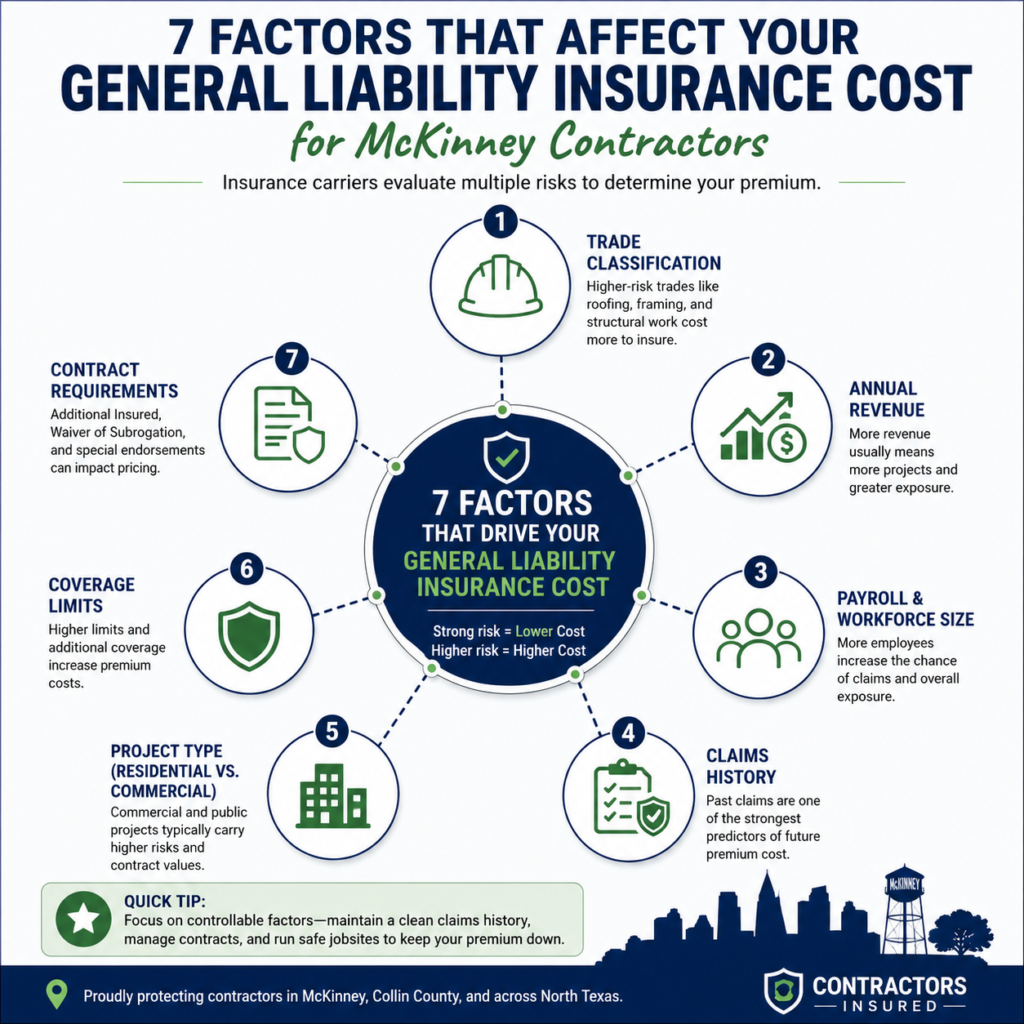
In brief: Carriers evaluate trade risk, payroll, revenue, claims history, project type, contract requirements, and geographic exposure when determining premiums.
Major pricing factors
Factor | Impact on Premium |
|---|---|
Trade classification | High |
Annual revenue | High |
Payroll size | Medium to High |
Claims history | High |
Project type | High |
Coverage limits | Medium to High |
Contract requirements | Medium |
1. Trade classification
Roofers, structural contractors, and certain specialty trades typically pay more than painters, flooring installers, or low-hazard interior contractors.
2. Annual revenue
Higher revenue generally means more projects, greater exposure, and increased claim potential.
3. Payroll and workforce size
Larger crews create more opportunities for incidents, resulting in greater underwriting scrutiny.
4. Claims history
Prior losses often have a significant impact on future pricing and carrier eligibility.
5. Residential versus commercial work
Commercial projects frequently involve higher contract values and more demanding insurance requirements.
6. Coverage limits selected
Increasing from $1M/$2M to $2M/$4M or adding umbrella coverage typically increases premium costs.
7. Contractual requirements
Additional insured requests, certificates of insurance, waiver provisions, and specialized endorsements can affect underwriting decisions and pricing.
Many contractors benefit from reviewing Certificate of Insurance basics before bidding larger projects because documentation errors often create more delays than premium costs themselves.
McKinney contract, lease, and COI requirements
In brief: Many McKinney, Collin County, and private-development projects require proof of insurance before work begins, often including Additional Insured and Waiver of Subrogation requirements.
Contractors are frequently asked to provide certificates of insurance before gaining site access, signing contracts, obtaining vendor approval, or beginning work.
The exact requirements vary by project owner, property manager, municipality, and developer, but common requirements include:
General liability coverage
Additional insured status
Primary and non-contributory wording
Waiver of subrogation endorsements
Completed operations coverage
Specific minimum liability limits
Official guidance on commercial general liability is published by the Texas Department of Insurance, which explains premises and operations, products and completed operations, umbrella and excess coverage, and the difference between occurrence and claims-made policies.
City projects may impose additional insurance specifications through McKinney Procurement Services bid documents. County projects reference insurance standards through Collin County Purchasing, and the insurance exhibit attached to the individual solicitation is what governs.
Work in the public right of way follows a separate and stricter track. Under section 90-231 of the McKinney city code, registration is a prerequisite to a construction permit, and public service providers together with the contractors and subcontractors working on their behalf must keep that registration current. Section 90-232 then requires each public service provider, at its own expense and naming the city as an additional insured, to carry general liability of not less than $1,000,000 primary plus $5,000,000 umbrella or other securities acceptable to the director of financial services, together with workers’ compensation within statutory limits and employer’s liability of not less than $1,000,000. Read carefully, the ordinance places those limits on the service provider, while the City’s Right-of-Way Construction and Permitting Procedures Manual, effective July 1, 2025, also asks each contractor working for a provider to furnish its own certificates of insurance in compliance with the section 90-232 limits, with the City of McKinney as additional insured, plus performance, payment and maintenance bonds. Because the ordinance and the manual describe that duty differently, confirm your own obligation with Public Works right-of-way inspection before you bid. None of this attaches to an ordinary building permit obtained through Building Inspections.
Common COI requirements in McKinney
Requirement | Commonly Requested |
|---|---|
$1M/$2M General Liability | Yes |
Additional Insured | Frequently |
Waiver of Subrogation | Frequently |
Primary & Non-Contributory | Often |
Completed Operations | Often |
Umbrella Coverage | Larger projects |
Before submitting documentation, contractors should understand the purpose of an Additional Insured endorsement and how it differs from simply providing a certificate.
Many municipal and commercial contracts also require a Waiver of Subrogation endorsement before final approval.
What general liability does NOT cover
In brief: General liability is essential, but it does not cover every risk a contractor faces.
General liability coverage is often misunderstood because many business owners assume it protects every loss connected to their company.
In reality, several major exposures require separate policies.
Common exclusions
Exposure | Covered by GL? | Typical Solution |
|---|---|---|
Employee injuries | No | Workers’ compensation |
Damage to your own work | Usually No | Risk management / specialty coverage |
Commercial vehicles | No | Commercial auto |
Professional mistakes | No | Professional liability |
Theft of tools | No | Inland marine |
Intentional acts | No | Excluded |
For example, if an employee is injured on a McKinney jobsite, that claim generally falls under workers’ compensation rather than general liability. Workers’ compensation in Texas is administered by the Texas Department of Insurance, Division of Workers’ Compensation. TDI states that private employers in Texas can choose to carry workers’ compensation coverage but are not required to in most cases, so confirm what a specific contract, permit or project owner requires.
Likewise, damage to your own completed work is generally not covered simply because a contractor wishes it had been performed differently.
Contractors seeking a broader understanding of coverage structure should review what general liability covers for contractors and how general liability works for contractors when building a complete insurance program.
How McKinney contractors can lower GL costs without creating coverage gaps
In brief: The best cost-control strategy is improving risk quality, not reducing coverage limits.
Many contractors focus exclusively on lowering premiums. The more effective approach is improving underwriting quality while maintaining adequate protection.
Practical ways to reduce premiums
Maintain a clean claims history.
Use written subcontractor agreements.
Require certificates from subcontractors.
Review contracts before signing.
Avoid unnecessary classifications.
Bundle eligible policies.
Improve jobsite safety procedures.
Keep payroll and revenue reporting accurate.
Contractors working with tract developers in Stonebridge Ranch, Trinity Falls, Tucker Hill, and similar communities should carefully review builder insurance requirements before bidding work.
Likewise, firms bidding county projects should review vendor insurance language early in the process rather than after award.
A common mistake is purchasing the cheapest available policy only to discover later that required endorsements were never added.
Compared with many online aggregators that focus heavily on price, the more important question is whether the policy satisfies the actual contract requirements attached to the job.
What to prepare before requesting a quote
In brief: Accurate business information produces faster quotes, more accurate pricing, and fewer surprises after binding coverage.
The more information a contractor provides upfront, the more accurate the quote will be.
McKinney contractor quote checklist
Information Needed | Why It Matters |
|---|---|
Legal business name | Policy issuance |
Years in business | Risk evaluation |
Trade classification | Premium calculation |
Annual revenue | Exposure measurement |
Payroll estimate | Underwriting |
Claims history | Eligibility and pricing |
Service territory | Geographic exposure |
Desired limits | Coverage structure |
Current insurance | Comparison purposes |
Texas license information | Verification |
Tract developer project? Y/N | Contract review |
Collin County vendor portal? Y/N | Endorsement review |
Additional Insured required? Y/N | COI compliance |
Waiver required? Y/N | Endorsement pricing |
“The contractors who get the fastest and most accurate quotes are usually the ones who provide the contract requirements before we start shopping coverage. A five-minute review of the insurance schedule can prevent days of revisions later.”
Pascal Burke, Licensed Insurance Broker (CA #6015321, TX #3305690)
Businesses operating in multiple North Texas markets may also want to compare requirements under general liability insurance for Texas contractors because project requirements can vary significantly between municipalities and private developments.
Frequently asked questions about general liability insurance cost McKinney TX
How much does general liability insurance cost for a McKinney contractor in 2026?
Most McKinney contractors pay approximately $150 to $400 per month, or roughly $1,800 to $4,800 annually, for a standard $1 million per occurrence and $2 million aggregate general liability policy. Lower-risk trades may pay less, while roofing contractors, structural trades, and businesses performing larger commercial or municipal work often pay significantly more due to increased exposure and stricter contract requirements.
Is general liability insurance legally required by Texas state law for a McKinney contractor?
Texas has no single law that requires every contractor to carry general liability insurance, and the City of McKinney publishes no general liability minimum for an ordinary building permit. Several licensed trades that McKinney does register are another matter, because the coverage is a condition of the state license itself. Electrical contractors, electrical sign contractors and residential appliance installation contractors must maintain at least $300,000 per occurrence, $600,000 aggregate and $300,000 aggregate for products and completed operations under 16 TAC 73.40. Air conditioning and refrigeration contractors must maintain $300,000, $600,000 and $300,000 for a Class A license, or $100,000, $200,000 and $100,000 for a Class B license, under 16 TAC 75.40. Where a city requires a permit, Texas Occupations Code 1301.552 requires a responsible master plumber to have a certificate of insurance on file providing commercial general liability of not less than $300,000 for all claims arising in a one-year period, which is an annual all-claims floor rather than a per-occurrence limit. Beyond those, many customers, developers, lenders, municipalities, property managers, and commercial clients require proof of coverage before awarding contracts.
What GL limits do Collin County and McKinney municipal contracts typically require?
There is no single limit that applies to every McKinney or Collin County project. Many contracts call for at least $1 million per occurrence and $2 million aggregate, and larger contracts may require higher limits, umbrella coverage, additional insured status, waiver of subrogation endorsements, or other specialized provisions. Some run far higher: Collin County request for qualification 2025-234 A, for construction manager at risk services, required $3,000,000 each occurrence, $6,000,000 general aggregate, $5,000,000 products and completed operations aggregate and $5,000,000 umbrella, with Collin County named as an additional insured. The insurance exhibit attached to the actual solicitation or contract is what controls, so read it before bidding or signing.
How does Collin County tract-housing or small-commercial growth affect a McKinney contractor's GL premium?
Growth increases construction activity, which creates more opportunities but also more exposure. As project values rise and contracts become more sophisticated, insurers often place greater emphasis on subcontractor management, documentation quality, claims history, and contractual obligations when determining premium levels.
Can a McKinney contractor get a same-day COI for a tract-developer or Collin County contract project?
In many situations, yes. If the contractor already has active coverage and the requested requirements are consistent with existing policy endorsements, a certificate of insurance can often be issued quickly. Delays typically occur when additional insured wording, waiver requirements, or special endorsements must be added before issuance.
How does TDI commercial general liability guidance interact with McKinney contractor coverage?
Texas Department of Insurance guidance explains the basic structure and purpose of commercial general liability coverage throughout Texas. Contractors in McKinney use the same core policy framework, but their pricing, endorsements, and contractual obligations are influenced by local project types, developer requirements, and municipal specifications.
Does general liability cover damage I cause to my own work on a McKinney project?
Generally, no. General liability insurance is designed to address damage or injury suffered by third parties. Damage to your own work is often excluded or limited under standard policy language. Contractors should review policy details carefully and discuss project-specific risks with their broker.
What information speeds up a McKinney contractor GL quote?
The fastest quotes typically occur when contractors provide their business name, trade classification, annual revenue, payroll estimates, claims history, desired limits, and copies of any contract insurance requirements. Having this information available allows carriers to evaluate risk more efficiently and produce more accurate pricing.
Why is contractor GL in McKinney often priced similarly to Dallas but at the outer-ring DFW level?
McKinney shares many economic characteristics with the broader Dallas-Fort Worth region, including strong construction demand and commercial growth. However, its project mix remains more heavily weighted toward residential development and smaller commercial projects. As a result, many contractors experience pricing that is similar to Dallas while still reflecting outer-ring suburban underwriting conditions.
Get a McKinney general liability quote
If you’re bidding residential construction, commercial remodeling, municipal work, or subcontracting projects in McKinney, Allen, Prosper, Melissa, Anna, Princeton, Celina, Fairview, Lucas, or elsewhere in Collin County, the right general liability policy can help protect your business while satisfying contract requirements.
Whether you need a new policy, help interpreting insurance specifications, or a fast certificate request, our team can help.
Ask us for a quote, or request a certificate of insurance for a specific McKinney project.
ContractorsInsured specializes in helping general contractors and specialty trades secure compliant coverage for residential, commercial, and public-sector projects throughout Texas.
Disclaimer
This article is provided for general informational and educational purposes only and should not be considered legal, tax, underwriting, or insurance advice. Coverage terms, exclusions, eligibility requirements, limits, premiums, endorsements, and underwriting guidelines vary by carrier and policy. Always review policy documents and contract requirements carefully and consult a licensed insurance professional regarding your specific situation before making coverage decisions.
For context beyond McKinney, see our guide to average general liability insurance costs by trade.