
By Pascal Burke, Licensed California Insurance Broker (CA License # 6015321), Founder of ContractorsInsured.net
Last updated: June 19, 2026
Editorial disclosure: This article is educational and intended for California contractors and the professionals who advise them. ContractorsInsured.net is a licensed California insurance brokerage (CA License # 6015321), not a law firm or claims adjuster. California insurance market conditions, carrier appetites, and rate filings change as carriers, WCIRB, and the California Department of Insurance act. Always confirm specific rate, coverage, and switching decisions with your broker, the relevant carrier, qualified counsel, and your CPA before binding new coverage or non-renewing existing coverage.
- TLDR: The California Hard Market in One Glance
- What “Hard Market” Actually Means
- The Five Reasons California Contractor Insurance Got More Expensive
- Why Contractors Specifically Got Hit Harder
- How to Read Your Renewal Notice
- When the Renewal Increase Is Reasonable (And When It’s Not)
- How to Shop the Market Properly
- How to Switch Without Burning Your Carrier Relationship
- Three Illustrative California Renewal Scenarios
- Common Renewal Shopping Mistakes
- How ContractorsInsured.net Approaches California Renewals
- Frequently Asked Questions
- Key Takeaways
- Get a Side-by-Side Renewal Quote
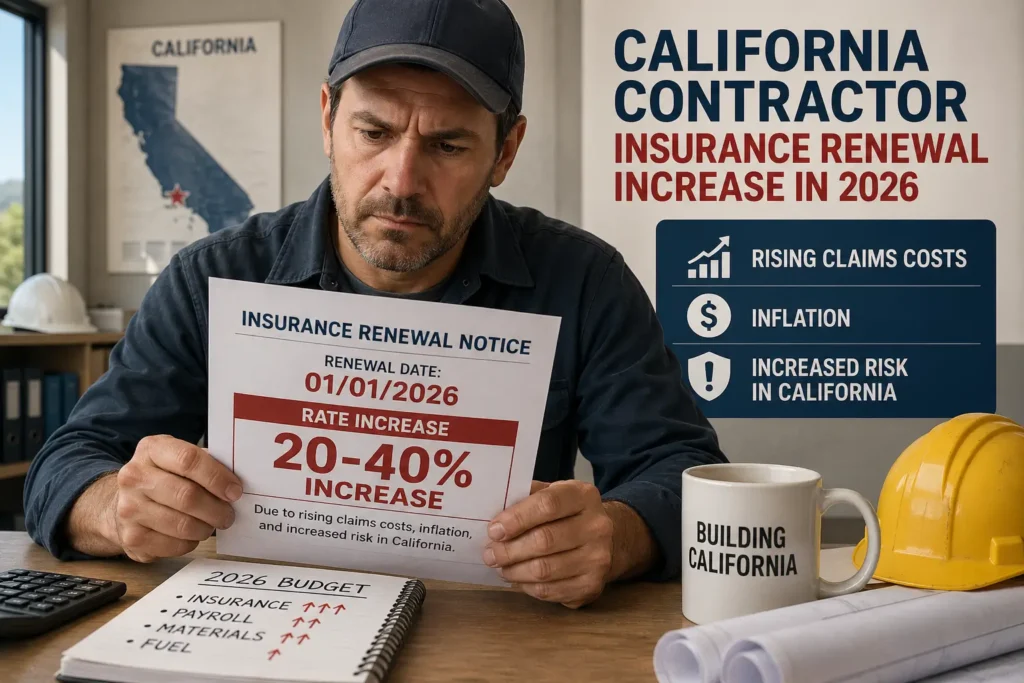
If your California contractor insurance renewal just landed in your inbox 20% to 40% higher than last year, you are not alone. We are seeing it across our book. Roofers, general contractors, plumbers, electricians, all watching their premiums climb at renewal. Some increases reflect a real market-wide shift. Some reflect carrier-specific issues with your account. Some reflect things you can fix.
This guide walks through what is actually happening, how to read your renewal notice, how to shop the market properly, and how to switch coverage without burning relationships you may need later.
TLDR: The California Hard Market in One Glance
California contractor insurance renewals are up 5% to 40% in 2026 because of five primary drivers: (1) wildfire and catastrophic loss pressure, (2) reinsurance cost increases, (3) carrier consolidation and California exits, (4) WCIRB (Workers’ Compensation Insurance Rating Bureau of California) pure premium rate filings, and (5) litigation and loss-trend pressure. The right response is to shop with an independent broker 45 to 60 days before expiration, compare coverage and total cost (not just headline premium), and bind new coverage effective the day current coverage expires. Roofing (C-39), concrete (C-8), and asbestos abatement (C-22) are seeing the steepest increases; lower-hazard trades face more modest pressure.
What “Hard Market” Actually Means
The Insurance Cycle (Soft Market vs Hard Market)
Insurance markets cycle. In a soft market, carriers compete aggressively for business: rates flatten or fall, underwriting loosens, coverage is broad. In a hard market, carriers tighten: rates rise, underwriting becomes selective, coverage narrows, and some carriers exit lines or geographies entirely.
Soft markets typically last several years. Hard markets typically last several years too. For California contractor lines, the 2010s were largely soft. The early 2020s started shifting, and by 2024 to 2026 we are squarely in a hard cycle for many contractor classes. Background context on hard-market cycles is available from the Insurance Information Institute.
Where California Sits Today
California is one of the harder markets in the country for contractor lines, particularly in workers’ compensation for high-hazard trades and general liability for trades with wildfire exposure. The combination of catastrophic loss years, reinsurance pressure, and a meaningful number of carriers reducing California appetite has compressed competition for many classifications.
How Long the Hard Market Typically Lasts
Hard markets do not last forever. Historical cycles suggest 3 to 5 years is common for hard-market conditions before pricing moderates. We are likely partway through that window, depending on loss experience and reinsurance trends over the next two renewal cycles.
The Five Reasons California Contractor Insurance Got More Expensive
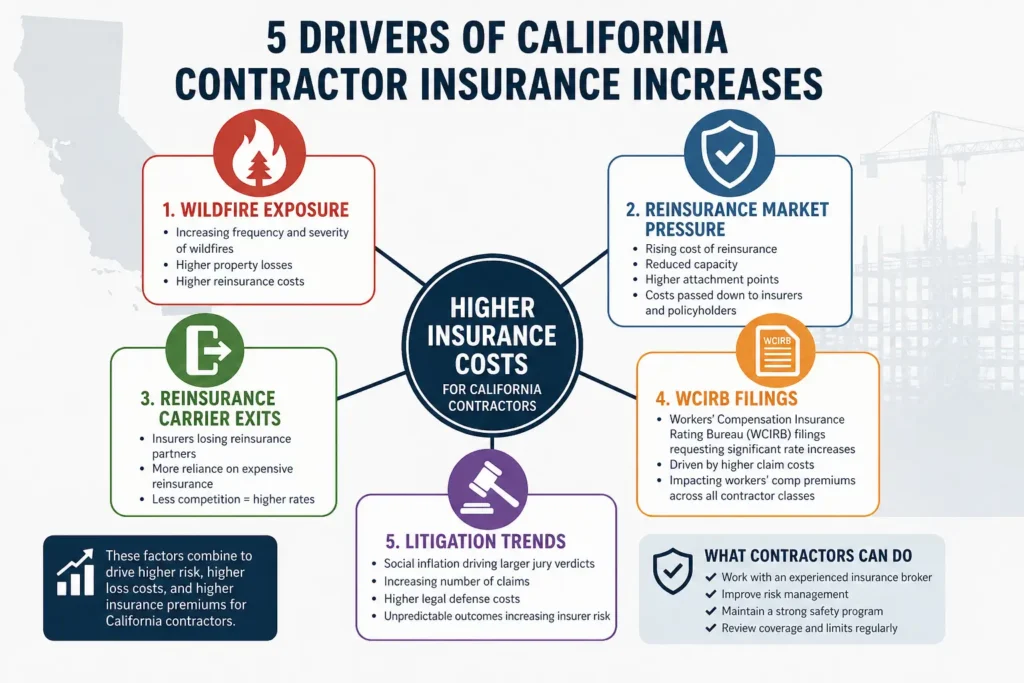
Reason 1: Wildfire and Catastrophic Loss Pressure on Carriers
California has seen multiple high-loss years driven by wildfire and other catastrophic events. Carriers exposed to California risk, including some that write contractor lines, have absorbed significant losses. The pricing impact shows up in two ways: direct rate increases on wildfire-adjacent risks, and indirect rate increases as carriers re-underwrite their entire California book to recover capital. Reference WCIRB (Workers’ Compensation Insurance Rating Bureau of California) California rate filings and California Department of Insurance market conduct guidance.
Reason 2: Reinsurance Cost Increases
Primary carriers buy reinsurance to spread their own risk. Reinsurance pricing has hardened globally over the last several renewal cycles, and primary carriers pass those costs through to policyholders at renewal. This is a structural driver that affects nearly every line of insurance, not just California contractor coverage.
Reason 3: Carrier Consolidation and California Exits
Some carriers that historically wrote California contractor business have non-renewed books, reduced their California appetite, or exited lines entirely. Fewer carriers competing for your business generally means less downward pressure on pricing. When your renewal comes from a carrier that has fewer California competitors than two years ago, the rate environment around your account is structurally different.
Reason 4: WC Class-Code Pure Premium Rate Filings
Workers’ compensation rates in California are heavily influenced by the WCIRB pure premium rate filings, which adjust base rates by class code based on loss experience. High-hazard classes such as roofing (Class Code 5552 (roofing operations)), concrete, asbestos abatement, and certain framing operations have typically seen the largest pure premium adjustments in recent filings. Lower-hazard classes have seen smaller shifts. Your renewal increase depends meaningfully on which class codes apply to your operations.
Reason 5: Litigation and Loss-Trend Pressure
Claim severity has trended upward in California for many lines. Larger settlements and higher loss costs feed back into underwriter pricing models and rate filings. This is a slower-moving driver than wildfire or reinsurance, but it compounds over multiple renewals.
💬 Broker’s Note (Pascal): I have contractors who stayed put with the same carrier from 2020 through 2024 because the rates were soft and there was no reason to shop. Then 2025 and 2026 hit, and they were quoting in a market that had completely shifted underneath them. If you have not shopped your contractor insurance in three years or more, what you are looking at this year is partly a real rate increase and partly catch-up to where the market actually is.
Why Contractors Specifically Got Hit Harder
Class Code Severity (Roofing, Concrete, Construction)
Construction class codes carry higher severity than most service businesses, and California’s construction class codes carry higher severity than most other states’ equivalents. Roofing in particular sits at the top of the rate table. The combination of falls, hot work, tear-off, and wildfire-adjacent project locations makes it one of the most heavily-priced classes in the country.
Sub Use and Audit Reclassification
Contractors who rely on 1099 helpers without proper certificates of insurance from those subs are exposed to audit reclassification surcharges that compound the renewal increase. When audit findings push payroll higher than the renewal estimate, the new policy is priced off the larger payroll base. Our premium audit guide covers this in more detail.
Heights, Hot Work, and Underwriting Hesitancy
Underwriters have tightened on operations that include working at heights, hot work, asbestos handling, and similar high-severity activities. The result is fewer carriers competing for those risks and less flexibility in rate negotiation. Trades with cleaner operational profiles have more carrier options and more competitive renewals.
How to Read Your Renewal Notice (And Spot What’s Actually Driving the Increase)
Base Rate vs Loss-Adjusted Rate
Your renewal premium is the base rate (set by carrier filings and class code) multiplied by your payroll or receipts, then adjusted for loss history, schedule credits or debits, and any state-mandated assessments. When premiums jump, find out which factor moved. A base rate increase from a WCIRB filing affects everyone in your class. A loss-adjusted rate increase reflects something specific to your account.
Experience Modifier (WC)
For workers’ compensation, the experience modifier (ex-mod, a multiplier reflecting your three-year loss history) reflects your three-year loss history relative to the average for your class. An ex-mod above 1.0 means you are paying more than the average. Below 1.0 means you are paying less. Even small ex-mod increases compound across payroll. Verify your published mod with WCIRB directly. Many contractors have never checked it.
Schedule Credits and Debits
Carriers can apply schedule credits or debits based on operational factors such as safety programs, fleet condition, claims management practices, and financial stability. If your carrier removed a credit or added a debit, the impact will not show in your ex-mod or class code. It will show in the underwriter’s notes.
Premium-Bearing Audit Adjustments From Last Year
Last year’s audit can affect this year’s renewal. If the audit found higher payroll than the original estimate, the renewal premium is calculated off the audit-adjusted figure. If subs were reclassified to payroll at audit, that reclassification carries forward.
When the Renewal Increase Is Reasonable (And When It’s Not)
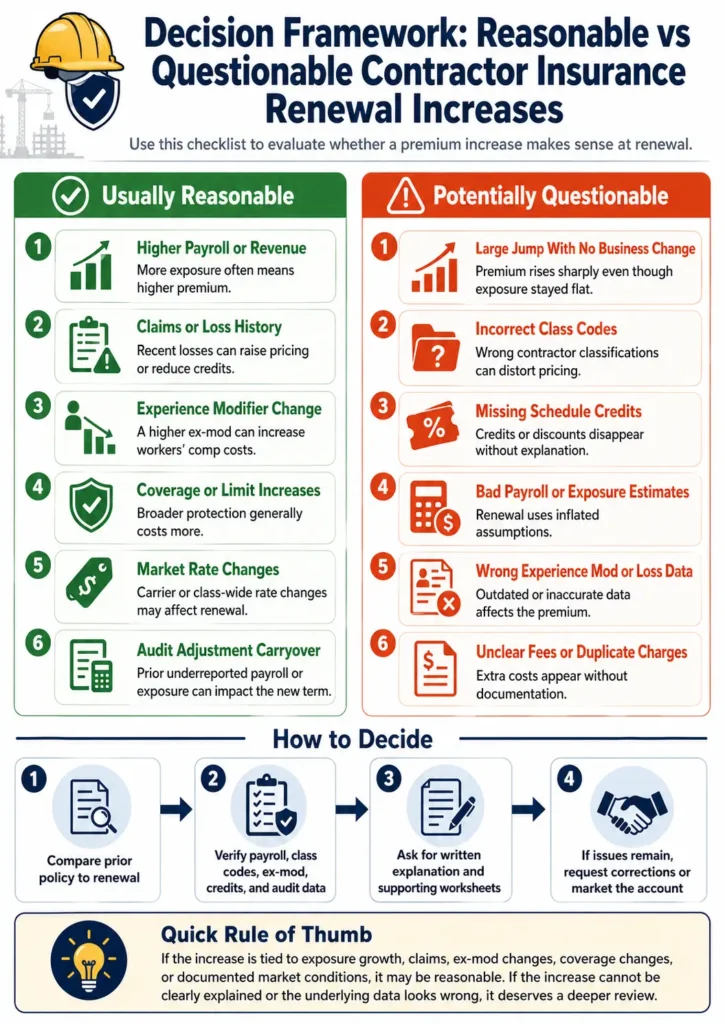
Reasonable: Market-Wide Hard-Market Pressure
If your class is seeing market-wide rate pressure (roofing, concrete, asbestos abatement, wildfire-adjacent operations), some increase is structural. Even a perfect account will see upward movement.
Reasonable: Your Loss History or Audit Findings Drove It
If you had a claim in the prior policy period or your audit reclassified payroll, the renewal reflects those facts. Switching carriers does not erase loss history. The new carrier will see your loss runs.
Maybe Not Reasonable: Single-Carrier Rate Hike Without Loss History
If your loss history is clean, your operations have not changed, your audit was clean, and your carrier still raised your rate well above market trend, that may reflect a carrier-specific issue rather than a market issue. This is exactly the situation where shopping with an independent broker can produce meaningful results.
Maybe Not Reasonable: Class Code Drift Without Operational Change
If the renewal applies class codes you did not have last year and your operations have not changed, the auditor or underwriter may have reclassified part of your operations. This is worth pushing back on. Sometimes it is correct. Sometimes it is not. The documentation matters.
How to Shop the Market Properly
Step 1: Get Your Renewal Notice and Loss Runs Together
Before talking to anyone new, gather your declarations page, the renewal notice with the proposed new premium, three to five years of loss runs (your current carrier will provide), and your most recent audit summary. Without these, no broker can give you a real comparison.
Step 2: Choose Your Effective Date Carefully (Don’t Let Coverage Lapse)
Your goal is for new coverage to bind effective the same date your current coverage expires. Even a one-day gap in coverage exposes you to uninsured loss and complicates future renewals.
Step 3: Send the Same Information to an Independent Broker
A captive agent represents one carrier. An independent broker shops multiple carriers per renewal. Send the same package (dec page, loss runs, audit summary, renewal notice) to an independent broker and ask for a side-by-side quote.
Step 4: Compare on Coverage and Total Cost, Not Just Premium
A premium that looks $4,000 lower may carry a $5,000 higher deductible, narrower coverage, or missing endorsements your contracts require. Compare limits, deductibles, endorsements, and exclusions side by side. The lowest premium is rarely the best value.
💬 Broker’s Note (Pascal): The single biggest mistake I see is contractors who wait until 5 days before their effective date to start shopping. By then, my options are limited to whatever carriers can quote in 48 hours. Start the shop 45 to 60 days out and you have real choices. Start it the week before and you have whatever fits in the time window.
Step 5: Decide on the Switch Before Renewal Effective Date
Once you have side-by-side quotes, decide. If the new quote is materially better and the coverage is equal or better, bind the new policy effective your current expiration date. If the renewal with the current carrier is better than the alternatives, stay put with eyes open about why.
Get a Side-by-Side Renewal Quote
Send your dec page, loss runs, and renewal notice. We’ll quote across our California carriers and return a side-by-side comparison within 24 to 48 hours.
How to Switch Without Burning Your Carrier Relationship

Notify Your Current Broker Cleanly
If you are switching brokers, send a written notice (email is fine) thanking them for their work and confirming the new effective date. Do not let the new carrier-bound policy be how your current broker finds out. Carrier relationships in California are smaller than most contractors realize, and how you exit a relationship matters.
Don’t Cancel Mid-Term Without a Reason
Mid-term cancellations are flagged in carrier underwriting systems. Future carriers see them. Unless there is a compelling reason (coverage gap, carrier non-renewal, business closure), wait for renewal expiration and switch cleanly.
Why Carrier Relationships Matter More Than Most Contractors Think
The same carriers writing California contractor business today will likely be writing it in 5 to 10 years. If you switched away from a carrier in 2026, then in 2031 the market shifts and that carrier becomes the best option for your trade, the underwriting team will remember whether you left cleanly or burned the bridge. This is especially true in higher-hazard classes where the carrier pool is smaller.
When Going Back Later Is Possible (And When It Isn’t)
If you left cleanly at renewal and your loss history stays clean, going back is generally possible. If you canceled mid-term, had a string of losses while away, or left in the middle of an audit dispute, the path back narrows.
💬 Broker’s Note (Pascal): I have seen contractors chase the lowest quote three years in a row, switching carriers each renewal, and end up with no carrier willing to renew them when their loss history caught up. The cheapest quote at any cost is a strategy that backfires 3 to 5 years down the road. Carrier loyalty has value when it is mutual.
Three Illustrative California Renewal Scenarios
The following are illustrative scenarios drawn from typical patterns we see in our renewal book, not specific named clients. Outcomes for any individual contractor depend on class, loss history, current carrier, and operational facts.
Scenario 1: C-39 Roofer With a Steep Renewal Increase
A Long Beach C-39 (CSLB roofing classification) contractor with three years of clean loss runs receives a 35% renewal increase from his incumbent carrier. On the surface, this matches the hard-market trend for roofing. After we shop the account across multiple California-admitted carriers, two carriers come back with terms closer to flat year-over-year, and one carrier offers credit for a documented fall-protection program. He binds effective his expiration date with no coverage gap. The fact that the incumbent quoted plus 35% did not mean the broader market was at plus 35% for his specific risk.
Scenario 2: Plumber With Clean Loss Run
A Sacramento C-36 (CSLB plumbing classification) contractor with five years of zero claims receives an early-double-digit-percent renewal increase. After we shop the account, the incumbent carrier matches a competitor’s quote at a meaningfully lower rate plus a schedule credit, ending close to flat. He stays with the incumbent. The shop did not produce a switch, but it produced a meaningful reduction off the original renewal because the incumbent had room to move when there was real competition for the account.
Scenario 3: GC Consolidating Multi-Policy to One Carrier
A Riverside Class B general contractor carries GL with one carrier, WC with another, and commercial auto with a third. Each renewal comes in 15% to 25% higher. We consolidate all three lines with a single carrier offering a multi-line discount and improved umbrella terms. Total premium drops meaningfully versus the combined incumbent renewals, with broader coverage. Consolidation is not always the answer, but for contractors with the right risk profile it is worth running the numbers.
For California general contractors specifically, our guide to California general contractors general liability coverage walks through the coverage and limits most renewal shoppers compare.
Common Renewal Shopping Mistakes
Mistake 1: Letting Coverage Lapse During the Shop
Even one day uninsured exposes you to uninsured-loss risk and complicates future renewals. Bind effective the expiration date.
Mistake 2: Comparing Quotes With Different Limits or Endorsements
A $1M/$1M policy is not the same as a $1M/$2M policy. A policy with blanket Additional Insured is not the same as a policy with scheduled AI. Match limits, deductibles, and endorsements before comparing premiums. See our guides on the Additional Insured endorsement, Primary and Noncontributory, and Waiver of Subrogation for endorsement context.
Mistake 3: Switching for the Lowest Premium Without Reading Coverage
The cheapest quote sometimes excludes coverage your contracts require. We see contractors switch for a few thousand in savings only to find out at the next bid that their new policy does not support the GC’s required endorsements.
Mistake 4: Waiting Until 5 Days Before Effective Date
Underwriters need time. Carriers need time. Endorsements need time. Start 45 to 60 days before expiration if you want real options.
Mistake 5: Not Disclosing Claims History to the New Broker
The new carrier will see your loss runs. Hiding a claim does not work, and undisclosed losses are a basis for policy rescission. Disclose everything upfront.
How ContractorsInsured.net Approaches California Renewals
We are a California-licensed insurance brokerage (CA License # 6015321) founded by Pascal Burke in 2017. Pascal came up through construction before he came into insurance, and the brokerage was built specifically for contractors who want a broker who understands the job site.
Because we are a fiercely independent broker, we are not tied to any single carrier. We shop multiple carriers per renewal and present a side-by-side comparison so you can see what each carrier offers on coverage, deductibles, endorsements, and total cost. ContractorsInsured.net reports saving clients an average of 10% to 40% on premiums, depending on class, loss history, and current carrier. Specific outcomes for any individual contractor depend on operational facts and carrier appetite at renewal.
When you send us your renewal notice, we read it the same way we would read our own. We look for the base rate, the ex-mod, the schedule credits, the audit-adjusted payroll, and the underwriter’s notes. We tell you whether the increase reflects market-wide pressure or a carrier-specific issue, and what your real options are.
Send Us Your Renewal Notice
Forward your renewal notice and current dec page. We’ll tell you whether the increase reflects market pressure or carrier-specific issues, and what your options are.
Frequently Asked Questions
Why did my California contractor insurance go up at renewal?
Most California contractor renewals in 2025 to 2026 are running 5% to 40% higher than the prior year due to a combination of wildfire and catastrophic loss pressure, reinsurance cost increases, carrier consolidation and California exits, WCIRB pure premium rate filings, and litigation/loss-trend pressure. Your specific increase depends on classification, loss history, and current carrier. Check whether your renewal reflects market-wide trends or carrier-specific issues.
Is the California insurance market in a hard market right now?
California contractor insurance is generally in a hardening market in 2025 to 2026. Hard market conditions include rate increases, tighter underwriting, narrower coverage, and reduced carrier competition. The hardest classes are typically roofing, concrete, and other high-hazard trades. Lower-hazard trades face more moderate pressure. Hard markets historically last 3 to 5 years before pricing moderates.
Should I switch brokers if my renewal went up 20-40%?
A 20% to 40% renewal increase is worth shopping, but the decision to switch depends on whether the increase reflects market-wide pressure (hard to escape) or carrier-specific issues (often shoppable). An independent broker can shop the market across multiple carriers and produce a side-by-side comparison. The right answer is sometimes to stay with the incumbent at a negotiated renewal, sometimes to switch carriers, and sometimes to consolidate multiple lines.
How do I shop my California contractor insurance properly?
Gather your declarations page, three to five years of loss runs, your renewal notice, and your most recent audit summary. Send the same package to an independent broker and ask for a side-by-side comparison. Compare on coverage, limits, deductibles, and endorsements rather than headline premium. Bind effective your current expiration date so coverage does not lapse. Start the shop 45 to 60 days before expiration.
Will switching brokers cause my coverage to lapse?
Not when the switch is timed properly. The new policy should bind effective the same date your current coverage expires. A clean transition has zero gap. A coverage lapse, even one day, exposes you to uninsured loss and creates underwriting questions on future renewals. Coordinate the bind date with both the new carrier and the existing carrier.
Can I get a better rate without switching carriers?
Sometimes yes. When your incumbent carrier sees real competition from other carriers, they often have room to move on rate, schedule credits, or coverage terms. The shop itself can produce a renegotiated renewal even if you stay put. This is one reason we recommend shopping every renewal cycle, not just the renewals that look painful.
How do I avoid a non-renewal in California?
Non-renewal protection depends on carrier appetite, claims history, audit accuracy, and timely communication with your broker. Clean loss runs, accurate payroll estimates at binding, documented safety programs, and proactive sub compliance reduce non-renewal risk. If your current carrier signals non-renewal, work with an independent broker immediately to find replacement coverage before the effective date.
What's the difference between a captive agent and an independent broker?
A captive agent represents one carrier (or a small group of affiliated carriers) and quotes from that carrier’s products only. An independent broker represents the contractor and shops multiple carriers per renewal. In a hard market, captive options narrow with the carrier. Independent options reflect the broader market. Most California contractors benefit from independent representation in a hard cycle.
When in the year should I start shopping my renewal?
Start 45 to 60 days before your renewal effective date. This gives the new broker time to gather information, market the account to multiple carriers, receive quotes back, present a side-by-side, and bind effective your expiration date. Starting 5 to 10 days out limits options to whatever carriers can quote on a rush basis, which is rarely the best market.
Does ContractorsInsured.net shop renewals for California contractors?
Yes. We are a California-licensed insurance brokerage (CA License # 6015321) and we shop multiple carriers per renewal for contractor clients across California. Send us your renewal notice, current dec page, and loss runs, and we will return a side-by-side comparison within 24 to 48 hours.
Key Takeaways
- California contractor insurance is in a hard market driven by wildfire and CAT loss, reinsurance cost, carrier consolidation, WCIRB pure premium filings, and litigation trends
- Typical renewal increases for 2025 to 2026 range from 5% to 40%+ depending on classification and loss history
- Roofing, concrete, and asbestos abatement face the steepest pressure. Lower-hazard trades face more modest increases
- Read your renewal notice for the base rate, ex-mod, schedule credits, and audit-adjusted payroll. Different drivers require different responses
- Shop the market 45 to 60 days before expiration. Compare on coverage and total cost, not headline premium
- Bind new coverage effective your current expiration date. Coverage lapses create more problems than they solve
- Switching brokers is sometimes the right call, sometimes the wrong call. The shop itself often produces a better renewal even when you stay put
- Carrier relationships matter long-term. Exit cleanly at renewal rather than mid-term where possible
- Disclose all claims history to any new broker. Undisclosed losses are a basis for policy rescission
- An independent broker shops the market on your behalf. A captive agent quotes from one carrier
Get a Side-by-Side Renewal Quote
If your California contractor renewal looks higher than expected, send it our way. We will read the dec page and renewal notice the same way we read our own, shop the market across multiple California-admitted carriers, and return a side-by-side comparison within 24 to 48 hours.
Request a Renewal Shop
Send your renewal notice, dec page, and loss runs. Side-by-side comparison within 24 to 48 hours. Independent California broker. CA License # 6015321.
This guide is educational and not legal, tax, or coverage advice. California insurance market conditions evolve. Always confirm specific rate, coverage, and switching decisions with your broker, the carrier, and qualified counsel before binding new coverage or non-renewing existing coverage.