

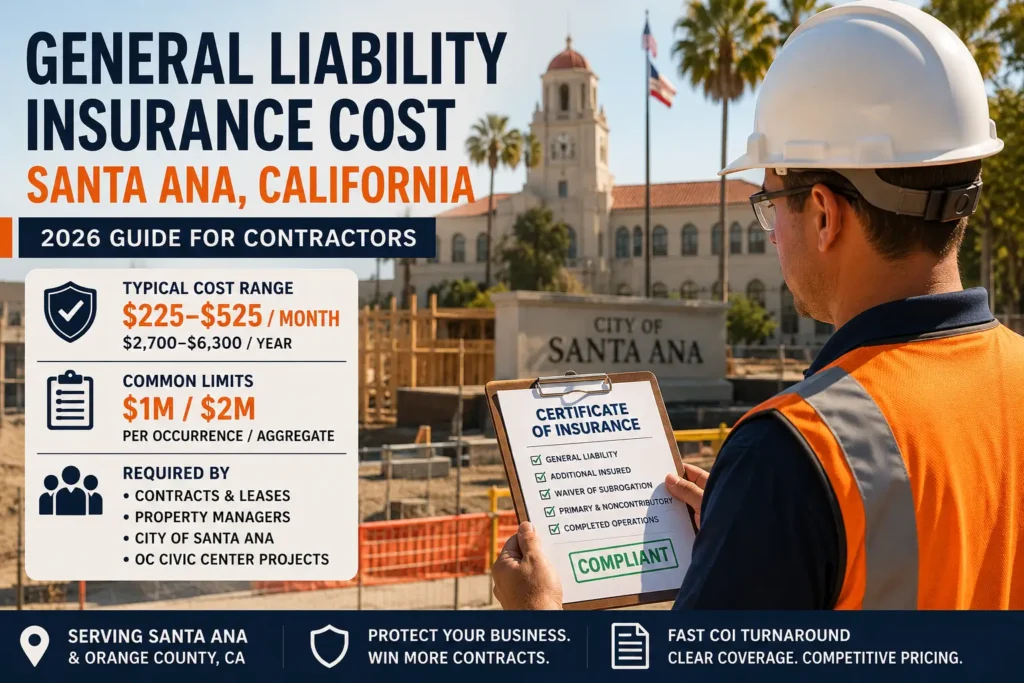
Most Santa Ana general contractors typically pay $225 to $525 per month ($2,700 to $6,300 annually) for a standard $1 million per occurrence / $2 million aggregate general liability policy. Higher-risk trades such as roofing, structural work, demolition, and large tenant-improvement projects often pay substantially more. As ContractorsInsured.net (CA Lic #6015321), we shop multiple California-admitted carriers for Santa Ana contractors, quote the same business day, and issue the COI right after binding.
Santa Ana contractors frequently work in occupied commercial buildings, public facilities, retail centers, and mixed-use developments throughout Orange County. Those environments increase third-party liability exposure and often come with strict Certificate of Insurance (COI) requirements. Understanding what drives pricing can help contractors secure proper coverage while avoiding costly delays caused by rejected certificates or missing endorsements.
What General Liability Insurance Covers
General liability insurance protects contractors against claims involving third-party bodily injury, third-party property damage, personal injury, advertising injury, and covered legal defense costs.
For Santa Ana contractors, this is typically the first insurance policy requested by general contractors, property managers, landlords, city agencies, and commercial clients before work begins.
Examples include:
- A visitor trips over materials at a jobsite and is injured.
- A plumbing contractor accidentally damages a customer’s flooring.
- Overspray from painting operations damages neighboring property.
- A completed project later causes damage to surrounding property.
General liability does not replace workers’ compensation, commercial auto insurance, inland marine coverage, or professional liability insurance. Each policy addresses different categories of risk.
For a broader explanation, see our complete contractor general liability guide.
How Much Does General Liability Insurance Cost in Santa Ana?
TL;DR: Most Santa Ana, California general contractors pay roughly $225 to $525 per month ($2,700 to $6,300/year) for a standard $1M/$2M general liability policy. Lower-risk artisan trades generally fall below that range and high-hazard trades above it. Final cost depends on trade, payroll/revenue, claims history, and the coverage limits your Orange County contracts require. Get a same-day certificate of insurance after binding.
Most Santa Ana contractors fall into the following premium ranges:
Contractor Type | Typical Monthly Cost | Typical Annual Cost |
Handyman / Low-Risk Artisan Trade | $40 to $150 | $480 to $1,800 |
Small Residential Contractor | $150 to $325 | $1,800 to $3,900 |
General Contractor | $225 to $525 | $2,700 to $6,300 |
Tenant-Improvement Contractor | $275 to $650 | $3,300 to $7,800 |
Roofing, Structural, or High-Hazard Trade | $350 to $800+ | $4,200 to $9,600+ |
These figures assume a contractor with standard limits, moderate revenue, acceptable claims history, and normal Orange County exposure.
Actual pricing depends on:
- Trade classification
- Annual revenue
- Payroll
- Subcontractor costs
- Claims history
- Project type
- Coverage limits
- Endorsement requirements
Why Contractor GL Pricing Reflects Orange County Reality in Santa Ana
Santa Ana is not priced like a rural California market. It serves as Orange County’s government center and contains a mix of public facilities, commercial properties, downtown redevelopment projects, and dense tenant-improvement work.
Several local factors influence pricing.
First, contractors frequently work in occupied environments. Office buildings, restaurants, retail centers, medical facilities, and mixed-use developments create greater third-party exposure than vacant construction sites.
Second, public projects often require extensive insurance documentation. Contractors pursuing municipal work may need certificates, endorsements, and contract-specific language before permits or project approvals are issued.
Third, Orange County property managers frequently require Additional Insured endorsements, Primary and Noncontributory wording, Waivers of Subrogation, and completed operations coverage.
As Pascal Burke notes:
“In 15+ years writing California contractor GL, the number one reason Santa Ana tenant-improvement and OC Civic Center COIs get rejected is not the policy. It is missing the property manager’s exact Additional Insured and Waiver of Subrogation wording.”
Finally, construction remains a high-hazard industry. Roofing, structural work, excavation, demolition, and public-facing projects generally receive higher premiums due to increased claim severity.
Cost by Coverage Limit
Most contractors begin with a standard $1 million / $2 million policy. Larger commercial projects often require higher limits.
Coverage Limit | Typical Use Case |
$1M / $2M | Residential projects, artisan trades, small commercial work |
$2M / $4M | Larger commercial projects, tenant improvements, public facilities |
$1M / $2M + Umbrella | Contractors needing $3M to $5M total limits |
$5M+ Total Limits | Large institutional, government, and infrastructure projects |
Many contractors find it more cost-effective to add an umbrella policy rather than dramatically increase underlying GL limits.
The 7 Factors Carriers Use to Price Your Policy
Insurance carriers evaluate several key exposures when determining premium.

Pricing Factor | Why It Matters |
Trade Classification | Higher-risk trades generate higher premiums |
Annual Revenue | More revenue generally means more exposure |
Payroll | Larger crews create greater liability exposure |
Subcontractor Usage | Uninsured subs increase risk |
Claims History | Previous losses impact underwriting |
Jobsite Type | Occupied and public-facing sites increase exposure |
Endorsement Requirements | Complex contracts often require specialized forms |
A roofing contractor and a finish carpenter working from the same Santa Ana address can receive dramatically different premiums because their exposure profiles differ significantly.
Santa Ana Contract, Lease, and COI Requirements
Many Santa Ana contractors purchase general liability insurance because a contract requires it.
Common requirements include:
- Additional Insured endorsements
- Primary and Noncontributory wording
- Waiver of Subrogation endorsements
- Completed operations coverage
- Minimum coverage limits
- Vendor portal compliance
Common reasons certificates are rejected include:
- Incorrect certificate holder information
- Missing endorsements
- Inadequate limits
- Missing completed operations wording
- Failure to provide endorsement copies
The safest approach is to review the contract before purchasing coverage so endorsements can be matched to project requirements.
What General Liability Does NOT Cover
General liability insurance is important, but it has limitations.
Not Covered by GL | Usually Covered By |
Employee Injuries | Workers’ Compensation |
Company Vehicles | Commercial Auto |
Tools & Equipment | Inland Marine |
Design Errors | Professional Liability |
Pollution Claims | Pollution Liability |
Cyber Incidents | Cyber Liability |
Contractual Penalties | Contract Review / Risk Management |
Contractors should view general liability as one component of a broader insurance program rather than a complete risk-management solution.
How Santa Ana Contractors Can Lower GL Costs Without Creating Coverage Gaps
The goal should be reducing premium without sacrificing necessary coverage.
Practical strategies include:
- Classify operations accurately.
- Provide realistic revenue estimates.
- Maintain organized loss history records.
- Require certificates from subcontractors.
- Use written subcontractor agreements.
- Review contract requirements before binding coverage.
- Bundle policies when appropriate.
- Avoid uninsured subcontractors.
A lower premium loses value quickly if a certificate is rejected and delays project mobilization.
What to Prepare Before Requesting a Quote
Contractors receive faster and more accurate quotes when they provide complete underwriting information.
Prepare:
Quote Item | Why It Matters |
Legal Business Name | Matches contracts and certificates |
CSLB License Number | Confirms licensing and classification |
Trade Classification | Determines eligibility and pricing |
Annual Revenue | Measures exposure |
Payroll Information | Assists underwriting |
Subcontractor Costs | Impacts risk transfer |
Current Insurance Policy | Shows existing coverage |
Loss Runs | Documents claims history |
Sample Contract | Identifies endorsement requirements |
COI Wording Requirements | Prevents rejected certificates |
Providing complete information upfront typically results in better pricing and fewer delays.
Frequently Asked Questions About General Liability Insurance Cost Santa Ana CA
How much does general liability insurance cost for a Santa Ana contractor in 2026?
Most Santa Ana general contractors pay approximately $225 to $525 per month for a standard $1 million per occurrence and $2 million aggregate policy. Lower-risk trades may pay substantially less, while roofing, structural, demolition, and tenant-improvement contractors often pay more. Final pricing depends on revenue, payroll, claims history, subcontractor usage, project type, endorsements, and carrier appetite for the contractor’s trade classification.
Is general liability insurance legally required by California for a Santa Ana contractor?
California generally does not require every licensed contractor to carry general liability insurance as a condition of licensure. One statutory exception applies to limited liability companies: under California Business and Professions Code section 7071.19, a CSLB-licensed LLC must carry liability insurance with a total aggregate limit of $1 million for five or fewer persons on its personnel of record, plus $100,000 for each additional person, up to a $5 million cap. However, many Santa Ana contractors still need coverage because customers, landlords, general contractors, property managers, and government agencies require it. Workers’ compensation requirements are separate and may apply depending on business structure and employee status.
What GL limits do Orange County public-facility contracts typically require?
Many projects begin with $1 million per occurrence and $2 million aggregate limits. Larger public-facility projects, government contracts, and institutional work often require $2 million/$4 million limits or higher. Some contracts also require umbrella coverage to achieve total limits of $5 million or more. Contractors should always review project-specific insurance requirements before submitting certificates.
How does dense urban tenant-improvement work affect a contractor's premium?
Tenant-improvement projects frequently occur in occupied buildings with significant third-party exposure. Contractors may be working around employees, customers, tenants, or visitors. Water damage, dust, fire, access issues, and property-manager requirements can increase underwriting concerns. Because of these risks, carriers often charge higher premiums for contractors specializing in tenant improvements.
Can a Santa Ana contractor get a same-day COI?
Yes. Many contractors can receive a same-day Certificate of Insurance if their policy is active and the requested wording is already supported by the carrier. Problems typically arise when contracts require endorsements that have not been added to the policy. Providing contract language before a deadline helps avoid last-minute certificate issues.
Does general liability cover damage I cause to my own work?
Generally, no. General liability policies typically cover third-party bodily injury and property damage. They often do not pay to repair or replace defective workmanship itself. However, resulting damage to other property may be treated differently depending on policy language and claim circumstances. Contractors should review exclusions and completed operations provisions carefully.
How does workers' compensation interact with general liability coverage?
The two policies serve different purposes. General liability addresses covered third-party claims, while workers’ compensation addresses employee injuries arising out of employment. Contractors frequently need both policies to satisfy licensing, contractual, and project requirements. Maintaining proper workers’ compensation coverage is especially important when employees are involved. CSLB also states that active C-8 Concrete, C-20 Warm-Air Heating, Ventilating and Air-Conditioning, C-22 Asbestos Abatement, C-39 Roofing, and C-61/D-49 Tree Service licensees must carry workers’ compensation or hold a valid Certification of Self-Insurance whether or not they have employees. Under Business and Professions Code section 7125, as amended by SB 1455, that requirement extends to every active licensee regardless of classification on January 1, 2028.
What information speeds up a Santa Ana contractor quote?
Providing a complete submission package significantly improves quote turnaround time. Carriers typically request business information, license details, revenue, payroll, subcontractor costs, claims history, current coverage information, and project descriptions. Including contract requirements and endorsement wording early can prevent underwriting delays and certificate problems later.
Why is Santa Ana pricing different from Anaheim or Los Angeles?
Although Santa Ana and Anaheim share many Orange County market characteristics, exposure can differ based on project type. Santa Ana often includes government facilities, public projects, courthouse-related work, and downtown tenant improvements. Los Angeles may involve larger urban projects, industrial exposure, and higher litigation concerns. Pricing ultimately reflects exposure more than geography alone.
Get a Santa Ana General Liability Quote
The best general liability policy is not necessarily the cheapest. The best policy is the one that satisfies your contracts, supports your operations, and provides the endorsements required by customers, property managers, and public agencies.
ContractorsInsured helps Santa Ana contractors compare coverage options, review contract requirements, secure certificates quickly, and avoid costly compliance issues.
Whether you operate as a general contractor, specialty trade contractor, subcontractor, or growing commercial contractor, the smartest place to begin is with the contract requirements themselves.
Get a Contractor General Liability Quote
Disclaimer: This article is for educational purposes only and does not constitute legal, tax, or insurance advice. Coverage availability, pricing, exclusions, endorsements, and underwriting requirements vary by carrier and applicant. Always consult a licensed insurance professional regarding your specific situation.