
TL;DR
- Published national carrier figures for handymen currently run from NEXT’s $35 to $55 monthly band to Thimble’s $96.94 average, so about $35 to $100 per month is an honest planning range for general liability.
- California pricing still depends on your exact work, revenue, payroll, crew, location, limits, and claims history.
- Insureon’s average handyman policy carries $1 million per occurrence and $2 million aggregate limits.
- California does not generally require GL for unlicensed minor work, but clients often require a COI. The license exemption applies only below $1,000 when no permit is required and no employees are used.
- ContractorsInsured.net is a licensed California brokerage (CA #6015321): we quote handyman general liability the same business day and issue your COI right after binding.
| Provider or item | Current published figure |
|---|---|
| NEXT | 41% pay $35 to $55/month for GL |
| Insureon | $81/month average for GL |
| Hiscox | $50 to $80/month for sole proprietor GL |
| Thimble | $96.94/month average for handymen and contractors |
| Standard limits | $1M/$2M |
| Top 3 cost drivers |
|
What insurance does a California handyman actually need?
In brief: A California handyman usually starts with general liability for third-party injury and property damage, then adds tools coverage, commercial auto, and workers’ compensation when the business has those exposures, because state law does not impose one universal package and the right answer depends on the work, vehicles, equipment, employees, and client contract.
General liability is the core policy
General liability insurance for contractors is the policy most handymen buy first. It can respond to covered claims that someone outside your business was injured or that you damaged property while working. It may also include personal and advertising injury, products and completed operations, medical payments, and legal defense, subject to the policy’s terms, limits, exclusions, and endorsements.
Consider a simple example. You are mounting shelves in an occupied home and your drill damages a hidden water line. Water reaches the flooring before the valve is closed. A covered property damage claim may involve the homeowner’s damaged flooring and related repairs. The cost of replacing your own faulty installation is a separate issue, which is why the actual policy language matters.
California does not generally require commercial general liability for a contractor, according to the Contractors State License Board. For an individual doing properly exempt unlicensed minor work, the exemption itself does not add a GL mandate. Licensed contractor LLCs can have separate statutory requirements, and a project contract can require coverage even when a general state rule does not.
In practice, homeowners, landlords, property managers, commercial clients, and general contractors may ask for a certificate of insurance before they grant access or approve a vendor. Hiscox says many handyman clients insist on insurance before hiring, while Insureon notes that proof may be needed for a lease or client contract. A COI summarizes coverage at a point in time. It does not add coverage or replace an endorsement.
For a wider state-level view of contract and insurance requirements, see our guide to general liability for California general contractors.
Tools and equipment coverage
Your saws, drills, ladders, compressors, and other equipment are business property. General liability is designed mainly for claims by third parties, not theft or damage to your own tools. Tools and equipment coverage, often written as inland marine or contractor’s equipment coverage, can protect scheduled or eligible property in transit, at a jobsite, or away from your primary location.
Build the limit from a current inventory rather than a guess. Record model numbers, serial numbers, purchase dates, replacement costs, and photos. Ask how the policy treats theft from a vehicle that was not locked, property left overnight, rented equipment, and high-value individual items. Coverage terms and security requirements vary by carrier.
Commercial auto or hired and non-owned auto
A personal vehicle used for occasional commuting is not the same exposure as a van carrying tools between paying jobs. Progressive Commercial states that personal auto policies often exclude business use. A business-owned or regularly used work vehicle may need commercial auto, while hired and non-owned auto can address certain liability exposures involving rented vehicles or employee-owned vehicles used for business.
Tell the broker who owns each vehicle, who drives it, where it is garaged, how far it travels, and whether it carries permanently installed equipment. Do not assume that a personal policy will respond to a business trip simply because the registration is in your name.
Workers’ compensation when anyone works for you
California employers need workers’ compensation when they have one or more employees, including part-time employees. The rule is covered in detail below. For an unlicensed handyman, hiring an employee also destroys the minor-work license exemption, even when the project total remains below the dollar threshold.
How much does handyman insurance cost in California in 2026?
In brief: We use about $35 to $100 per month as a defensible planning range for handyman general liability because current first-party figures run from NEXT’s $35 to $55 customer band to Thimble’s $96.94 handyman and contractor average, and these national benchmarks are planning tools rather than guaranteed California quotes because an individual premium can fall outside them.
The range should help you plan, not tempt you to treat insurance like a shelf product. Each source measures a different customer group. NEXT reports a band for part of its handyman book. Insureon reports the average of policies bought through its marketplace. Hiscox describes an expected range for a sole proprietor. Thimble groups handymen with contractors. biBERK publishes a broad small-business figure rather than a handyman-only result.
| Provider | Current published figure | What the figure represents |
|---|---|---|
| NEXT | 41% pay $35 to $55 per month for GL | NEXT’s August 2026 handyman cost page says the data comes from active customers over the prior 12 months. Its broader expected GL band is $36 to $73 monthly, with limits that vary by selected package. |
| Insureon | $81 per month, or $978 per year | Insureon’s handyman cost page describes an average GL policy with $1 million per occurrence, $2 million aggregate, and a $500 deductible. |
| Hiscox | About $50 to $80 per month | Hiscox’s handyman page gives this expectation for a sole proprietor buying general liability. |
| Thimble | $96.94 per month | Thimble’s GL cost page lists this average for its combined Handymen and Contractors category and also offers shorter coverage periods. |
| biBERK | Policies start at $500 per year; most small businesses pay less than $2,000 per year | biBERK’s liability cost FAQ is a broad small-business benchmark, not a handyman-specific California price. |
The table does not support saying every California handyman will pay inside one narrow band. It does support a transparent planning answer. For a small operator comparing handyman-focused monthly figures, about $35 to $100 is more defensible than extending the range to an unverified number.
Why your California quote may be different
We see three underwriting groups doing most of the work: the exact work and trade classification; revenue, payroll, and crew size; and location, limits, and claims history. A handyman who hangs pictures, assembles furniture, and completes light finish repairs does not present the same risk as someone performing roof work, structural alterations, plumbing, electrical work, or projects that require permits.
Describe every operation honestly. A cheaper class code is not a bargain if it does not describe your actual work and creates a dispute when a claim occurs. Likewise, do not inflate revenue or payroll to look established. Accurate estimates give carriers a cleaner starting point and reduce surprise audit adjustments.
A $1 million per occurrence and $2 million aggregate structure is common in contractor contracts and is the average limit combination shown on Insureon’s current handyman page. It is not a statutory handyman minimum. Review the requirement page from the client before binding, especially if it asks for an additional insured endorsement, primary and noncontributory wording, a waiver of subrogation, or completed operations coverage.
Location also changes context. See the separate cost guides for San Francisco general liability and Los Angeles general liability, where larger contractor operations and urban project exposures can produce very different premiums from a light-duty solo handyman.
Marketplaces publish useful averages. We shop your actual operations across carriers. That distinction matters because carrier appetite, class rules, forms, and pricing can differ even when two applications appear similar. Our job is to present the work accurately, compare the available policy terms, and explain why the lowest number may not satisfy the job.
The $1,000 rule: what a California handyman can legally do without a license
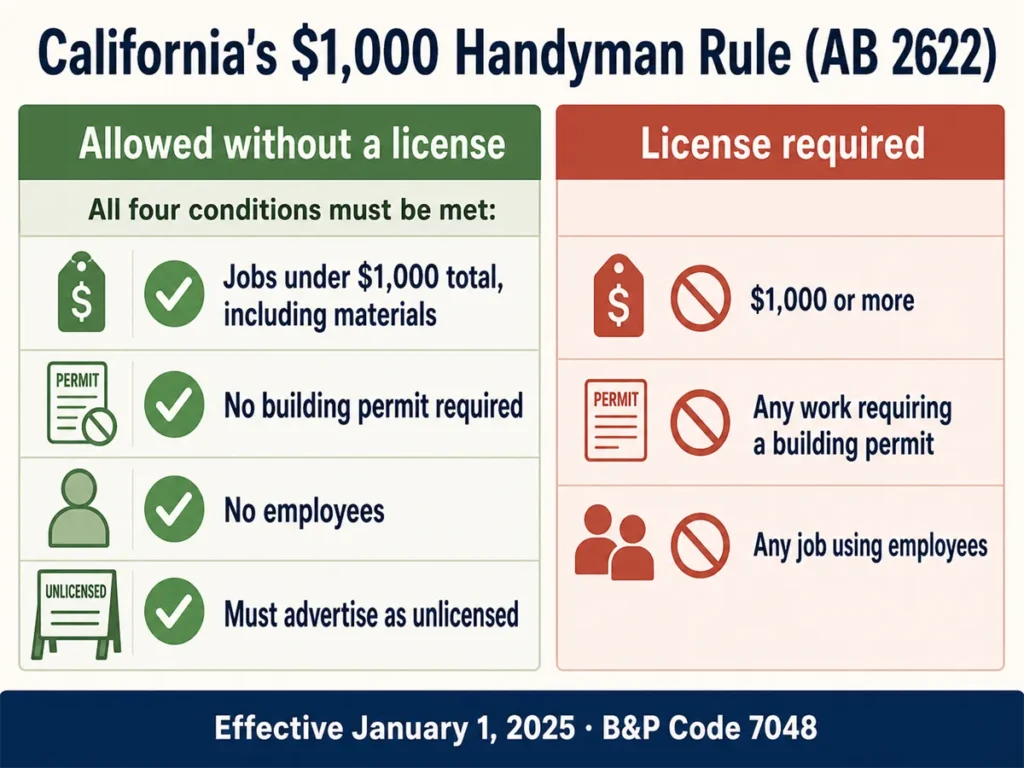
In brief: California’s minor-work exemption applies only when the aggregate price for labor, materials, and every other item is less than $1,000, the work requires no building permit, and the person uses no employees, while AB 2622 made this threshold effective January 1, 2025 without creating a general license for handyman work.
The exact threshold is where many summaries go wrong. Business and Professions Code section 7048, as amended by AB 2622, says the aggregate contract price must be less than $1,000. A project priced at exactly $1,000 is not within the exemption. The CSLB implementation release confirms that AB 2622 took effect January 1, 2025 and raised the prior $500 threshold.
All conditions must remain true
- The complete project price is below $1,000. Count labor, materials, and all other items. The customer buying materials separately does not automatically solve the issue if those items are part of the undertaking.
- No building permit is required. A low price does not exempt permit work. Permit requirements come from the appropriate local building department and depend on the work.
- No employees perform or assist with the work. A helper who is actually an employee removes the section 7048 exemption.
- The work is casual, minor, or inconsequential. Section 7048 uses those terms and blocks attempts to treat a portion of a larger operation as a separate exempt project.
You also cannot divide a larger project into several contracts below $1,000 to evade licensing. CSLB’s current before-applying guidance repeats the anti-splitting rule and says a license is required if the project needs a permit, uses additional workers, or reaches $1,000 in total labor and materials.
Advertising must say you are unlicensed
AB 2622 also amended Business and Professions Code section 7027.2. An unlicensed person may advertise eligible construction work only when the aggregate project price is less than $1,000 and the advertisement states that the person is not licensed. Do not use language, signs, cards, or branding that suggests you are a licensed contractor when you are not.
Advertising disclosure does not expand the work you may perform. An ad that says “unlicensed” does not make permit work lawful, does not allow employees, and does not turn a $1,000 project into exempt work. The project still must satisfy every section 7048 condition.
What changed in July 2026
SB 779 made a separate enforcement change operative July 1, 2026. A CSLB citation for a person acting as a contractor without a license, when no exemption applies, now includes a civil penalty of at least $1,500. The CSLB 2026 new-laws bulletin confirms that unlicensed-activity fines start at $1,500 from that date.
If a job is $1,000 or more, needs a permit, or requires employee labor, stop treating it as exempt handyman work. Determine the correct CSLB classification and licensing route before bidding or starting. Our verified trade fallback explains insurance for general contractors, but the correct license classification depends on the work, not the label you prefer to use.
No policy yet but a client or GC wants a COI?
In brief: We quote California handyman general liability the same business day, issue the COI right after binding, and help match the certificate holder details to the request, with the firm speed commitment applying to GL while workers’ compensation and commercial auto are handled fast but can require additional underwriting.
When workers' comp becomes mandatory
In brief: California requires workers’ compensation when a handyman business has one or more employees, even if the employee is part time, and using an employee also ends the unlicensed minor-work exemption, while in 2026 five specified CSLB classifications need coverage without employees and the broader all-licensee mandate is scheduled for January 1, 2028.
The California Division of Workers’ Compensation says a business with one or more employees must satisfy the workers’ compensation requirement. That includes a part-time employee. Do not wait for a full-time hire or a certain payroll amount. Coverage should be in place when the employment exposure begins.
For a solo unlicensed handyman, hiring a helper creates two separate problems if the helper is an employee. First, workers’ compensation becomes mandatory. Second, Business and Professions Code section 7048 no longer exempts the project because the statute does not apply to a person who employs someone to perform or assist with the work.
Licensed contractors have an additional CSLB filing layer. The current CSLB workers’ compensation page says active C-8 Concrete, C-20 HVAC, C-22 Asbestos Abatement, C-39 Roofing, and C-61/D-49 Tree Service contractors must carry workers’ compensation or valid self-insurance whether or not they have employees.
SB 216 originally pointed toward a broader mandate. SB 1455 later delayed the requirement for all licensed classifications until January 1, 2028. In 2026, eligible licensed contractors outside the five listed classifications may still file a no-employee exemption, subject to CSLB requirements. Once they employ someone, that exemption is no longer valid.
Calling someone a subcontractor does not decide their legal status. Worker classification depends on the real relationship and applicable law. If you plan to bring a helper onto jobs, describe the arrangement to your broker before the work begins and get qualified employment advice when the classification is uncertain.
City business licenses: LA, San Diego, San Francisco, Sacramento
In brief: A valid section 7048 exemption does not excuse local business registration, because Los Angeles, San Diego, and San Francisco impose their own registration or tax-certificate rules while Sacramento County specifically addresses unlicensed handyman activity in unincorporated areas, so check the jurisdiction where the business is based and where each job is performed before starting.
| Area | Local requirement | Important distinction |
|---|---|---|
| Los Angeles | The Los Angeles Office of Finance says all individuals or entities conducting business activities in the city must apply for and obtain a Business Tax Registration Certificate, commonly called a BTRC. | The BTRC is tax registration. It is not a CSLB contractor license or an insurance policy. |
| San Diego | The City Treasurer says all businesses operating in San Diego must register for a Business Tax Certificate. Applications received more than 15 days after the business start date are assessed late fees. | The city expressly says the certificate does not authorize work that requires another state or local license or permit. |
| San Francisco | The Treasurer and Tax Collector says every person engaging in business in San Francisco generally must register within 30 days after commencing business and renew annually. | Performing or soliciting work in the city can trigger registration even when the business address is elsewhere, subject to the city’s stated thresholds and exceptions. |
| Unincorporated Sacramento County | The county’s license checker specifically lists home repair or handyman activity without a contractor license. General and special license requirements depend on address and activity. | An official Sacramento County 311 answer says operating without a required license is a misdemeanor punishable by up to a $500 fine and six months in jail. |
Do not collapse these documents into one concept. A city business registration identifies and taxes the local business. A CSLB license authorizes covered contracting work within the license classification. Insurance transfers specified financial risks. A client can reasonably ask for both a local registration and a COI because they answer different questions.
What handyman general liability does NOT cover
In brief: General liability does not replace workers’ compensation, commercial auto, tools coverage, or professional liability and should not be assumed to pay the cost of correcting your own defective work, although resulting third-party damage may be covered in some circumstances depending on the policy form, exclusions, endorsements, timing, and facts of the loss.
Use the following list as a coverage review, not as a promise about a claim:
- Employee injuries: Workers’ compensation is the primary policy for covered job-related employee injuries and illness. General liability commonly excludes bodily injury to employees arising from employment.
- Business driving: Commercial auto or hired and non-owned auto may be needed for vehicles used in the business. GL is not a substitute for auto liability.
- Your own tools: Inland marine, contractor’s tools and equipment, or eligible property coverage in a business owner’s policy addresses business property. General liability focuses on third-party claims.
- Professional advice or design errors: Professional liability or contractors’ errors and omissions may address certain claims alleging negligent advice, design, or professional service, depending on the policy.
- The faulty-work redo: Liability insurance is not a warranty for poor workmanship. The expense of removing and replacing your own defective work may be excluded, while resulting damage to other property can present a different coverage question.
- Intentional damage and known problems: Insurance generally is not designed to finance deliberate harm or a loss the insured already knew had occurred before coverage began.
Review the exclusions and endorsements on the actual general liability policy. A one-page certificate cannot answer these questions. If a contract requires completed operations, additional insured status, or special wording, confirm the endorsement rather than relying on a note in the certificate description box.
How to pay less for handyman insurance in California
In brief: We lower avoidable insurance cost by classifying the work accurately, reporting realistic revenue and payroll, comparing carrier appetite, and buying only the limits and endorsements the business actually needs, while bundling eligible property coverage into a BOP or paying annually may help when the resulting policy still avoids exclusions or paperwork that block the job.
Use the right class code
List the tasks you perform now, not only the services printed on a business card. Tell the broker whether you paint, mount fixtures, repair drywall, assemble furniture, perform exterior work, work above a certain height, or touch plumbing, electrical, roofing, structural components, or excavation. A precise description helps the broker approach carriers that actually want the risk; if you also wash exterior surfaces, describe that too and see our guide to pressure washing insurance.
Report honest revenue, payroll, and subcontractor cost
Many commercial policies are priced from projected exposure and later audited. Understating an exposure can lead to an additional bill, while overstating it can make the initial premium unnecessarily high. Keep contracts, payroll records, certificates from insured subcontractors, and clear job descriptions so an audit can be reconciled to evidence.
Compare a BOP when you need property coverage
A business owner’s policy combines general liability with eligible commercial property coverage. It can be efficient for a qualifying low-risk business that needs both, but it is not automatically right for every handyman. Confirm whether tools that travel, property kept in a vehicle, and jobsite equipment need separate inland marine coverage.
Ask about annual payment
Some carriers charge installment fees or offer a cleaner total when the annual premium is paid in full. Compare the total annual cost, not only the monthly installment. Preserve enough cash for deductibles and normal business operations instead of forcing an annual payment that creates a cash-flow problem.
Shop carrier appetite, not just price
One carrier may treat light repair work favorably while another may decline it because of one task. We compare the operations, exclusions, limits, endorsements, and certificate needs, then explain the tradeoffs. Start with our contractor GL guide if you want the policy terms before comparing quotes.
Finally, keep a clean claims record through basic jobsite controls. Photograph the work area, move fragile property, use written scopes, document change orders, follow permit rules, and stop work when a hidden condition changes the job. These practices cannot guarantee a lower premium, but they make the business easier to describe and reduce preventable disputes.
Frequently asked questions
In brief: These answers cover the cost, licensing threshold, insurance requirement, employee rule, advertising disclosure, and same-day COI process California handymen ask us about most, with every legal answer preserving all three section 7048 conditions: a total below $1,000, no permit requirement, and no employees working on the project.
How much is handyman insurance in California?
Handyman general liability in California has a practical planning range of about $35 to $100 per month based on current national first-party figures, although an individual quote can fall outside it. NEXT says 41% of its handyman customers pay $35 to $55 monthly, Insureon reports an $81 average, Hiscox says $50 to $80 for a sole proprietor, and Thimble lists $96.94 for handymen and contractors. We price your actual work, revenue, payroll, location, limits, and claims history.
Can a handyman work without a license in California?
A handyman can work without a CSLB license only when the entire project qualifies for the minor-work exemption. The aggregate price for labor, materials, and all other items must be less than $1,000, the work must require no building permit, and the handyman must use no employees. The exemption does not permit splitting a larger project into smaller contracts. A project priced at exactly $1,000, any permit work, or any job using employee labor requires the appropriate license.
Does California require handymen to have insurance?
California does not generally require an individual performing properly exempt unlicensed minor work to carry general liability insurance. Clients, landlords, property managers, and general contractors can still require GL and a COI before work starts. Workers’ compensation is different: a business with one or more employees must provide it, and five specified licensed classifications require it even without employees in 2026. Commercial auto and tools coverage depend on the vehicles, property, and risks involved.
How fast can ContractorsInsured cover a California handyman?
ContractorsInsured can quote California handyman general liability the same business day and issue the COI right after the policy is bound. We need an accurate description of your work, annual revenue, payroll or employee count, claims history, requested limits, and any client insurance requirements. Workers’ compensation and commercial auto are handled fast, but the same-business-day commitment applies to general liability. Carrier underwriting, eligibility, and payment still control when coverage becomes effective.
What insurance do I need to advertise as a handyman in California?
No general liability policy creates permission to advertise or perform work that requires a CSLB license. If you rely on the minor-work exemption, the advertised project must remain below $1,000 in total, require no building permit, and use no employees, and your advertisement must state that you are unlicensed. General liability is still valuable because customers may demand proof before hiring. Add workers’ compensation, commercial auto, or tools coverage when the corresponding exposure exists.
How much is a $1 million liability policy for a handyman?
A handyman policy with a $1 million per-occurrence limit can reasonably be planned around the same $35 to $100 monthly range, but limits alone do not determine price. Insureon’s current average handyman GL policy costs $81 per month and carries $1 million per occurrence with a $2 million aggregate. Your operations, revenue, payroll, location, claims, deductible, endorsements, and carrier appetite can move the quote. We compare the full policy rather than treating the limit as the only feature.
Do I need workers' comp for a part-time helper in California?
Yes, a California business generally needs workers’ compensation when it has even one part-time employee. For an unlicensed handyman, using that employee also ends the section 7048 minor-work exemption, regardless of whether the project total is below $1,000 or no permit is required. Do not assume that calling a helper a subcontractor settles the issue, because worker status depends on the real relationship and applicable law. Arrange coverage and classification advice before the helper starts work.
How do I get a same-day COI as a handyman?
We issue your COI right after your general liability policy is bound, so the fastest route is to send complete quote details and the client’s insurance request at the start. Include the certificate holder’s legal name and address, project address, required limits, additional insured wording, and any waiver or primary and noncontributory requirement. If you are already insured, use the Request a COI option above. A COI summarizes active coverage but does not create an endorsement.
Get covered before your next job
In brief: We quote California handyman general liability the same business day, compare the policy against your real work and client requirements, and issue the COI right after binding, so send the job details before a deadline becomes an emergency, especially when the client asks for additional insured wording or a specific certificate holder.
Have your legal business name, work description, annual revenue, payroll, employee count, claims history, desired limits, and project request ready. If you are uncertain whether the work remains below California’s license threshold, confirm the total price, permit status, and labor arrangement before bidding.
ContractorsInsured.net is a licensed brokerage serving contractors in California and Texas. Pascal Burke is a Licensed Insurance Broker, CA License #6015321 and TX License #3305690. Review the broader California contractor GL requirements, or get your handyman GL quote before the next client asks for proof.
This article provides general educational information, not legal advice or a coverage determination. Permit rules, worker classification, licensing, policy eligibility, forms, exclusions, endorsements, and pricing depend on the facts. Confirm legal questions with the appropriate authority or qualified counsel and review insurance terms with a licensed broker.
Written and reviewed by Pascal Burke, Licensed Insurance Broker. Pascal Burke is the founder of ContractorsInsured.net, a licensed insurance brokerage serving contractors in California and Texas. CA License #6015321. TX License #3305690.
Last updated: August 2026