
Last updated: June 2026
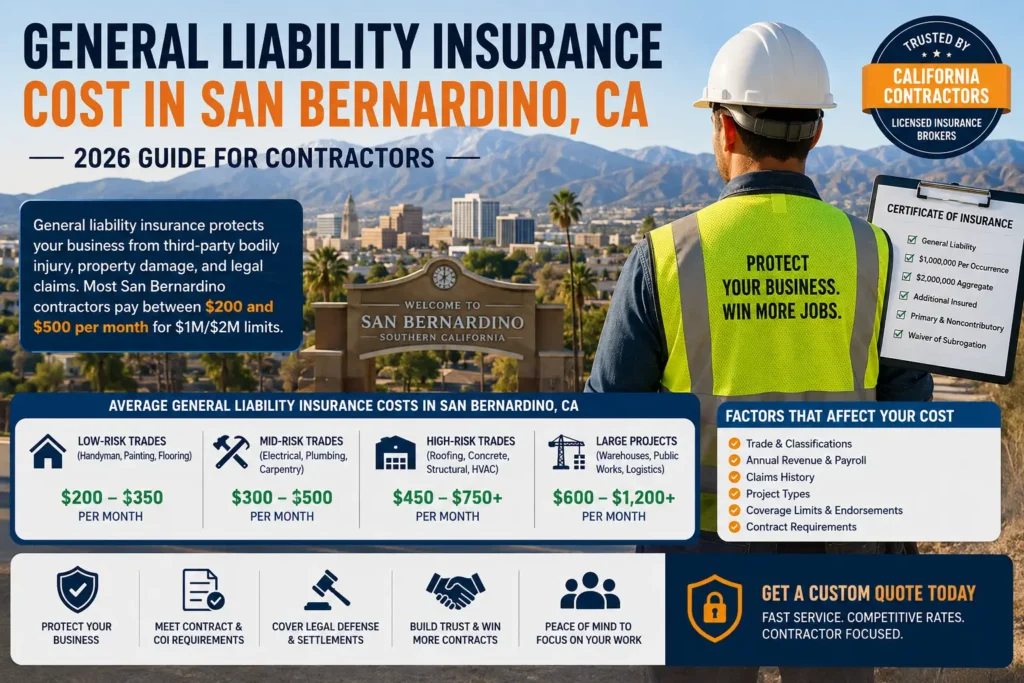
Most San Bernardino general contractors typically pay $200 to $500 per month ($2,400 to $6,000 per year) for a standard $1M per occurrence / $2M aggregate general liability policy, with roofers, structural trades, warehouse-build contractors, and contractors on Cajon Pass logistics or county facility projects often paying more. As ContractorsInsured.net (CA Lic #6015321), we shop multiple California-admitted carriers for San Bernardino contractors, quote the same business day, and issue the COI right after binding.
San Bernardino remains one of the Inland Empire’s largest construction and logistics markets. Contractors working near warehouse developments, public facilities, transportation corridors, and county government projects frequently face stricter insurance requirements than contractors focused solely on residential remodeling. While pricing is generally comparable to Riverside, exposure to freight operations, public works contracts, and vendor portal requirements can increase premiums. Understanding how carriers evaluate your trade classification, revenue, payroll, claims history, and contract requirements is essential when budgeting for coverage.
What general liability insurance covers
In brief: General liability insurance protects contractors against third-party bodily injury, third-party property damage, and personal and advertising injury claims. It is one of the most commonly required coverages for bids, permits, leases, vendor portals, and construction contracts.
General liability insurance is a third-party liability policy that responds to claims arising from a business’s operations, including bodily injury to non-employees, property damage to third parties, and personal and advertising injury. For contractors, it is the most commonly required coverage in contracts, leases, vendor portals, and city permit packets.
In San Bernardino, contractors often need proof of coverage before accessing job sites, obtaining permits, entering public works projects, or satisfying commercial landlord requirements. Whether you’re remodeling homes in Highland, performing tenant improvements in Redlands, or working on warehouse facilities near the I-10 and I-15 corridors, general liability coverage forms the foundation of your insurance program.
Scenario 1: Delivery driver injured at a warehouse project
A delivery driver visits a Fontana warehouse construction site and trips over unsecured materials. The driver suffers a broken ankle and files a claim for medical expenses and lost wages. General liability insurance may respond to covered bodily injury claims and legal defense costs.
Scenario 2: Property damage during a remodel
A plumbing contractor performing a residential remodel in Redlands accidentally cracks newly installed tile flooring while moving equipment. The homeowner seeks compensation for repairs. General liability insurance may respond to covered third-party property damage claims.
Scenario 3: Advertising injury claim
A subcontractor in Rialto uses a copyrighted job site photograph on marketing materials without authorization. The copyright owner files a claim. General liability policies often include personal and advertising injury protection for covered claims.
Scenario 4: Completed operations claim
A roofing contractor completes a project in Highland. Six months later, a leak causes interior water damage. Depending on the circumstances, completed operations coverage within the policy may respond to covered claims.
Scenario 5: Defense against a lawsuit
A general contractor in Colton is named in a lawsuit alleging defective work performed by a subcontractor. Even if allegations are ultimately unfounded, general liability insurance can help cover defense costs for covered claims.
Contractors seeking a broader understanding of coverage structures can review our guide to general liability insurance for contractors and explore how general contractors typically structure liability programs for California projects.
How much does general liability insurance cost in San Bernardino?
In brief: Most San Bernardino contractors can expect to pay between $200 and $500 per month for a standard $1 million/$2 million policy, although higher-risk trades and public works contractors often pay substantially more.
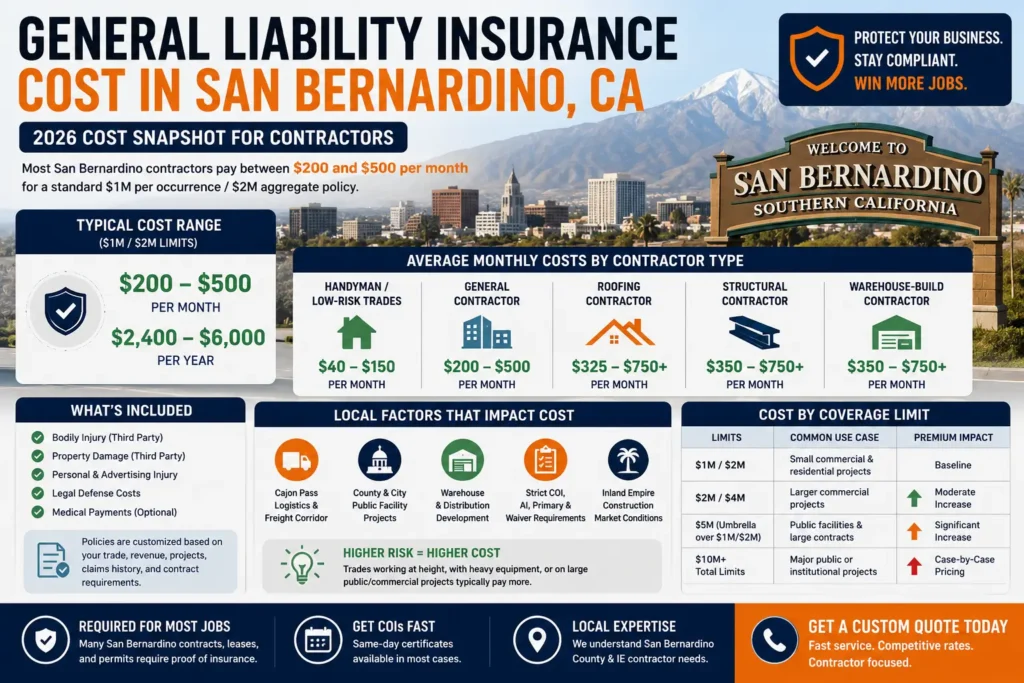
Most San Bernardino general contractors typically pay between $200 and $500 per month ($2,400 to $6,000 annually) for a standard $1 million per occurrence and $2 million aggregate general liability policy.
The Inland Empire construction market creates a unique pricing environment. While operating costs may be lower than coastal Southern California markets, warehouse construction, logistics facilities, transportation infrastructure, and public works projects frequently introduce additional underwriting considerations.
Typical San Bernardino contractor premium ranges
Contractor Type | Estimated Monthly Premium | Estimated Annual Premium |
Handyman / Low-risk trades | $40-$150 | $480-$1,800 |
General contractor | $200-$500 | $2,400-$6,000 |
Roofing contractor | $325-$750+ | $3,900-$9,000+ |
Structural contractor | $350-$750+ | $4,200-$9,000+ |
Warehouse-build contractor | $350-$750+ | $4,200-$9,000+ |
These ranges are estimates. Actual premiums vary based on payroll, subcontractor usage, revenue, claims history, coverage limits, project type, and contract requirements.
Why pricing differs from online insurance estimates
Many national insurance aggregators publish broad statewide averages that do not fully reflect Inland Empire project realities. A San Bernardino contractor bidding county facility work, logistics facilities, educational projects, or public infrastructure often faces different insurance requirements than a small residential contractor working exclusively on owner-occupied homes.
That difference is why many contractors compare general liability insurance cost in Riverside with local San Bernardino pricing before selecting coverage.
Common contract requirements affecting premiums
San Bernardino contractors frequently encounter requests for:
- Additional Insured endorsements
- Primary and Noncontributory wording
- Waiver of Subrogation endorsements
- Higher aggregate limits
- Completed operations coverage
- Specific certificate wording
- Vendor portal compliance requirements
Each requirement can influence underwriting and premium calculations.
Why contractor GL pricing reflects Inland Empire warehouse and public-facility reality in San Bernardino
In brief: The combination of logistics infrastructure, warehouse development, county government projects, transportation corridors, and public works activity creates a unique risk profile that carriers factor into pricing.
San Bernardino sits at the center of one of the nation’s most important logistics and transportation regions. The city serves as a gateway between Southern California ports and inland distribution networks through the I-10, I-15, and I-215 corridors.
Contractors working in and around:
- Cajon Pass freight corridors
- Distribution centers
- Warehouse developments
- County government facilities
- Educational campuses
- Public works projects
- Airport-related developments
often face insurance requirements that exceed those of typical residential projects.
Large warehouse facilities involve substantial subcontractor coordination, equipment exposure, and schedule pressure. Public works projects frequently require detailed insurance specifications and strict certificate compliance.
“In 15+ years writing California contractor GL, the most common reason I see San Bernardino warehouse and public-facility COIs get rejected isn’t the policy, it’s a missing or mismatched Additional Insured plus Primary Noncontributory endorsement behind the wording. Read the schedule before you bind.”
Pascal Burke, Licensed Insurance Broker (CA #6015321, TX #3305690)
Carriers recognize that contractors operating in these environments may encounter more contractual risk, larger project values, and increased third-party exposure. As a result, underwriting becomes more detailed and pricing can increase compared with similar contractors focused solely on residential remodeling.
Additional factors unique to the Inland Empire include:
- High volume freight traffic
- Multi-employer job sites
- Warehouse expansion projects
- Public agency procurement requirements
- Vendor portal compliance standards
- Regional economic growth driving construction demand
For contractors bidding larger projects, understanding California contractor GL requirements before obtaining quotes can prevent costly delays and rejected certificates.
Cost by coverage limit
In brief: Higher limits provide additional protection but increase premiums. Larger commercial projects, logistics facilities, and public works contracts often require limits beyond the standard $1M/$2M policy.
Most small contractors begin with a $1 million per occurrence and $2 million aggregate policy. However, many commercial clients, municipalities, and logistics operators require higher limits.
Coverage Limits | Typical Use Case | Estimated Premium Impact |
$1M / $2M | Small commercial and residential projects | Baseline |
$2M / $4M | Larger commercial projects | Moderate increase |
$5M Combined via umbrella | Public facilities and large contracts | Significant increase |
$10M+ Total limits | Major public or institutional projects | Case-by-case pricing |
Contractors working with county agencies, public facilities, healthcare institutions, and large warehouse operators frequently encounter higher limit requirements during the bidding process.
The 7 factors carriers use to price your policy
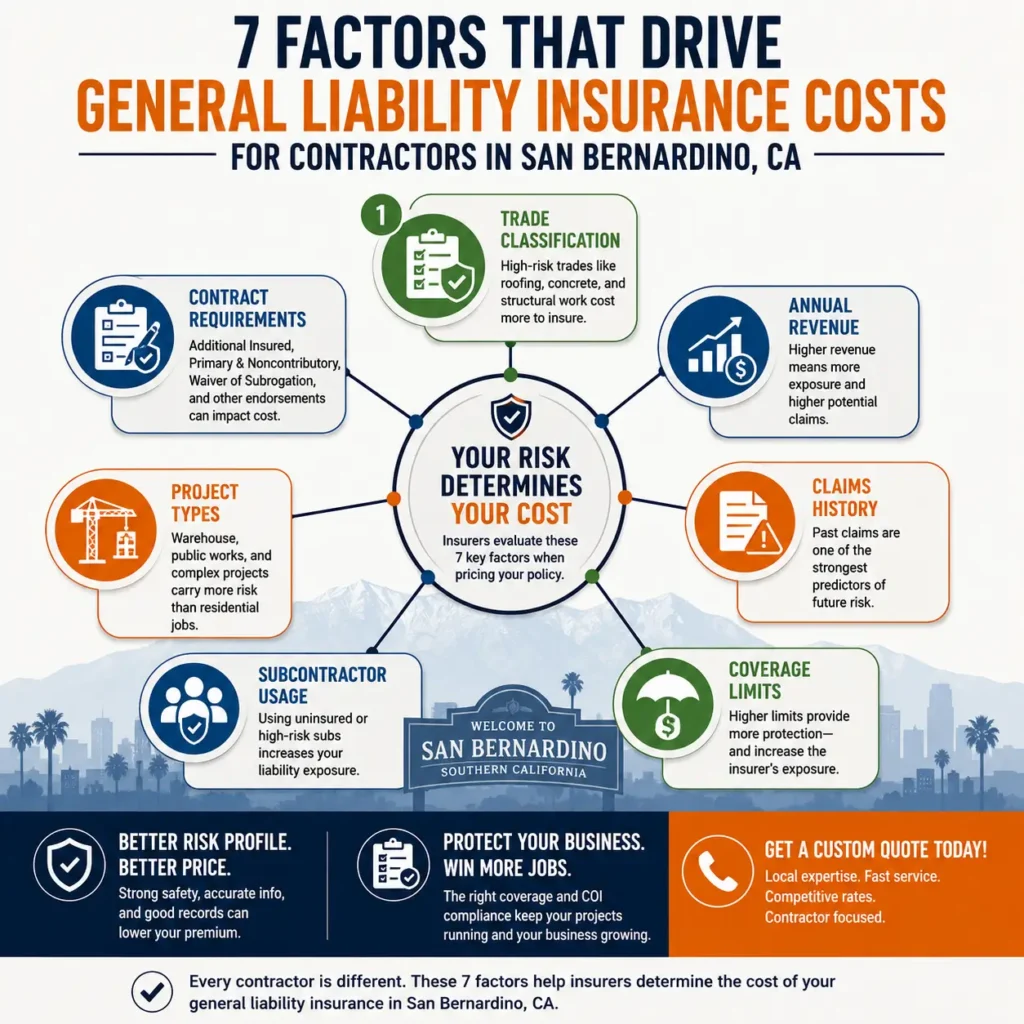
In brief: Insurers evaluate risk based on your trade, revenue, claims history, project types, subcontractor usage, coverage limits, and contract requirements. These variables matter more than company size alone.
Every contractor wants to know why one business pays $2,500 annually while another pays $8,000 or more for similar limits. The answer usually comes down to seven underwriting factors.
Pricing Factor | Impact on Premium | Why It Matters |
Trade Classification | High | Roofing, structural, and concrete work carry greater risk than painting or handyman services |
Annual Revenue | High | More revenue generally means more project exposure |
Claims History | High | Prior claims often increase premiums |
Coverage Limits | Medium-High | Higher limits create greater insurer exposure |
Subcontractor Usage | Medium-High | Uninsured subcontractors create additional risk |
Project Types | Medium | Public works and warehouse projects may increase costs |
Contract Requirements | Medium | Additional endorsements can affect pricing |
1. Trade classification
A handyman, painter, or flooring contractor generally presents lower liability exposure than a roofer, structural steel contractor, or excavation company. The higher the potential for costly third-party claims, the higher the premium.
2. Revenue
Revenue helps insurers estimate how much work your company performs annually. A contractor generating $5 million in annual sales typically presents more exposure than a contractor generating $250,000.
3. Claims history
Previous liability claims remain one of the strongest indicators carriers use when evaluating risk. Multiple losses often result in higher premiums or reduced carrier options.
4. Coverage limits
Higher limits provide more protection but also increase insurer exposure. Contractors pursuing larger commercial projects frequently need limits beyond the standard $1M/$2M policy.
5. Subcontractor management
Using uninsured subcontractors can significantly increase risk. Many carriers require proof that subcontractors maintain their own liability coverage.
6. Project type
Warehouse developments, logistics facilities, healthcare projects, educational facilities, and public infrastructure often carry greater underwriting scrutiny than residential remodeling.
7. Contract requirements
Projects requiring Additional Insured endorsements, Primary and Noncontributory wording, or Waiver of Subrogation endorsements can affect both underwriting and pricing.
San Bernardino contract, lease, and COI requirements
In brief: Many Inland Empire project owners require more than basic liability coverage. Contractors should review insurance requirements before bidding or signing contracts.
Commercial landlords, logistics operators, public agencies, and large property owners frequently require proof of insurance before allowing contractors on-site.
Common requirements include:
- $1 million per occurrence limits
- $2 million aggregate limits
- Additional Insured endorsement
- Primary and Noncontributory wording
- Waiver of Subrogation endorsement
- Completed operations coverage
- Certificate of Insurance submission
Contractors pursuing county projects, public works work, or logistics-facility contracts often face especially detailed insurance requirements.
Reviewing Certificate of Insurance basics before submitting project documentation can help avoid rejected certificates and project delays.
Likewise, understanding Additional Insured endorsement requirements and Waiver of Subrogation provisions is critical when working with municipalities, warehouse operators, and institutional clients.
Typical contract requirement comparison
Requirement | Residential Remodel | Commercial Project | Public Works Project |
General Liability | Yes | Yes | Yes |
Additional Insured | Sometimes | Common | Very Common |
Primary & Noncontributory | Rare | Common | Very Common |
Waiver of Subrogation | Rare | Common | Common |
Higher Limits | Rare | Sometimes | Frequently |
What general liability does NOT cover
In brief: General liability is essential coverage, but it does not protect against every type of contractor loss.
Many contractors mistakenly assume GL insurance covers all business-related incidents. In reality, several important gaps require separate policies.
General liability typically does not cover:
- Employee injuries
- Damage to your own tools
- Commercial vehicles
- Professional design errors
- Intentional acts
- Workers’ compensation claims
- Certain pollution-related claims
Common coverage gaps
Exposure | Usually Covered by |
Employee injury | Workers’ Compensation |
Work trucks | Commercial Auto |
Stolen tools | Inland Marine |
Design errors | Professional Liability |
Excess catastrophic losses | Umbrella Insurance |
Contractors should view liability coverage as one piece of a broader risk-management strategy rather than a complete insurance solution.
How San Bernardino contractors can lower GL costs without creating coverage gaps
In brief: The best way to reduce premiums is improving risk quality, not reducing coverage limits.
Contractors can often lower premiums while maintaining protection by focusing on operational controls.
Recommended strategies include:
- Maintain a clean claims history.
- Verify subcontractor insurance before work begins.
- Implement documented safety programs.
- Review project contracts before bidding.
- Bundle policies when appropriate.
- Avoid unnecessary classifications.
- Keep payroll and revenue records accurate.
Contractors pursuing warehouse developments, public facilities, and municipal projects should review insurance specifications early in the bidding process. Discovering endorsement requirements after binding coverage often creates unnecessary expenses.
Cost-saving opportunities
Strategy | Potential Benefit |
Strong safety procedures | Lower underwriting concerns |
Accurate classifications | Avoid overpaying |
Clean claims record | Better carrier options |
Subcontractor compliance | Reduced exposure |
Annual policy review | Improved pricing opportunities |
What to prepare before requesting a quote
In brief: Contractors who provide complete information receive faster quotes, more accurate pricing, and fewer underwriting delays.
Before requesting quotes, gather the following information.
“In 15+ years working with California contractors, the fastest way to improve quote accuracy is providing complete revenue breakdowns and project details upfront. Underwriters can price a risk more confidently when they understand exactly what work you perform and where you perform it.”
Pascal Burke, Licensed Insurance Broker (CA #6015321, TX #3305690)
Contractor quote checklist
Information Needed | Why It Matters |
Legal business name | Policy issuance |
CSLB license number | Carrier verification |
Annual revenue | Pricing calculation |
Payroll information | Risk assessment |
Trade classification | Underwriting |
Claims history | Carrier eligibility |
Project size range | Exposure evaluation |
Warehouse / county facility vendor portal? Y/N | Contract compliance review |
Desired limits | Policy structure |
Certificate requirements | Endorsement selection |
Having these details ready often shortens turnaround time and improves quote accuracy.
Frequently asked questions about contractor general liability in San Bernardino
How much does general liability insurance cost for a San Bernardino contractor in 2026?
Most San Bernardino general contractors pay between $200 and $500 per month for a standard $1 million/$2 million general liability policy. These are estimated ranges rather than measured market averages, and an individual quote can fall outside them. Lower-risk trades such as handymen often pay less, while roofers, structural trades, warehouse-build contractors, and public works contractors often pay significantly more depending on exposure, revenue, claims history, and contract requirements.
Is general liability insurance legally required by California for a San Bernardino contractor?
California does not universally require general liability insurance for every contractor, but a contractor licensed as an LLC must carry it as a condition of licensure: Business and Professions Code section 7071.19 sets a $1 million aggregate minimum for five or fewer personnel of record, adding $100,000 for each additional person up to a $5 million cap. Beyond that, many project owners, landlords, municipalities, lenders, and commercial clients require proof of coverage before work can begin. In practice, many contractors carry liability insurance because contracts and bid opportunities often require it.
What GL limits do San Bernardino County and city public-facility contracts typically require?
Requirements vary by agency and by project, and the $1 million per occurrence and $2 million aggregate figure is a floor rather than a typical ceiling. San Bernardino County’s basic contract requirement is $1 million per occurrence and $2 million aggregate, but its construction addendum requires at least $3 million on projects over $1 million, at least $5 million on projects over $3 million, and at least $10 million on projects over $5 million, plus $5 million in continuing products and completed operations coverage for at least three years on projects over $1 million. The City of San Bernardino’s published purchase order terms require $2 million per occurrence and a $4 million annual aggregate, with defense costs outside the limits. Larger projects may also require umbrella coverage, Additional Insured status, Primary and Noncontributory wording, and Waiver of Subrogation endorsements. Always price from the actual solicitation and contract specifications.
How does Cajon Pass freight corridor or warehouse work affect a San Bernardino contractor's GL premium?
Warehouse and logistics projects often involve larger project values, more subcontractors, higher traffic volumes, and stricter contract requirements. These factors can increase underwriting scrutiny and may contribute to higher premiums compared with similar contractors focused solely on residential work.
Can a San Bernardino contractor get a same-day COI for a county facility or warehouse vendor portal?
In many cases, yes. Contractors with active policies and standard endorsement requirements can often obtain certificates quickly. More complex requirements involving custom wording, additional insured schedules, or public agency specifications may require additional review before issuance.
Does general liability cover damage I cause to my own work in San Bernardino?
Generally, liability insurance is designed to cover third-party claims rather than paying to redo your own defective work. Standard ISO CG 00 01 language is more specific than that: the completed operations form of the your-work exclusion carries an exception when the damaged work, or the work that caused the damage, was performed on your behalf by a subcontractor, and an endorsement can remove that exception. Coverage outcomes depend on the specific facts of the claim, the form, and the endorsements on your policy. Contractors should review exclusions and completed operations provisions carefully with their broker.
How does CSLB workers' comp compliance interact with general liability for San Bernardino contractors?
Workers’ compensation and general liability serve different purposes. Workers’ compensation responds to employee injuries, while general liability addresses covered third-party claims. On the licensing side the dates matter: C-8, C-20, C-22, C-39 and C-61/D-49 licensees must carry workers’ compensation whether or not they have employees, while other licensees may still file the no-employee exemption through December 31, 2027. SB 1455 moved the universal CSLB workers’ compensation requirement to January 1, 2028. Contractors often need both coverages to satisfy licensing, contractual, and risk-management requirements.
What information speeds up a San Bernardino contractor GL quote?
Providing your business name, CSLB license number, revenue, payroll, trade classification, claims history, project types, and insurance requirements upfront helps carriers evaluate your risk more efficiently and produce more accurate quotes.
Why is contractor GL in San Bernardino often priced similarly to Riverside but differently than the LA basin?
San Bernardino and Riverside share many Inland Empire market characteristics, including logistics, warehouse development, and public works activity. Los Angeles often presents different exposure profiles, higher operating costs, denser urban environments, and larger project concentrations, which can influence pricing.
Get a San Bernardino general liability quote
Whether you’re bidding warehouse developments, public works projects, tenant improvements, healthcare facilities, educational projects, or residential construction work, having the right liability coverage is essential.
Our team works with California contractors across San Bernardino, Redlands, Rialto, Fontana, Highland, Colton, Loma Linda, and the broader Inland Empire to help secure compliant coverage, competitive pricing, and fast certificate issuance.
Disclaimer
This article is provided for educational and informational purposes only and should not be interpreted as legal, tax, insurance, or risk-management advice. Coverage terms, underwriting requirements, endorsements, and premiums vary by carrier and applicant. Always review policy language and consult a licensed insurance professional regarding your specific situation.
These are San Bernardino figures. Across trades and states, see general liability insurance cost benchmarks.