
Most Riverside general contractors typically pay $200 to $500 per month ($2,400 to $6,000 per year) for a standard $1M per occurrence / $2M aggregate general liability policy, with roofers, structural trades, warehouse-build contractors, and contractors on Inland Empire logistics or tract-housing projects often paying more. Riverside pricing is shaped by California contractor rules, Inland Empire warehouse exposure, tract-housing pace, subcontractor use, payroll, completed-operations risk, and the insurance wording required by developers, municipalities, logistics operators, and property managers. A small handyman may pay far less than a general contractor managing crews near Moreno Valley, Corona, Jurupa Valley, Eastvale, Perris, or the I-15 / I-215 corridor. The fastest way to control cost is to quote with the right trade class, accurate payroll, clean job descriptions, and the exact COI wording before binding. As ContractorsInsured.net (CA Lic #6015321), we shop multiple California-admitted carriers for Riverside contractors, quote the same business day, and issue the COI right after binding.
What general liability insurance covers
General liability insurance is a third-party liability policy that responds to claims arising from a business’s operations, including bodily injury to non-employees, property damage to third parties, and personal and advertising injury. For contractors, it is the most commonly required coverage in contracts, leases, vendor portals, and city permit packets.
A Commercial General Liability policy is the standard liability form used to insure many businesses, according to the California Department of Insurance’s Commercial Insurance Guide. For contractors, it is usually the coverage that lets you submit a bid, satisfy a lease, enter a jobsite, issue a COI, or prove that a third-party claim has a defense mechanism behind it.
In brief: General liability covers third-party bodily injury, third-party property damage, personal and advertising injury, and defense costs, but it does not replace workers’ comp, commercial auto, surety bonds, or professional liability.
Scenario card 1: Moreno Valley warehouse injury
A delivery driver walks through a Riverside-area warehouse buildout in Moreno Valley, trips over temporary material staging, and breaks an ankle. A GL policy may respond to the bodily injury claim if your business operations are alleged to have caused the injury.
Scenario card 2: Corona remodel property damage
A plumbing crew on a Corona remodel cracks a homeowner’s tile floor while moving equipment through a hallway. General liability may respond to third-party property damage, subject to policy terms, exclusions, and deductibles.
Scenario card 3: Eastvale advertising injury
An Eastvale subcontractor posts a copyrighted jobsite photo in a marketing update without permission. Depending on the policy and facts, personal and advertising injury coverage may be relevant.
Scenario card 4: Norco completed operations leak
A Norco roofing crew finishes a project. Six months later, a leak causes interior water damage. Completed operations coverage can matter because the claim arises after the work is complete.
Scenario card 5: Jurupa Valley subcontractor lawsuit
A Jurupa Valley general contractor is named in a lawsuit over a subcontractor’s work. GL can help pay defense costs, which may be one of the most important benefits even before liability is decided.
For a deeper contractor-specific explanation, see our complete contractor general liability guide.
How much does general liability insurance cost in Riverside?
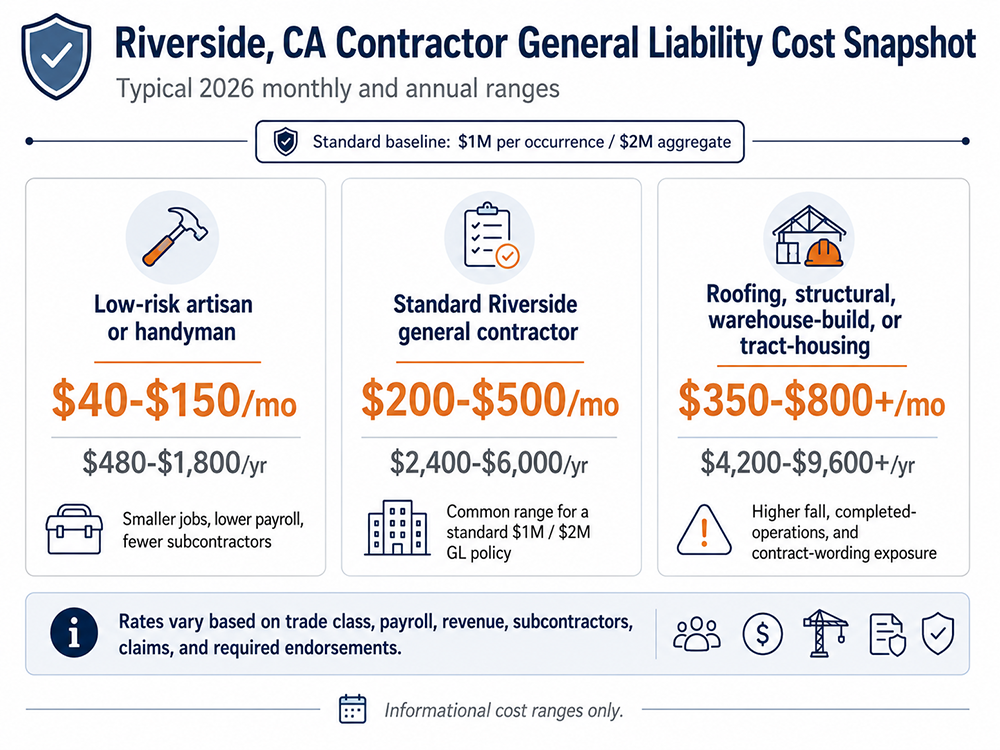
Most Riverside general contractors typically pay $200 to $500 per month, or $2,400 to $6,000 per year, for a standard $1M per occurrence / $2M aggregate general liability policy.
In brief: Riverside GL cost is usually slightly lower than many coastal California metros, but warehouse, logistics, roofing, structural, and tract-housing exposure can push premiums above the baseline.
Riverside contractors do not all price the same. A solo finish carpenter working low-risk residential jobs in Canyon Crest can look very different to an underwriter than a general contractor coordinating multiple trades on warehouse tenant improvements near the 91 freeway or a roofing contractor working in Norco, Perris, and Eastvale.
Unlike carrier and aggregator cost pages that average all small businesses together, this guide is built around Riverside contractor exposure, including California licensing context, COIs, additional insured language, public works packets, logistics operators, and high-volume tract-housing jobs.
| Riverside contractor profile | Typical monthly GL range | Typical annual GL range | Riverside pricing notes |
|---|---|---|---|
| Low-risk artisan or handyman | $40 to $150 | $480 to $1,800 | Smaller jobs, lower payroll, fewer subcontractors, limited completed-operations exposure |
| Standard Riverside general contractor | $200 to $500 | $2,400 to $6,000 | Common range for $1M/$2M limits when operations, payroll, and subcontractor controls are clean |
| Roofing, structural, warehouse-build, or tract-housing contractor | $350 to $800+ | $4,200 to $9,600+ | Higher fall, completed-operations, jobsite, and contract-wording exposure |
| Multi-crew GC with logistics or public works contracts | $500 to $1,200+ | $6,000 to $14,400+ | Higher revenue, additional insured schedules, waiver wording, and possible umbrella requirements |
| Riverside monthly versus annual GL planning | Often custom quoted | Often custom quoted | Coverage structure, endorsements, umbrella requirements, and project-specific contractual obligations |
Riverside Monthly Versus Annual GL Planning
| Budget view | Low-risk contractor | Standard GC | Higher-risk trade or logistics exposure |
|---|---|---|---|
| Monthly planning number | $40 to $150 | $200 to $500 | $350 to $800+ |
| Annual planning number | $480 to $1,800 | $2,400 to $6,000 | $4,200 to $9,600+ |
| Best use of range | Early budgeting | Bid planning and COI readiness | Contract review and underwriter submission |
| What can move the quote | Trade class, payroll, revenue | Subcontractors, claims, job type | Roofing, structural work, warehouse builds, tract housing, required endorsements |
If you work across Southern California, pricing may also differ from the general liability insurance cost in Los Angeles because Los Angeles basin rating, litigation, traffic, jobsite density, and contract requirements can differ from Riverside and Inland Empire work.
Why contractor GL pricing reflects Inland Empire logistics + housing growth
Riverside pricing reflects a mix of lower inland operating costs and higher project exposure tied to logistics, warehouses, infrastructure, housing growth, and corridor-based construction.
In brief: Inland Empire logistics and tract-housing growth can make Riverside GL pricing more sensitive to subcontractor controls, completed operations, additional insured language, and jobsite safety.
Riverside is not just an inland residential market. It is part of the Inland Empire’s logistics, warehousing, transportation, military-adjacent, university, healthcare, and housing-growth economy. Contractors may work near March Air Reserve Base, UC Riverside, Riverside Municipal Airport, downtown Riverside, La Sierra, Canyon Crest, Moreno Valley, Corona, Norco, Jurupa Valley, Eastvale, Perris, Hemet, Lake Elsinore, Temecula, Murrieta, and the San Bernardino County edge.
Warehouse and logistics projects often involve more certificate review, site access rules, delivery traffic, higher-value property, and tight operator requirements. Tract-housing projects often involve repeated work, multiple subcontractors, high completed-operations exposure, and developer-specific endorsement wording.
Cal/OSHA notes that construction employers in California must comply with applicable safety regulations and guidance through the state’s construction employer guidance. OSHA also describes construction as a high-hazard industry with exposures such as falls, heavy equipment, electrocution, silica, and asbestos in its construction safety overview.
“In 15+ years writing California contractor GL, the #1 reason Inland Empire logistics-warehouse and housing-tract COIs get rejected isn’t the policy, it’s missing the developer’s or operator’s exact Additional Insured + Primary Noncontributory wording. Read the schedule before you bind.”
Pascal Burke, Licensed Insurance Broker (CA #6015321, TX #3305690)
The zero-click search environment also rewards concise, source-backed answers. Pew Research found that users who saw an AI summary clicked traditional search results less often than users who did not see one, according to its AI summary click analysis. That is why this guide uses short, quotable cost answers supported by detailed contractor context.
Cost by coverage limit
A standard $1M per occurrence / $2M aggregate GL policy is the baseline for many Riverside contractors, while logistics operators, tract-housing developers, public agencies, and larger commercial clients may require $2M/$4M limits or $5M+ total limits with umbrella or excess liability.
In brief: The cheapest policy is not always the right policy. Riverside contractors should price the limit required by the contract, not just the lowest premium available.
| Coverage structure | Typical Riverside use case | Premium impact | Notes |
|---|---|---|---|
| $1M occurrence / $2M aggregate | Standard residential and light commercial contractor GL | Baseline | Common starting point for many Riverside contractors |
| $2M occurrence / $4M aggregate | Larger GC work, logistics operators, tract-housing contracts, higher-value commercial sites | Moderate increase | May be required by contract or vendor portal |
| $1M/$2M plus $1M umbrella | Contracts needing higher total limits without changing the GL form alone | Moderate to significant increase | Often used when client requires more protection |
| $1M/$2M plus $5M umbrella or excess | Large warehouse, public works, institutional, or developer-controlled projects | Significant increase | Underwriter will review operations, payroll, autos, claims, and subcontractors carefully |
The City of Riverside has used public works and contract language requiring contractor commercial general liability coverage with bodily injury, property damage, premises operations, products-completed operations, independent contractor’s liability, personal injury, and contractual liability, including $1,000,000 per occurrence and $2,000,000 aggregate language in a city contract record. Contractors should review the actual current packet, but the city example shows why City of Riverside insurance language matters before you quote.
If you need help matching limits to bid language, review GL cost factors and limits before choosing the lowest premium.
The 7 factors carriers use to price your policy
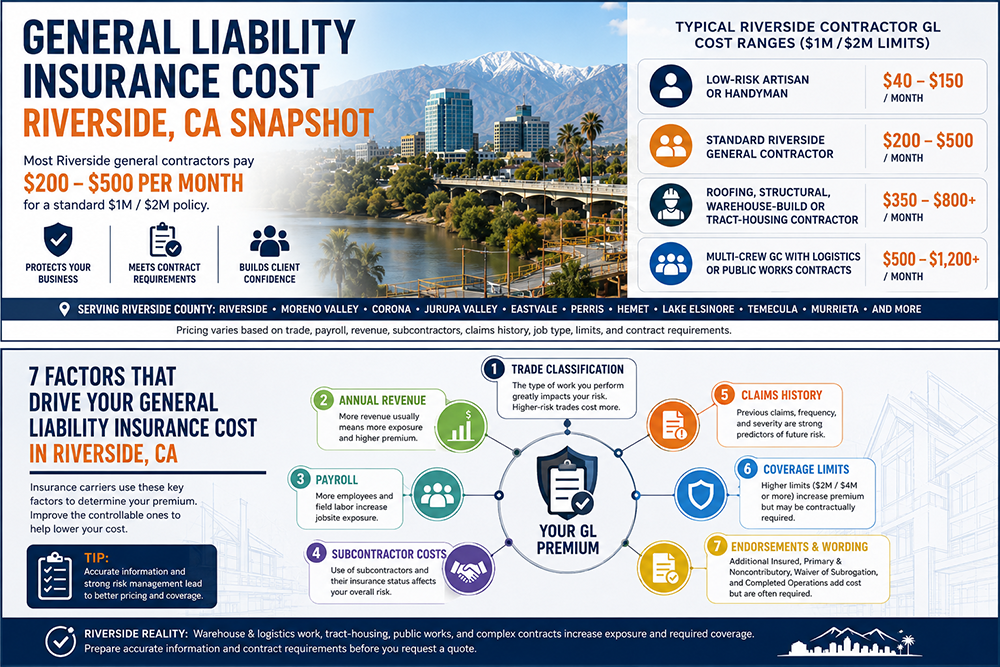
A Riverside contractor’s final GL price can move by hundreds of dollars per month based on trade classification, payroll, revenue, subcontractor use, claims, limits, and contract wording.
In brief: Underwriters price the probability and severity of third-party claims, then adjust for Riverside job type, project size, safety controls, and COI requirements.
| Pricing factor | What the carrier reviews | Riverside example |
|---|---|---|
| Trade classification | The type of work you perform | Roofing, framing, concrete, grading, and structural work usually rate higher than finish trades |
| Annual revenue | Gross receipts and project volume | A GC handling multiple Moreno Valley warehouse TI projects may price higher than a small remodeler |
| Payroll | Employee exposure and field activity | More field labor usually means more jobsite exposure |
| Subcontractor costs | Whether subs carry their own GL and name you correctly | Missing sub COIs can push your pricing or create coverage problems |
| Claims history | Prior GL claims, open disputes, and severity | Water intrusion, trip-and-fall, and property damage claims can affect eligibility |
| Coverage limits | $1M/$2M versus higher limits | Developer and logistics contracts may require $2M/$4M or umbrella |
| Endorsements and wording | Additional insured, primary noncontributory, waiver, completed operations | Vendor portals often reject incomplete wording, even when limits look correct |
Riverside contractors bidding near San Bernardino County should also compare local Inland Empire pricing and contract conditions with the general liability insurance cost in San Bernardino once that sibling guide is published.
Riverside contract, lease, and COI requirements
Riverside contractors often need GL not because state law universally mandates it for every job, but because contracts, leases, permits, public works packets, vendor portals, and project owners require proof before work starts.
In brief: In Riverside, COI details can be just as important as the premium. A policy that cannot satisfy the certificate and endorsement language may delay a job.
California contractor insurance compliance starts with knowing which coverage is legally required and which coverage is contractually required. CSLB states that failure to maintain required workers’ compensation coverage can result in license suspension, according to its workers’ compensation requirements. That is separate from general liability, but both are frequently reviewed together in contractor packets.
The City of Riverside public works permit materials require applicants to upload items such as state licensing, scope information, traffic control materials, authorization to sign, and insurance documentation. Riverside contractors working in public right-of-way, street, utility, or permit settings should review the current construction permit insurance requirements before assuming a standard COI is enough.
Riverside County purchasing materials also show how vendor insurance is handled in procurement. The county vendor handbook says bidders must submit evidence of required insurance listed in the solicitation, including a current COI or a signed statement acknowledging the requirements, according to the county’s vendor insurance requirements.
Common Riverside COI requirements include:
Certificate holder name and address exactly as listed.
Additional insured status for the owner, developer, municipality, landlord, or logistics operator.
Primary and noncontributory wording when required.
Completed operations additional insured coverage when the contract requires it.
Waiver of subrogation where required by contract.
Specific limits, often $1M/$2M, $2M/$4M, or higher with umbrella.
Thirty-day notice wording or cancellation language when required and available.
Existing clients who need proof quickly can use Certificate of Insurance basics or request a same-day COI when the policy and endorsements already support the request.
What general liability does NOT cover
General liability does not cover every risk a Riverside contractor faces, and using it as a substitute for other policies can create expensive coverage gaps.
In brief: GL is third-party liability coverage, not a full contractor insurance program.
General liability usually does not cover:
Employee injuries. Workers’ compensation responds to employee injuries when required.
Your business vehicles. Commercial auto is needed for owned, hired, and non-owned vehicle exposure.
Your tools and equipment. Inland marine or contractor’s equipment coverage is usually needed.
Faulty workmanship itself. GL may respond to resulting third-party damage, but not necessarily the cost to redo your own defective work.
Professional design errors. Professional liability or contractor E&O may be needed for design, consulting, or specification exposure.
Surety bond obligations. Bonds are not insurance for your negligence. SBA explains that surety bonds help small businesses win contracts by guaranteeing completion in its surety bond overview.
Intentional acts, fraud, or known losses. Insurance is not designed to cover intentional harm or claims known before coverage begins.
If your Riverside project packet asks for hold harmless wording, owner protection, or specific additional insured language, the Additional Insured endorsement and Waiver of Subrogation requirements should be reviewed before the job starts.
For broader California placement context, see general liability insurance for California contractors.
How Riverside contractors can lower GL costs without creating coverage gaps
Riverside contractors can often reduce GL cost by cleaning up underwriting information, tightening subcontractor controls, selecting accurate classifications, and quoting before a contract deadline creates urgency.
In brief: Lowering premium should not mean stripping out the endorsements needed to pass a Riverside COI review.
Use the right trade classification. Do not describe roofing, structural, grading, or warehouse work as generic handyman work just to chase a lower quote. Misclassification can cause quote changes or claim problems.
Separate low-risk and high-risk operations. A contractor doing both finish carpentry and structural framing should make the scope clear.
Keep subcontractor COIs current. Require subs to carry GL, list your company correctly, and provide endorsements when needed.
Control completed-operations exposure. Keep contracts, job photos, change orders, warranty records, and closeout documentation organized.
Review vendor portals before binding. Logistics operators, public agencies, and tract-housing developers may need specific wording.
Bundle only when it helps. GL, workers’ comp, commercial auto, tools, and umbrella coverage may be coordinated, but each policy must still fit the job.
Avoid last-minute certificate requests. The tighter the deadline, the harder it is to fix wording, exclusions, or missing endorsements.
Build a clean claims narrative. If you had a prior claim, explain what happened, what changed, and what controls are now in place.
Contractors that bid larger residential or commercial jobs can also review California contractor GL requirements before finalizing limits and endorsements.
What to prepare before requesting a quote
Most Riverside contractors can speed up a GL quote by preparing license details, revenue, payroll, trade description, subcontractor costs, prior coverage, claims history, and any contract or COI wording before the submission goes to market.
In brief: A complete quote packet reduces back-and-forth, prevents wrong classifications, and helps avoid COI rejection after purchase.
| Quote item | What to prepare | Why it matters |
|---|---|---|
| Legal business name | Entity name, DBA, mailing address | Must match policy and COI |
| CSLB license number | Active license, classification, qualifier details | Helps confirm California contractor status |
| Trade description | What you do and do not do | Drives classification and eligibility |
| Annual revenue | Projected gross receipts | Major premium rating factor |
| Payroll | Employee payroll by trade | Helps price field exposure |
| Subcontractor cost | Annual subcontracted work and COI controls | Affects GC and subcontractor exposure |
| Prior insurance | Current carrier, limits, premium, expiration | Helps avoid lapses and compare options |
| Claims history | Date, type, amount, status | Carriers need accurate loss information |
| Job geography | Riverside, Moreno Valley, Corona, Eastvale, Perris, Temecula, Murrieta, IE corridor | Helps underwriter understand territory |
| Contract wording | COI, Additional Insured, Primary Noncontributory, Waiver of Subrogation | Determines whether the policy can satisfy the packet |
| Logistics / warehouse vendor portal? Y/N | Upload requirements, certificate wording, sample endorsement requests | Prevents last-minute rejections |
| Tract-housing or developer work? Y/N | Developer name, scope, limits, completed operations wording | Helps price higher-volume completed-operations exposure |
The SBA explains that business insurance can protect against financial loss from bodily injury, property damage, medical expenses, libel, slander, lawsuits, and judgments in its business insurance overview. That general concept is useful, but Riverside contractors still need a contractor-specific submission because trade risk, subcontractors, and contract wording heavily affect pricing.
“Before you ask for the cheapest Riverside GL quote, send the contract insurance page, your CSLB license number, estimated payroll, subcontractor spend, and the exact COI wording. The right first submission often saves more time than shopping five incomplete quotes.”
Pascal Burke, Licensed Insurance Broker (CA #6015321, TX #3305690)
For trade-specific support, Riverside general contractors can start with our trade page before requesting coverage.
Frequently asked questions about general liability insurance cost in Riverside CA
In brief: These answers summarize the Riverside GL cost, compliance, and COI issues contractors ask most often before buying or renewing coverage.
How much does general liability insurance cost for a Riverside contractor in 2026?
Most Riverside general contractors typically pay $200 to $500 per month, or $2,400 to $6,000 per year, for a standard $1M per occurrence / $2M aggregate general liability policy. Smaller low-risk contractors can pay less, while roofers, structural trades, warehouse-build contractors, and contractors on Inland Empire logistics or tract-housing projects often pay $350 to $800+ per month. Final pricing depends on trade class, payroll, revenue, subcontractors, claims, and required endorsements.
Is general liability insurance legally required by California for a Riverside contractor?
California does not impose a general liability requirement on every licensed contractor, but there is an important exception. Under Business and Professions Code section 7071.19, a contractor licensed as a limited liability company must maintain liability insurance of at least $1,000,000 in aggregate for five or fewer persons on its personnel of record, plus $100,000 for each additional person, up to a maximum of $5,000,000. A licence can be suspended by operation of law if that aggregate limit is not reinstated for the next designated period. Riverside contractors are also required to carry GL by many contracts, landlords, public works packets, developers, logistics operators, and vendor portals. CSLB workers’ compensation rules are separate, and required workers’ comp must be maintained continuously. For practical purposes, many Riverside contractors need GL because they cannot bid, pull certain permits, access jobsites, or issue acceptable COIs without it.
What GL limits do Riverside County logistics and warehouse contracts typically require?
For a City of Riverside Public Works construction or street opening permit, the City’s current insurance requirements list $1,000,000 per occurrence and $2,000,000 aggregate general liability, a current City business tax certificate, a specific endorsement naming the City of Riverside as additional insured, and a workers’ compensation waiver of subrogation. Private logistics operators, warehouse owners, public agencies, and larger commercial clients may require $2M/$4M limits or umbrella coverage for $5M+ total limits. The exact requirement depends on the contract, site owner, certificate holder, additional insured wording, primary and noncontributory wording, waiver wording, and completed-operations language. Confirm the current permit or contract insurance schedule and send it to your broker before binding coverage.
How does Inland Empire warehouse construction affect a Riverside contractor's GL premium?
Warehouse and logistics construction can increase GL pricing because it may involve higher-value property, multiple trades, active delivery yards, heavy equipment, tenant improvements, strict site access rules, and detailed vendor insurance schedules. A contractor doing small residential work in Riverside may price differently than a contractor handling warehouse buildouts near Moreno Valley, Perris, Eastvale, or the I-215 corridor. Underwriters look at the job type, subcontractor controls, completed-operations exposure, and contract wording.
How does CSLB workers' comp compliance interact with general liability for Riverside contractors?
Workers’ compensation and general liability cover different risks, but Riverside contractors are often asked for both in the same insurance packet. Workers’ comp addresses employee injuries when required, while GL responds to third-party bodily injury, property damage, and personal and advertising injury claims. Contractors holding a C-8 Concrete, C-20 Warm-Air Heating, Ventilating and Air-Conditioning, C-22 Asbestos Abatement, C-39 Roofing, or C-61/D-49 Tree Service classification must carry workers’ compensation or a valid Certification of Self-Insurance whether or not they have employees. Other eligible licensees with no employees may still file an exemption, and under current law that requirement extends to all licensees on January 1, 2028. CSLB can suspend a license for failure to maintain required workers’ compensation coverage. A contractor may still need GL for contracts, COIs, additional insured requests, and jobsite access even when workers’ comp is handled separately.
Can a Riverside contractor get a same-day COI for a logistics or tract-housing vendor portal?
Often yes, but only when the active policy already supports the requested limits and endorsements. A same-day COI is much easier when the contractor has the certificate holder, contract insurance page, additional insured wording, primary and noncontributory requirement, waiver requirement, project description, and completed-operations language ready. If the vendor portal asks for wording not included on the policy, the broker may need carrier approval or an endorsement change before the COI can be accepted.
Does general liability cover damage I cause to my own work in Riverside?
General liability is not designed to function as a workmanship warranty. It may cover resulting third-party property damage caused by your work, subject to policy terms and exclusions, but it usually does not pay simply to redo defective work. For example, if your work causes damage to a customer’s other property, GL may be relevant. If the issue is only the cost to repair your own faulty work, that may be excluded. Contractor E&O or other coverage may be needed for some professional exposures.
What information speeds up a Riverside contractor GL quote?
The fastest Riverside GL quotes usually include the legal business name, CSLB license number, trade class, detailed work description, annual revenue, payroll, subcontractor costs, prior insurance, claims history, job geography, and any contract insurance requirements. Contractors working in logistics, warehouse, public works, or tract-housing environments should also send the vendor portal requirements and COI wording. Complete information helps the broker classify the risk correctly and avoid re-quoting after the first COI request.
Why is contractor GL in Riverside often priced differently than the LA basin or Bay Area?
Riverside is usually priced differently because its mix of job types, labor costs, property values, traffic patterns, litigation environment, warehouse growth, and tract-housing exposure differs from the LA basin and Bay Area. Some inland contractors may see lower baseline costs than coastal metros, but that advantage can narrow when the work involves roofing, structural trades, logistics facilities, warehouse buildouts, public works, or high-volume residential developments. The best comparison is by trade, payroll, revenue, and contract requirements.
Get a Riverside general liability quote
In brief: The right Riverside GL quote should match your work, contract wording, COI needs, and Inland Empire job exposure, not just the lowest advertised price.
If you are a Riverside contractor pricing coverage for a residential remodel, warehouse project, logistics operator, tract-housing developer, public works packet, or commercial lease, ContractorsInsured can help you compare policy options and identify the COI wording before it becomes a job delay.
We help Riverside County contractors review:
$1M/$2M and higher GL limits.
Additional insured wording.
Primary and noncontributory requirements.
Waiver wording.
Completed-operations requirements.
Subcontractor COI controls.
Umbrella or excess needs.
Workers’ comp, commercial auto, tools, and broader contractor insurance gaps.
Existing client with a certificate deadline? Request a Riverside COI
Disclaimer: This article is for general educational purposes only and does not provide legal, tax, or insurance coverage advice. Insurance availability, pricing, terms, exclusions, endorsements, and limits vary by carrier, underwriting, state, trade, payroll, revenue, claims history, and contract wording. Always review your policy, endorsements, exclusions, and project requirements with a licensed insurance professional before relying on coverage.
Riverside numbers sit inside a wider picture: see what contractors pay for insurance nationally.