

How Much Does General Liability Insurance Cost in Frisco, Texas? 2026 Guide
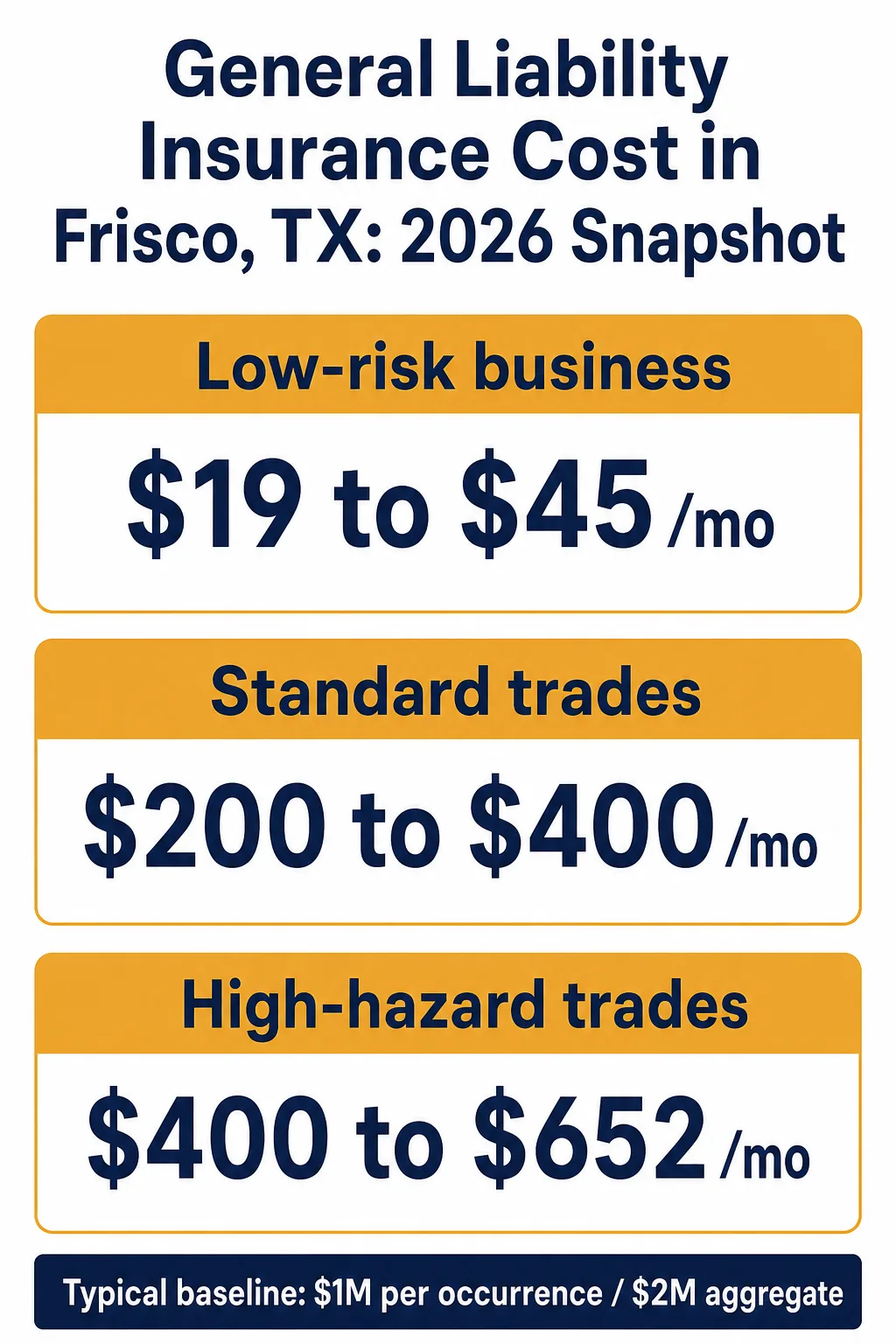
At a glance: No carrier or marketplace we found publishes a Frisco-only average. Current planning benchmarks put many low-risk small businesses at $19 to $45 per month, according to ERGO NEXT, while MoneyGeek places most contractor trades at $200 to $400 per month and its roofing model reaches $652 per month. Trade class, revenue, payroll, subcontractor use, claims, limits, endorsements, and carrier appetite drive the actual quote. A $1 million per-occurrence and $2 million aggregate CGL policy is the common baseline in Insureon customer data and the current City of Frisco supplier guide. Frisco registrations, project owners, GCs, and landlords can also require a COI and additional insured wording. As ContractorsInsured.net (CA #6015321, TX #3305690), we shop multiple Texas-admitted carriers for Frisco contractors, quote the same business day, and issue the COI right after binding.
What general liability insurance covers (and what it is)
In brief: General liability insurance protects a Frisco contractor against covered claims that someone outside the business suffered bodily injury, property damage, or personal and advertising injury because of the contractor’s operations, products, or completed work, while also paying covered legal defense costs subject to the policy terms.
A commercial general liability policy, often shortened to CGL or GL, is the third-party foundation of a contractor insurance program. The Texas Department of Insurance CGL guide describes coverage for bodily injury and property damage liability, contractual liability in certain insured contracts, products and completed operations, and personal and advertising injury. It also explains that exclusions and endorsements can change how a policy responds.
For a Frisco trade business, the core coverages usually work like this:
- Third-party bodily injury: A homeowner, delivery driver, visitor, or another trade is injured because of covered jobsite conditions or operations.
- Third-party property damage: Your crew, materials, or work accidentally damages property belonging to a client, neighbor, GC, or other outside party.
- Products and completed operations: Covered injury or damage appears after you have finished the job, such as resulting water damage after a completed installation.
- Personal and advertising injury: A covered claim alleges libel, slander, or certain advertising-related offenses.
- Legal defense: The insurer handles covered defense expenses under the policy wording, even when the allegations are disputed.
Coverage is not the same as a promise that every accident will be paid. The facts of the claim, policy dates, exclusions, deductibles, endorsements, and limits all matter. Start with what general liability covers, then compare the contract in front of you with the actual policy forms.
Frisco contractors also need to distinguish a certificate from the policy. A certificate of insurance for contractors is evidence of active coverage and listed limits on a date. It does not create coverage, raise a limit, or add another party to the policy. If a GC or owner requests additional insured status, the operative protection normally comes from an endorsement, not from a checked box on the certificate.
How much does general liability insurance cost in Frisco in 2026?
In brief: We use published 2026 benchmarks that put many low-risk small businesses at $19 to $45 per month, the modeled Texas small-business average at $122 per month, and most contractor trades at $200 to $400 per month, because no live source publishes a reliable Frisco-only average.
The safest answer separates different datasets instead of blending them into one false local average. ERGO NEXT says coverage starts at $19 per month for some businesses and that many small businesses pay $19 to $45 per month. Insureon reports $43 per month for its Texas general liability customers. Insureon calculates its figures from the median cost of policies sold, which excludes outlier high and low premiums, even where its own headings say average. Progressive Commercial reports a 2025 median of $55 per month and average of $79 for new customers.
The Hartford reports that its small-business customers pay an average of $68 per month, or $810 per year. Its separate $1 million-policy figure is $69 per month, or $824 per year. Those are national customer averages, not Frisco contractor rates.
MoneyGeek’s current Texas model is higher. Its 2026 Texas report estimates $122 per month, or $1,462 per year, for a standardized business with one to four employees and $1 million per occurrence with $2 million aggregate limits. The same report models Texas construction at $343 per month. MoneyGeek labels these as standardized estimates rather than observed Frisco invoices.
For contractors, MoneyGeek’s 2026 contractor study says most trades in its model fall between $200 and $400 per month, while the complete trade spread runs from $137 to $652 for businesses with one to four people. Insureon’s customer data often comes in lower: it reports a $89 monthly median for construction customers and says 76 percent of those customers pay less than $150 per month. Different business sizes, trades, carrier panels, and methods explain why the numbers do not match.
| Dataset | Monthly benchmark | Annual benchmark | What it represents |
|---|---|---|---|
| ERGO NEXT | $19 to $45 | $228 to $540 | Many small businesses, with annual figures calculated from its monthly range |
| Insureon Texas | $43 | $516 | Texas customer median, with annual figure calculated from the monthly amount |
| The Hartford | $68 | $810 | National small-business customer average |
| MoneyGeek Texas | $122 | $1,462 | Modeled Texas business with one to four employees |
| MoneyGeek contractor trades | $200 to $400 | $2,400 to $4,800 | Band containing most modeled contractor trades |
These published benchmarks explain why the first quote is only a starting point. The same contractor can fit one carrier’s preferred class and another carrier’s restricted class. We compare the scope of work, exclusions, limits, and endorsements as well as price. That is the practical value of reviewing GL cost factors and limits before binding.
Frisco general liability cost by trade
In brief: Trade is one of the strongest price signals because a light handyman, painter, plumber, general contractor, and roofer create different injury and property-damage exposures, so the table uses a transparent span between Insureon customer medians and MoneyGeek modeled averages instead of claiming Frisco-specific filed rates.
The lower endpoint below comes from current Insureon customer data for the named trade. The upper endpoint comes from MoneyGeek’s modeled national average for a one-to-four-person business in the same trade. Annual lower endpoints are Insureon’s published annual values where available or straightforward monthly multiplication; upper endpoints are MoneyGeek’s published annual values. These are comparison bands across two methods, not guaranteed minimums and maximums.
| Trade | Monthly benchmark span | Annual benchmark span | Main exposure |
|---|---|---|---|
| Handyman | $67 to $219 | $804 to $2,625 | Scope can range from light repair to remodeling |
| Painter | $59 to $206 | $708 to $2,478 | Overspray, spills, ladder work, occupied property |
| General contractor | $152 to $410 | $1,824 to $4,916 | Subcontractors, site control, completed operations |
| Electrician | $57 to $379 | $684 to $4,553 | Fire, property damage, energized work |
| Plumber | $115 to $365 | $1,380 to $4,379 | Water damage and completed work |
| Roofer | $267 to $652 | $3,200 to $7,829 | Heights, hot work, weather exposure |
| Concrete or masonry | $102 to $401 | $1,218 to $4,815 | Heavy materials, structural work, adjacent property |
| Landscaper | $51 to $197 | $610 to $2,368 | Equipment, client property, excavation, chemicals |
| HVAC contractor | $78 to $377 | $936 to $4,522 | Refrigerant, gas, electrical, water damage |
| Carpenter | $85 to $249 | $1,020 to $2,986 | Framing, structural scope, finished property |
Source detail is available on Insureon’s live cost pages for general contractors, roofers, electricians, and its other trade pages. MoneyGeek publishes its complete trade table on the contractor study linked above.
A Frisco GC that performs ground-up commercial work and uses many subs should not expect the same result as a solo remodeler. Review our insurance guidance for general contractors or the separate roofing contractor insurance guide for trade-specific underwriting issues.
Why general liability costs more (or less) in Frisco
In brief: Frisco pricing rises or falls with the contractor’s actual operations, payroll, revenue, subcontractor controls, claims, and project requirements, while local job density, expensive finished property, and stricter contract wording can increase the amount or severity of third-party loss that an underwriter expects.
Location matters, but it rarely overrides the business itself. MoneyGeek’s Texas methodology treats location as one input alongside industry and employee count. Frisco is part of a busy North Texas construction market, yet a carrier still begins with what the contractor does, how much work it performs, and who performs that work.
Several local conditions can affect underwriting:
- Occupied and closely spaced sites: Working around homeowners, tenants, neighboring property, deliveries, and other trades creates more third-party contact.
- Repair severity: Damage inside a finished home or commercial space can be costlier than the same mistake on an open site.
- Subcontractor documentation: Missing sub COIs, lapsed policies, or contracts without risk-transfer terms can shift more exposure back to the GC.
- Project requirements: Owners may require higher limits, additional insured status, completed-operations wording, primary and noncontributory coverage, or waiver of subrogation.
- City work: The current City supplier guide lists insurance terms that must be built into a bid or contract price.
Nearby comparisons can still help with market context. See McKinney general liability costs and Dallas general liability costs, but treat each city guide as a benchmark rather than a substitute for underwriting.
Cost by coverage limit ($1M/$1M vs $1M/$2M vs $2M/$4M)
In brief: Higher liability limits generally cost more, but no current source provides a dependable Frisco percentage or flat surcharge, so the right comparison is to quote the same business at each contract-acceptable limit and evaluate whether umbrella or excess coverage is the cleaner way to reach the required total.
Insureon says 91 percent of its general liability customers choose $1 million per occurrence and $2 million aggregate limits. Its construction and landscaping pages report similarly high selection of that baseline. The current City of Frisco supplier guide also lists $1 million per occurrence and $2 million aggregate comprehensive general liability for city suppliers.
| Limit structure | How to read it | Common fit | Pricing treatment |
|---|---|---|---|
| $1M / $1M | Up to $1 million for one occurrence and $1 million total aggregate | Only when the contract accepts the lower aggregate | Quote required |
| $1M / $2M | Up to $1 million for one occurrence and $2 million total aggregate | Common contractor, lease, and City supplier baseline | Quote required |
| $2M / $4M | Up to $2 million for one occurrence and $4 million total aggregate | Higher-limit commercial or owner requirements | Quote required, sometimes structured with umbrella or excess |
ERGO NEXT’s 2026 coverage guide shows occurrence options through $1 million and aggregate options through $2 million for its listed BOP form, while MoneyGeek says many Texas businesses carry $2 million and $4 million limits. Availability still depends on the carrier and class.
No carrier publishes a Frisco-specific price for each limit structure. The best published reference is Insureon’s national customer data, calculated as medians of policies sold: $45 monthly for a $1 million per-occurrence and $2 million aggregate policy, and $46 monthly for a $2 million per-occurrence and $4 million aggregate policy. Those two figures compare complete bundles in which the per-occurrence and the aggregate limit both change, so they do not isolate the price of either limit on its own. Quote each contract-acceptable structure rather than assuming the step up is cheap.
The 7 factors carriers use to price your policy
In brief: Carriers price contractor GL by combining seven connected inputs: trade class code, annual revenue, payroll and employees, subcontractor use, claims history, limits and endorsements, and carrier appetite for the work and territory, so complete and accurate submissions produce more comparable quotes and fewer audit surprises.
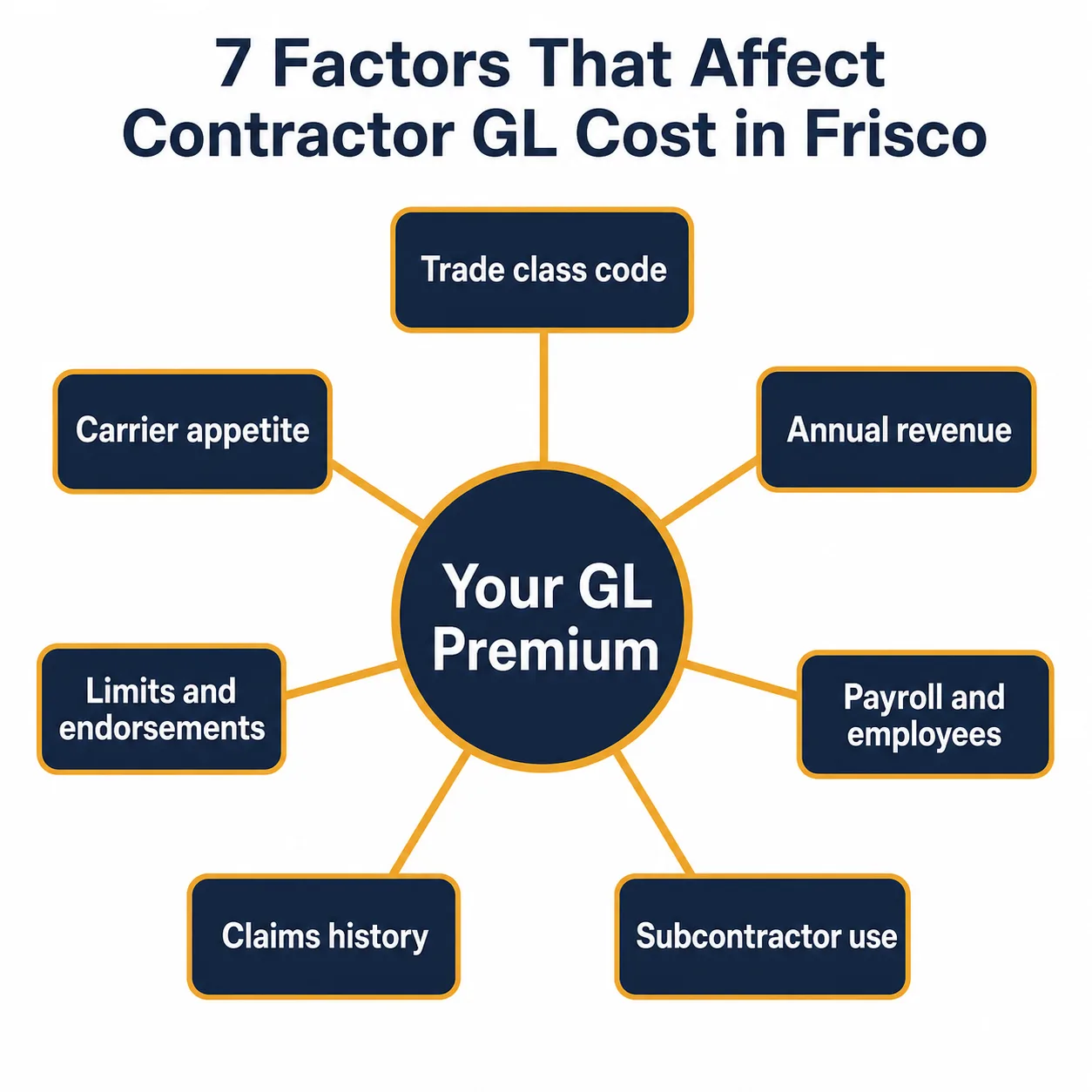
| Factor | Why it changes cost | What to provide |
|---|---|---|
| Trade class code | Defines the operations and baseline hazard | Plain-language scope, largest jobs, and excluded work |
| Annual revenue | More work can mean more third-party exposure | Prior-year actual and current projection |
| Payroll and employees | More people and activity can increase claim opportunity | Payroll, headcount, and employee duties |
| Subcontractor use | Uninsured or poorly documented subs can shift exposure upstream | Sub costs, trades, contracts, COIs, and vetting process |
| Claims history | Past losses influence expected future loss | Current loss runs and explanations for corrected causes |
| Limits and endorsements | Broader requirements can change carrier exposure | Full insurance exhibit or bid packet |
| Carrier appetite | Each insurer prefers and restricts different work | Accurate geography, project types, and operations |
TDI explains that many CGL policies are auditable and that estimated sales, payroll, or units can be reconciled against actual records after the policy term. Accurate inputs protect the contractor from both an inflated starting quote and an avoidable additional-premium bill.
Subcontractors deserve special attention. Collect active COIs, confirm required limits, and make sure the contract’s risk-transfer terms match the supporting endorsements. An additional insured endorsement for contractors can extend certain protection to a GC or owner, while a waiver of subrogation requirement addresses certain recovery rights after a covered loss. Neither should be assumed from a COI note alone.
“The contractors who usually pay the most aren’t always the highest-risk contractors. They’re often the ones who accepted the first quote without making sure their business was classified correctly. We shop multiple carriers because pricing can vary significantly for the same contractor.”
Pascal Burke, Licensed Insurance Broker, quoted in ContractorsInsured.net’s live San Francisco cost guide
Frisco and Texas insurance and contract requirements
In brief: We tell Frisco contractors to check three layers before work starts: Texas trade-specific licensing and insurance rules, City of Frisco registration and proof requirements, and the owner’s or GC’s contract, because Texas has no statewide general-contractor license or blanket GL rule that replaces those separate obligations.
The Texas Governor’s Business Permits Office guide states that general contractors are not required to obtain a state license to practice in Texas and may be subject to city or county requirements. The Governor’s current Business Permit Office page also says Texas does not require a general business license, while specific activities can require permits or professional licenses.
That does not mean every trade is unregulated. Under 16 TAC 73.40, electrical contractors, electrical sign contractors, and residential appliance installation contractors must each maintain at least $300,000 per occurrence, $600,000 aggregate, and $300,000 products and completed-operations aggregate. Air conditioning and refrigeration contractors have their own limits under 16 TAC 75.40: a Class A licensee must carry at least $300,000 per occurrence, $600,000 aggregate, and $300,000 products and completed-operations aggregate, while a Class B licensee must carry at least $100,000 per occurrence, $200,000 aggregate, and $100,000 products and completed-operations aggregate. For plumbing, Texas Occupations Code 1301.552 requires a Responsible Master Plumber to have on file a certificate of insurance providing commercial general liability coverage of not less than $300,000 for all claims arising in a one-year period. Those are state trade rules, not a blanket Frisco GC minimum.
The City of Frisco contractor registration page says contractors must register with Building Inspections before doing work in Frisco. It lists general contractors, electrical contractors, mechanical contractors, plumbing contractors, pool contractors, sign contractors, fence contractors, third-party raters, and residential engineers of record for structural and foundation work. Backflow and irrigation contractors register through Public Works instead, and franchise utility contractors register through the City’s right-of-way process. Applicants submit company and contact information, required documents, insurance information, master licenses where applicable, and registration fees.
The same City page says contractors working in Frisco must carry commercial general liability, identify the City of Frisco as certificate holder at 6101 Frisco Square Boulevard, and provide the most recent ACORD 25. It says the City’s registration number, called an R-Number, expires on the same day as the contractor’s general liability insurance. The registration page itself singles out only the engineer of record, who must provide a minimum of $1 million for each occurrence, and it does not print a dollar figure for the other listed trades. The City’s contractor registration ordinance does. It sets the minimum required liability insurance coverage at $300,000 per occurrence for registrants, and requires registrants who are design engineers to also provide professional liability insurance with a minimum of $1,000,000. Treat $300,000 per occurrence as the City’s registration floor, then check the specific contract or bid, which can require higher limits.
The registration page confirms fees apply by contractor type but does not publish the amounts online, so confirm the current fee with the City of Frisco Building Inspections Division when you register.
City contracting is a separate layer. The current Frisco Purchasing page links a supplier guide that lists $1 million per occurrence and $2 million aggregate comprehensive general liability, the City as additional insured, and a workers’ compensation waiver of subrogation. A specific solicitation or agreement can change or add requirements, so use the insurance exhibit in the actual bid.
Some solicitations set higher limits than the supplier guide baseline, so always read the insurance exhibit in the specific bid packet rather than assuming the baseline applies.
For the broader state and contract framework, review general liability insurance for Texas contractors and the related Texas contractor GL requirements. Collin County, a project owner, a lender, or a GC can set different limits and endorsement wording. The signed contract controls the private obligation, subject to applicable law and policy availability.
What general liability does NOT cover
In brief: General liability is not an all-risk contractor policy: it usually does not cover employee injuries, business vehicles, stolen tools, professional design errors, damage to the project under construction, or the cost to replace your own defective work, so those exposures require separate coverage or careful endorsements.
TDI’s CGL guide says the policy is not intended to provide workers’ compensation or employer’s liability coverage. It also explains exclusions for damage to your product, damage to your work in certain circumstances, recall costs, pollution, aircraft, auto, and watercraft, subject to the exact policy and exceptions.
- Employee injury: Workers’ compensation and employer’s liability address covered employee injuries. Texas rules and contract requirements should be reviewed separately.
- Business vehicles: Commercial auto covers owned work trucks and vans. Hired and non-owned auto may be needed for rented or personal vehicles used for business.
- Tools and mobile equipment: Inland marine or contractor tools and equipment coverage handles eligible property that moves between jobsites.
- Professional errors: Professional liability can address covered design, consulting, or specification mistakes that cause financial loss.
- Work in progress: Builder’s risk protects eligible structures and materials during construction, subject to project terms.
- Your faulty work: GL may respond to resulting third-party damage but generally is not a warranty that pays to redo defective work itself.
That is why general liability insurance for contractors is a foundation, not the whole program. Match each real exposure to its policy instead of expecting one certificate line to cover everything.
How to lower your general liability costs in Frisco
In brief: The best way to lower Frisco contractor GL cost without creating a coverage gap is to classify the work accurately, submit clean and complete records, control claims, document subcontractor insurance, compare equivalent carrier quotes, and buy only the limits and endorsements the business and contracts actually require.
Begin with the class code. A contractor who describes the business only as “construction” may be quoted for work it never performs. Give the broker a precise scope, largest project type, residential and commercial split, subcontracted work, and any operations the company avoids.
Then improve the parts an underwriter can evaluate:
- Keep revenue and payroll current: TDI warns that auditable policies can produce additional premium when actual exposure exceeds estimates.
- Control preventable claims: Written site rules, housekeeping, incident reporting, and documented corrections can improve the loss story.
- Vet subcontractors: Collect policies, COIs, required endorsements, and renewal documents before they expire.
- Bundle only when it fits: A BOP can combine GL with eligible property coverage for suitable lower-risk businesses, but not every contractor qualifies.
- Right-size limits: Do not cut below a signed contract. Ask whether an umbrella is more efficient than higher underlying limits.
- Compare equivalent terms: A cheaper quote with a restrictive exclusion, unsupported endorsement, or wrong class is not equivalent.
- Ask about billing: Compare annual and installment options, including any carrier fees, before choosing a payment plan.
TDI recommends getting quotes from several companies because insurers use different underwriting criteria. That is where a contractor-focused broker helps: we present the same accurate submission to suitable markets and explain why the policies differ.
What to prepare before requesting a quote
In brief: A complete Frisco quote packet should identify the legal entity, applicable trade license or registration, detailed work scope, revenue, payroll, employees, subcontractor costs and controls, project types, claims history, requested limits, and every COI or endorsement requirement from the active contract or bid.
Have the following ready before requesting terms:
- Legal business name, DBA, entity type, physical address, and start date.
- Texas trade license numbers and Frisco registration details when applicable.
- A specific description of operations, including residential, commercial, new construction, service, and repair work.
- Prior-year revenue and a realistic projection for the coming policy term.
- Payroll, employee count, job duties, and the employee versus independent-contractor split.
- Subcontractor costs, trades used, written agreements, COI collection, and required limits.
- Largest project, average project, work radius, and percentage of work in occupied buildings.
- Current loss runs and explanations of corrective action after any claim.
- Desired per-occurrence and aggregate limits, deductible preferences, and umbrella needs.
- The full insurance exhibit, vendor-portal instructions, and required additional insured, primary and noncontributory, waiver, or completed-operations wording.
Do not wait for the last COI field to reveal the actual requirement. Send the entire insurance page before the quote is finalized. That gives the broker time to confirm that a carrier can support the requested forms rather than discovering a mismatch after binding.
Frequently asked questions
In brief: These answers give Frisco contractors concise guidance on current published cost benchmarks, the meaning of a $1 million policy, whether a $200 monthly quote is reasonable, ContractorsInsured timing, Texas and City requirements, registration, and how a COI is issued after coverage becomes active.
How much is general liability insurance in Frisco?
Current published benchmarks place many low-risk small businesses at $19 to $45 per month and most modeled contractor trades at $200 to $400 per month, but no verified source publishes a Frisco-only average. ERGO NEXT supports the lower business band, while MoneyGeek supports the contractor band and models roofing at $652 per month. Your trade, revenue, payroll, subs, claims, limits, and endorsements determine the real quote.
How much is a $1,000,000 general liability policy for a Frisco contractor?
A $1,000,000 per-occurrence policy has no single Frisco price, although Insureon reports $152 per month for its Texas general contractor customers and MoneyGeek models general contractors at $410 per month nationally. Both figures describe different datasets and business profiles, so neither is a guaranteed quote. The aggregate limit, payroll, revenue, scope, subcontractors, claims, deductible, and required endorsements can materially change the result.
Is $200 a month a lot for general liability insurance?
$200 per month can be reasonable for contractor GL, but it may be high for a low-risk office business and low for a roofer or other hazardous trade. MoneyGeek says most modeled contractor trades fall between $200 and $400 per month, while ERGO NEXT says many small businesses pay $19 to $45. Compare the class code, limits, exclusions, deductible, and endorsements before judging the premium alone.
How fast can ContractorsInsured cover a Frisco contractor?
ContractorsInsured quotes general liability for a Frisco contractor the same business day when the submission is complete, then issues the COI right after approved coverage is bound. Send the legal business name, trade, revenue, payroll, subcontractor details, claims history, desired effective date, and the GC’s full insurance requirements. Workers’ compensation and commercial auto can also move fast, but the firm same-business-day promise applies to GL only.
Do contractors in Frisco legally need general liability insurance?
Frisco contractors often need general liability even though Texas does not impose one blanket GL mandate or statewide general-contractor license on every contractor. The City requires contractor registration and commercial general liability proof for listed trades, while TDLR and other trade boards impose separate rules for electricians, HVAC contractors, plumbers, and similar licensees. Owners, GCs, landlords, lenders, and vendor portals can also make coverage a contract condition.
What insurance does Frisco require to register or contract?
The City of Frisco says registered contractors must carry commercial general liability, name the City as certificate holder, and submit the most recent ACORD 25 with required business and producer information. The City’s contractor registration ordinance sets the minimum required liability insurance coverage at $300,000 per occurrence, and design engineers must also provide professional liability insurance with a minimum of $1,000,000. The City’s supplier guide separately lists $1 million per occurrence and $2 million aggregate general liability, City additional-insured status, and a workers’ compensation waiver of subrogation. Always follow the specific registration page, solicitation, and signed contract.
Does Frisco require registration or a business license for contractors?
Frisco requires listed contractors to register with Building Inspections before doing work, even though Texas does not require a general state business license or statewide general-contractor license. The City’s list includes general, electrical, mechanical, plumbing, pool, sign, fence, and other contractors. State-licensed trades must also provide applicable master-license information. The City issues an R-Number, and its registration page says that number expires when the general liability policy expires.
How can I get a same-day certificate of insurance (COI) in Frisco?
We can issue a Frisco contractor’s COI right after binding when the GL quote is approved and the carrier activates coverage. Send the certificate holder’s exact legal name and address, project details, required limits, additional-insured wording, other endorsement requests, delivery email, and deadline in one complete message. Existing clients should use the Request a COI button above; contractors without active coverage must bind the policy before a certificate can be issued.
Get a Frisco general liability quote
In brief: ContractorsInsured helps Frisco contractors of all sizes compare general liability options across multiple Texas-admitted carriers, match limits and endorsements to the actual contract, bind approved coverage, and issue the COI right after binding, with same-business-day quoting for complete general liability submissions.
A useful quote is not just a premium. It should classify the work correctly, satisfy realistic Frisco and project requirements, and avoid exclusions that conflict with the operations you disclosed. Send the full packet once, including any bid deadline, so we can place the risk with carriers that want the trade.
Pascal Burke is a Licensed Insurance Broker and founder of ContractorsInsured.net. The brokerage serves contractors in Texas and California, shops multiple markets, and handles COI and endorsement details as part of the placement process.