
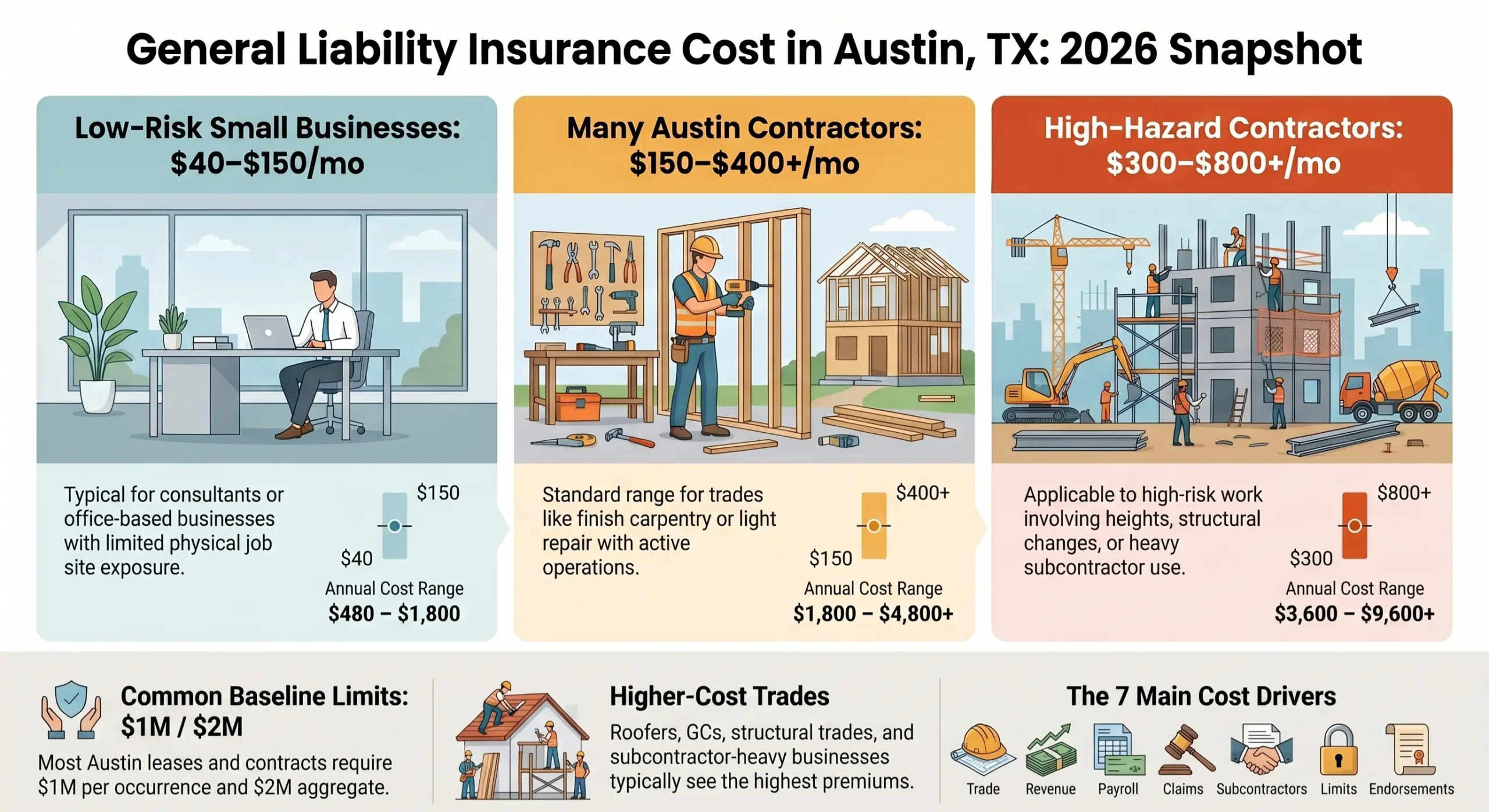
In 2026, Austin contractors typically pay $40 to $150/month for low-risk small businesses and $150 to $400+/month for most trades. Roofers and other high-hazard contractors often pay $300 to $800+/month. This guide breaks down pricing by trade, coverage limit, and the seven factors carriers use to quote your premium.
 By Pascal Burke, Licensed Insurance Broker (CA License #6015321 / TX License #3305690), Founder of ContractorsInsured.net Last updated: August 8, 2026 · Reviewed by ContractorsInsured Editorial Team
Editorial note: This article is educational and intended for contractors and the professionals who advise them. ContractorsInsured.net is a licensed insurance brokerage (CA License #6015321; TX License #3305690), not a law firm or claims adjuster. Premium audit outcomes generally depend on the specific carrier, audit findings, applicable rating bureau rules (WCIRB in California, NCCI in most other states), and the contractor’s records. Always confirm specific audit responses with your broker, the auditor, and qualified counsel or your CPA before disputing or paying an audit bill.
Table of Contents
- Quick answer / TLDR
- What general liability insurance covers
- How much does general liability insurance cost in Austin?
- Contractor general liability cost by trade in Austin
- Why Austin contractors pay more for general liability
- GL coverage limits Austin contracts typically require
- The 7 factors carriers use to price your policy
- Austin contract, lease, and COI requirements
- What general liability does not cover
- Texas non-subscription: how Workers’ Comp rules interact with GL
- How to lower your Austin GL premium without coverage gaps
- What to prepare before requesting your Austin GL quote
- Austin vs. other Texas cities: how GL cost compares
- Key takeaways
- Frequently asked questions
- Get an Austin general liability quote
General liability insurance cost Austin contractors face in 2026 typically runs $40 to $150 per month for low-risk small businesses and $150 to $400+ per month for most contractors. Roofers, general contractors, and higher-risk trades often pay $300 to $800+ per month depending on revenue, payroll, subcontractor usage, claims history, and required limits. As ContractorsInsured.net (TX Lic #3305690), we shop multiple Texas-admitted carriers for Austin contractors, quote the same business day, and issue the COI right after binding.
Trade-specific guides: general liability for general contractors in Austin · general liability for roofers in Austin · general liability for plumbers in Austin
These are Austin figures. Across trades and states, see how much contractor insurance costs.
If you searched for general liability insurance cost Austin TX, you are probably trying to figure out what coverage will cost before signing a lease, submitting a bid, starting a job, or uploading a Certificate of Insurance. The fastest way to get an accurate price is to send your trade, revenue, payroll, employee count, subcontractor use, claims history, and COI wording to a contractor-focused broker.
Quick answer / TLDR
General liability insurance in Austin, Texas often costs around $40 to $150 per month for lower-risk small businesses and about $150 to $400+ per month for many contractors. A common baseline is a $1 million per occurrence / $2 million aggregate policy, but some leases, project owners, GCs, vendor portals, and municipal contracts may ask for specific limits, additional insured wording, primary and noncontributory language, or other endorsements. Roofers, general contractors, structural trades, larger operations, and businesses with prior claims may pay more. The fastest way to price the premium Austin carriers will quote is to send your trade, revenue, payroll, employee count, subcontractor use, claims history, and COI wording to a contractor-focused broker.
Austin General Liability: Quick Facts (2026)
- Typical cost for most contractors
- $150 to $400+/month
- Low-risk small businesses
- $40 to $150/month
- High-hazard trades (roofing, structural)
- $300 to $800+/month
- Common limit required
- $1M per occurrence / $2M aggregate
- Legally required in Texas
- No universal state mandate, but electrical, HVAC and plumbing license holders must carry state minimums, and most leases, GCs, and vendor portals require it
- Same-day COI issuance
- Available for active policies in CA and TX
What general liability insurance covers
Before comparing quotes, it helps to know what the policy actually covers. General liability insurance is a commercial policy that pays for third-party bodily injury, property damage, and personal or advertising injury claims arising from a business’s operations, products, or premises.
In brief: General liability insurance helps protect Austin businesses and contractors against third-party injury, property damage, and certain legal defense costs. It does not replace workers’ comp, commercial auto, tools coverage, or every contract-required endorsement.
Commercial general liability, often called CGL or GL, protects a business against certain liability claims involving bodily injury, property damage, and personal or advertising injury. The Texas Department of Insurance commercial general liability explainer explains that CGL can include premises and operations coverage, products and completed operations coverage, and excess or umbrella liability options depending on the policy structure.
For contractors, general liability usually matters because accidents can happen on job sites, after completed work, during customer visits, or when a project owner, landlord, GC, or vendor portal asks for proof of insurance.
A contractor general liability policy may help respond to claims involving:
- Third-party bodily injury: A customer, visitor, tenant, or other non-employee alleges they were injured because of your work or operations.
- Third-party property damage: Your work damages someone else’s building, materials, fixture, or property.
- Products and completed operations: A claim arises after the work is completed, such as water damage, faulty installation, or property damage tied to completed work.
- Personal and advertising injury: Certain claims involving libel, slander, copyright issues in advertising, or similar covered allegations.
- Legal defense costs: Attorney fees, settlements, or judgments may be covered if the claim falls within the policy terms.
For Austin contractors, the key point is simple: general liability insurance for contractors is not just a box to check. It is often the policy that lets you submit a bid, satisfy a lease, work for a GC, enter a job site, or issue a COI when a client asks for proof of coverage.
How much does general liability insurance cost in Austin?
The general liability premium Austin contractors should budget for in 2026 depends on trade, revenue, and required policy limits. Below is a typical range by business type.
In brief: The typical general liability insurance cost in Austin, TX depends heavily on business type. A low-risk business may pay under $150 per month, while many contractors should budget closer to $150 to $400+ per month.
While Austin premiums scale across the standard $40 to $400+ monthly brackets, your final quote is mathematically tailored by Texas underwriters. Instead of guessing a single price point, carriers calculate your rate using an active risk matrix: your specific class code, physical job site footprints across Central Texas, gross revenue volume, and subcontractor risk transfers. Here is how those variables define your actual market tier.
| Business Type | Estimated Monthly Range | Estimated Annual Range | Why It Prices That Way |
| Low-risk consultant or office business | $40 to $75 | $480 to $900 | Limited jobsite exposure, low physical injury risk, fewer property damage claims |
| Retail or customer-facing business | $60 to $150 | $720 to $1,800 | More foot traffic, customer injury exposure, and premises liability risk |
| Restaurant or food service business | $90 to $250 | $1,080 to $3,000 | Customer traffic, slips and falls, food-related exposure, vendor requirements |
| Specialty contractor | $150 to $300+ | $1,800 to $3,600+ | Jobsite work, property damage risk, tools, active operations, client contract requirements |
| General contractor | $200 to $450+ | $2,400 to $5,400+ | Subcontractor exposure, project oversight, completed operations, higher contract requirements |
| Roofing or high-hazard contractor | $300 to $800+ | $3,600 to $9,600+ | Heights, tear-offs, hot work, structural risk, higher claim severity potential |
These are planning ranges, not guaranteed quotes. A small finish carpenter with no claims, limited payroll, and standard $1M/$2M limits may price very differently from a roofing contractor, paper GC, or commercial remodeler with subcontractors and strict contract wording.
Austin contractors working in Travis County, Williamson County, Hays County, Round Rock, Cedar Park, Pflugerville, Georgetown, Kyle, Buda, and other Central Texas job sites should expect underwriting to focus more on the actual work performed than the city name alone.
Contractor general liability cost by trade in Austin
In brief: Contractor GL pricing changes by trade because not every contractor creates the same risk. A roofer, plumber, GC, and handyman can all need GL, but carriers do not price them the same way.
| Contractor Trade | Expected Pricing Tier | Key Underwriting Concern |
| General contractor | Medium to high | Subcontractor controls, risk transfer, project size, completed operations |
| Roofing contractor | High | Heights, tear-offs, torch or hot work, water intrusion, injury severity |
| Plumbing contractor | Medium to high | Water damage, service work, commercial jobs, completed operations |
| HVAC or electrical contractor | Medium to high | Installation risk, fire or system damage exposure, licensing, commercial work |
| Finish trade contractor | Low to medium | Lower hazard work, but property damage and contract requirements still matter |
| Handyman or light repair contractor | Low to medium | Scope of work, excluded operations, revenue, whether structural or roof work is performed |
A contractor-focused broker will usually ask what percentage of your work falls into each trade. That matters because a “remodeling contractor” who performs light finish work is not the same risk as a GC overseeing structural jobs, plumbing work, roofing work, and subcontracted crews.
If your work includes roofing, structural framing, excavation, demolition, high-value commercial jobs, or heavy subcontractor usage, do not assume the lowest online estimate applies to you. A cheap policy that excludes the work you actually perform can become a problem when a GC asks for a COI or when a claim happens.
Why Austin contractors pay more for general liability
Austin contractors typically pay more than office-based businesses because jobsite work creates higher third-party injury and property damage exposure.
In brief: Contractors usually pay more than office businesses because jobsite work creates higher injury and property damage exposure. Austin’s construction growth, commercial projects, remodel activity, and suburban expansion can make COI accuracy especially important.
General liability is more expensive for contractors because the risk is more active. A consultant may spend most of the day at a desk.
A contractor, by contrast, may work around customers, tenants, property owners, other trades, tools, ladders, vehicles, unfinished structures, water lines, electrical systems, or expensive building materials.
Austin contractors may see higher GL premiums because of:
- Jobsite property damage exposure: Contractors often work inside homes, offices, retail spaces, restaurants, and commercial buildings. One mistake can create a large property damage claim.
- Completed operations risk: A problem may show up after the job is finished. For example, improper installation can lead to water damage, fire damage, or structural issues.
- Subcontractor exposure: GCs and larger trades may rely on subcontractors. Carriers want to know how subs are vetted, whether they carry their own insurance, and whether proper contracts and COIs are collected.
- Higher-value projects: Work on expensive homes, commercial properties, multifamily buildings, and public facilities can increase claim severity.
- Contractual requirements: Some Austin contracts may ask for higher limits, additional insured endorsements, waiver of subrogation, or primary and noncontributory wording.
- Trade hazard: Roofing, structural work, plumbing, electrical, HVAC, demolition, and excavation usually price differently from lower-risk finish trades.
- Claims history: Prior GL claims can make the business more expensive to place or limit carrier options.
That is why an Austin contractor should not only ask, “What is the cheapest general liability policy?” The better question is, “What policy will satisfy my contract, match my work, and still protect me if something goes wrong?”
GL coverage limits Austin contracts typically require
The premium Austin contractors pay also moves with the policy limit selected.
In brief: Many Austin businesses start with $1M/$2M general liability limits, but higher limits may be required by contracts, leases, GCs, or public project requirements. The right limit depends on the job, not just the monthly premium.
A common general liability baseline is $1 million per occurrence / $2 million aggregate. This means the policy may pay up to $1 million for a covered occurrence and up to $2 million total during the policy period, subject to policy terms, exclusions, and endorsements.
| Coverage Limit | Common Use Case | Notes |
| $1M per occurrence / $2M aggregate | Common baseline for many small businesses and contractors | Often requested by leases, GCs, owners, and vendor portals |
| $2M per occurrence / $4M aggregate | Larger contracts, commercial projects, or stricter certificate requirements | May be required by certain owners or higher-value jobs |
| Umbrella or excess liability | When the required limit is higher than the primary GL policy | Can sit above GL, commercial auto, and sometimes employer liability depending on structure |
| Project-specific requirement | Certain municipal, venue, commercial, or owner-controlled jobs | The contract wording should be reviewed before binding coverage |
The Austin Convention Center event insurance requirements provide a useful example of local paperwork expectations. The page states that a COI is required for events and lists commercial general liability with a minimum combined single limit of $1,000,000 per occurrence and $1,000,000 aggregate, including products and completed operations and contractual liability coverage. It also requires the City of Austin to be shown as additional insured for CGL and automobile liability in that event context. The original convention center closed in April 2025 and is being replaced by a larger building scheduled to open in 2029, so read those published limits as an example of how a City department words an insurance requirement rather than as a live venue requirement today.
Do not read that as a universal requirement for every Austin contractor. It is an example of how public facilities, venues, municipalities, landlords, and project owners can create specific insurance requirements that go beyond simply buying a basic GL policy.
The 7 factors carriers use to price your policy
In brief: Carriers price Austin general liability policies by measuring risk. Your trade, revenue, payroll, claims history, subcontractor use, limits, and contract wording can all move the final premium.
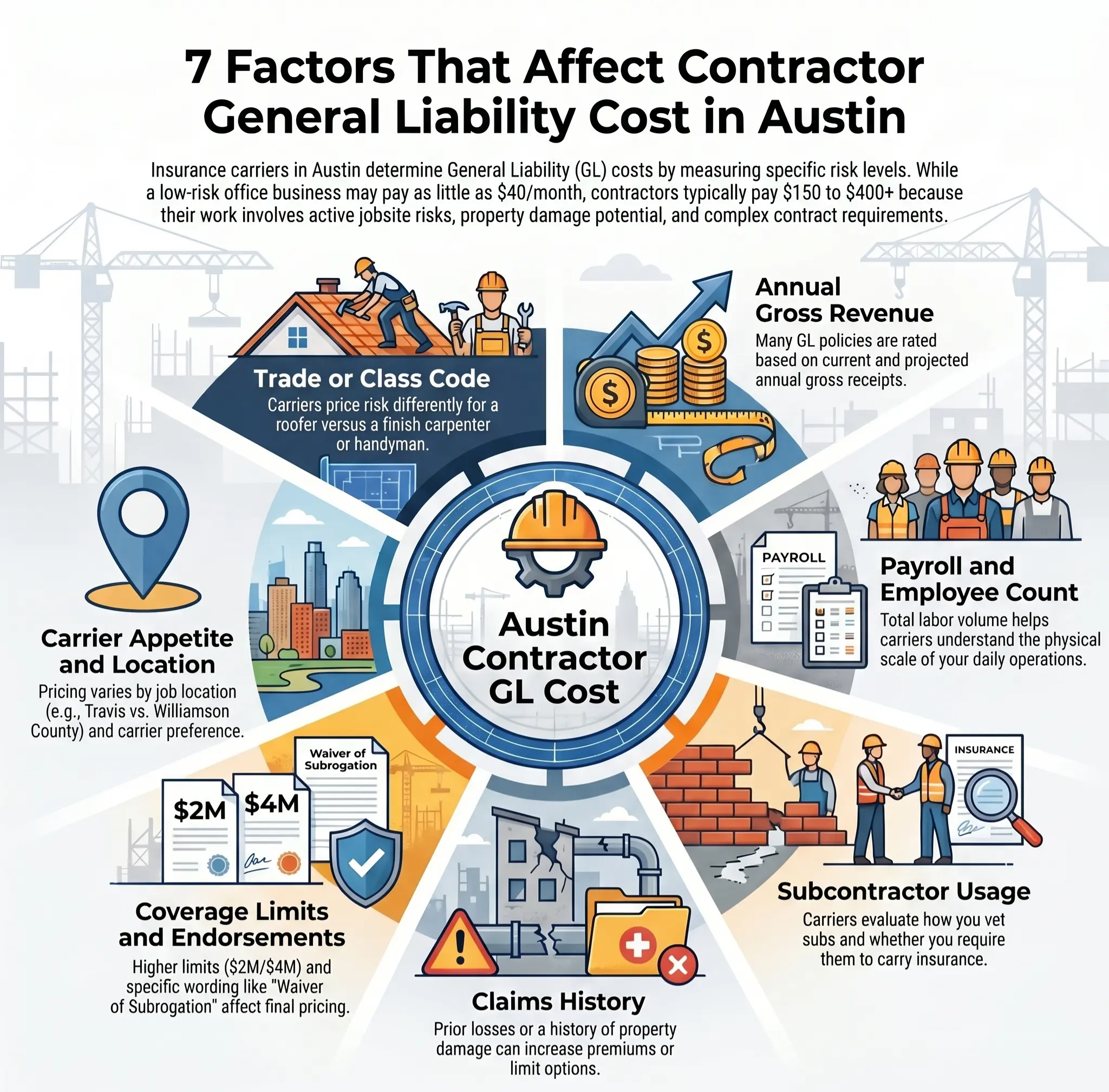
| Factor | Why It Matters | What to Prepare |
| Trade or class code | A roofer, plumber, GC, and consultant do not create the same risk | Clear description of work performed |
| Revenue | Higher sales can mean more operations and more claim exposure | Current and projected annual gross revenue |
| Payroll and employee count | More labor can mean more active jobs and more exposure | Payroll estimate and number of employees |
| Subcontractor usage | Subs can create risk transfer issues and completed operations exposure | Percentage of work subcontracted, COIs from subs, subcontract agreements |
| Claims history | Prior claims may affect eligibility and pricing | Loss runs or claim details from prior policies |
| Limits and endorsements | Higher limits and special wording can affect premium | Contract, lease, bid packet, or vendor portal wording |
| Carrier appetite and location | Not every carrier wants every contractor class or job type | Current operations, job locations, and prior coverage details |
Here is how these factors usually show up in real underwriting.
- Trade and class code: The carrier needs to know what work you actually do. A handyman doing light repairs should not be classified the same way as a roofer or structural contractor.
- Revenue: Many GL policies rate partly on gross receipts. Understating revenue can cause audit issues or coverage problems later.
- Payroll and employee count: Even though GL is not workers’ comp, employee count and payroll help carriers understand the scale of the operation.
- Subcontractors: General contractors and trade contractors who subcontract a large percentage of work need strong controls. Carriers may ask whether subcontractors carry their own GL and workers’ comp.
- Claims history: A clean loss history can help. A history of water damage, construction defect, injury, or property claims may increase pricing.
- Limits and endorsements: Additional insured, primary and noncontributory, waiver of subrogation, completed operations, and specific certificate wording can affect placement.
- Carrier appetite: Some carriers like artisan contractors. Others avoid roofing, structural work, demolition, open roof work, or high subcontractor percentages. A broker with access to multiple markets can help avoid wasted time.
Austin contract, lease, and COI requirements
In brief: Texas does not require every Austin business to carry general liability insurance, but contracts often do. Leases, bid packets, GCs, city facilities, and vendor portals may ask for a COI, additional insured wording, and specific limits before work starts.
A Certificate of Insurance, or COI, is often the document that proves your policy exists. Contractors commonly need a COI before they can start a job, enter a commercial property, work for a general contractor, satisfy a landlord, or complete vendor onboarding.
The Austin Center for Events insurance guidance explains that event organizers whose events impact or occur on City property must obtain insurance to protect the City against loss from liability for bodily injury and property damage. It also explains that the insurance must name the City as an additional insured and be maintained for the duration of the event.
For Austin contractors, that local example reinforces a broader point: requirements are usually contract-driven. Before you bind coverage, send the insurance section of the contract, lease, bid packet, or vendor portal instructions to your broker.
Not every Austin requirement is contract-driven. Trade contractors, general contractors, and homeowners acting as their own contractor must register with the City of Austin before construction begins, and mechanical, electrical and plumbing contractors do that on top of holding the state license. Excavation and driveway or sidewalk work in the public right of way goes further and requires a City of Austin Right of Way Contractor’s License, and subcontractors who impact the right of way must be named on the permit and licensed as well. That license is four documents: a $10,000 license and permit surety bond, a certificate of insurance, a resolution of authority, and an authorized agent form. The City’s published insurance requirement is commercial general liability with a minimum per occurrence limit of $500,000 for Coverage A and Coverage B, a $500,000 minimum for products and completed operations, plus explosion, collapse and underground (XCU) coverage and independent contractors coverage. Certificates must show the City of Austin as additional insured (endorsement CG 2010 or equivalent), a waiver of subrogation in the City’s favor (CG 2404 or equivalent), and 30 day notice of cancellation (CG 0205 or equivalent), and the carrier must hold an A.M. Best rating of B+ VII or better.
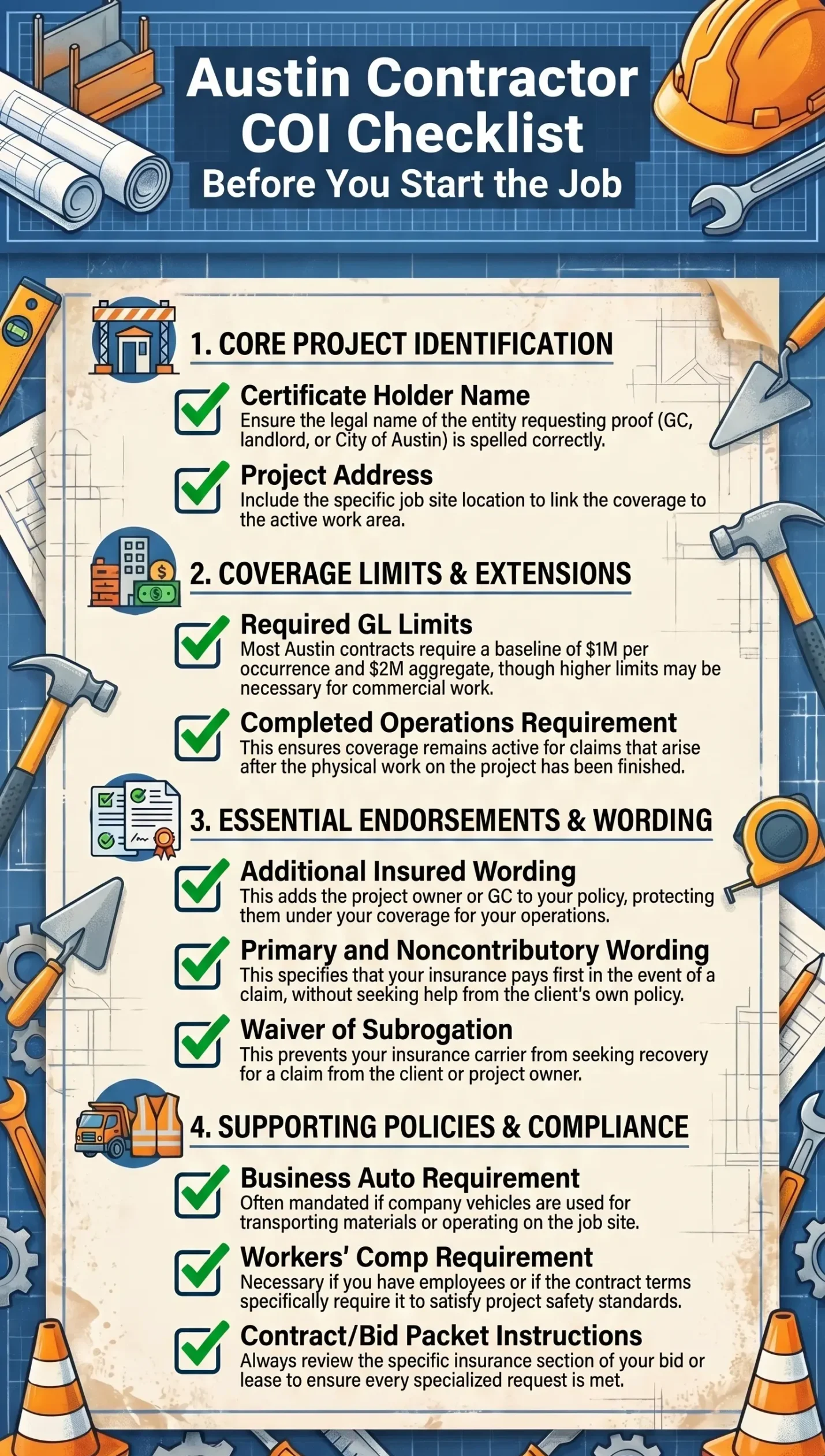
Common Austin COI and endorsement requests may include:
- Certificate of Insurance
- Additional insured endorsement
- Primary and noncontributory wording
- Waiver of subrogation
- Completed operations coverage
- Specific certificate holder wording
- $1M/$2M or higher limits
- Business auto liability if vehicles are used
- Workers’ compensation if employees are involved or the contract requires it
If you already have coverage and only need proof for a job, start with the certificate of insurance process. If your contract asks to add another party to your policy, review the additional insured endorsement requirements carefully. If your contract references subrogation, check whether a waiver of subrogation is needed and available.
What general liability does not cover
In brief: General liability is important, but it is not a complete contractor insurance program. Austin contractors may also need workers’ comp, commercial auto, tools and equipment, professional liability, or other policies depending on their operations.
General liability is designed for certain third-party liability claims. It does not cover every loss a contractor can face.
General liability usually does not cover:
- Employee injuries: Employee injuries are usually handled through workers’ compensation insurance for contractors, if required or purchased.
- Company vehicles: Business vehicles usually need commercial auto insurance for contractors.
- Your own tools and equipment: Stolen or damaged tools usually require inland marine, tools and equipment, or property coverage.
- Professional design errors: Design, engineering, consulting, or professional mistakes may require professional liability or errors and omissions coverage.
- Pollution claims: Pollution exclusions are common. Certain contractors may need separate pollution liability coverage.
- Intentional acts: Insurance generally does not cover intentional wrongdoing.
- Your own faulty work: GL may respond to resulting property damage in some cases, but it generally does not function like a warranty for replacing your defective work.
This is why contractors should think in terms of a coverage stack. GL may be the first policy a GC asks for, but it is often paired with workers’ comp, commercial auto, contractor bonds, tools coverage, and compliance and certificates support.
Texas non-subscription: how Workers’ Comp rules interact with GL
In brief: Texas is the only U.S. state where private employers can legally opt out of workers’ compensation. That choice does not change your general liability obligations, but it does change how a contractor’s overall risk picture looks to a GC, project owner, or underwriter.
Unlike most states, Texas allows private employers to operate as non-subscribers, meaning they decline state-regulated workers’ compensation coverage. The Texas Department of Insurance confirms that workers’ comp is generally optional for most private employers, though contracts and public projects can still require it.
For Austin contractors, the distinction matters in three practical ways:
- GL still does not cover employee injuries. Opting out of workers’ comp does not push employee bodily injury claims onto your general liability policy. Those claims become a direct liability of the business, often handled through an occupational accident plan or absorbed at the company level.
- Many GCs and project owners require subscription anyway. Commercial GCs and large private project owners frequently mandate state-regulated workers’ comp on their COIs even though Texas law does not require it of most private employers. On public work it is the law and not just the contract: under Texas Labor Code 406.096, a governmental entity that enters into a building or construction contract must require the contractor to certify in writing that it provides workers’ compensation coverage for each employee on the public project, and each subcontractor must give its certificate to the general contractor to pass on to the governmental entity. Non-subscriber status can disqualify you from those bids.
- Underwriters factor non-subscription into your GL risk profile. Carriers may ask whether you subscribe, whether you carry an alternative occupational accident plan, and how injured-worker claims are handled. The answer can influence appetite, pricing, and which markets will quote your GL.
If you operate as a Texas non-subscriber, send that detail to your broker upfront alongside any alternative coverage documents. It speeds underwriting and prevents COI rejections during a bid.
How to lower your Austin GL premium without coverage gaps
You can usually reduce the GL premium Austin carriers quote without sacrificing required limits or endorsements. Here are the tactics that move the needle.
In brief: Lowering cost should not mean buying the wrong policy. The goal is to give carriers clean, accurate underwriting information so they can price the business correctly.
Austin contractors can often improve pricing or avoid unnecessary delays by preparing the right information before requesting a quote.
Here are practical ways to control cost:
- Use the correct trade classification. Do not describe your business too broadly. “Contractor” is not enough. Explain whether you are a plumber, roofer, GC, finish carpenter, remodeler, HVAC contractor, handyman, or another trade.
- Separate low-risk and high-risk operations. If most of your work is finish carpentry but you occasionally touch roofing, structural repairs, or exterior work, say so clearly. It matters.
- Keep subcontractor controls clean. If you use subs, collect COIs, confirm limits, require additional insured wording when appropriate, and use written agreements.
- Report accurate revenue. Revenue estimates should be realistic. Understating revenue can create audit issues or renewal problems.
- Maintain a clean claims history. Safety procedures, job documentation, written change orders, photos, and quality control can reduce claim frequency.
- Review contracts before binding. Buying a policy first and checking the contract later can lead to expensive endorsement changes or a COI that does not satisfy the project owner.
- Avoid lapsed coverage. A clean history of continuous coverage can help with underwriting. Lapses may create concern for some carriers.
- Bundle only when it makes sense. Some businesses benefit from packaging GL with other policies. Others need separate policies to satisfy contractor-specific requirements. Let the contract and underwriting decide.
- Work with a contractor-focused broker. Contractors have different insurance needs than standard office or retail businesses. A broker who understands COIs, additional insured wording, waiver of subrogation, and jobsite requirements can save time.
What to prepare before requesting your Austin GL quote
In brief: The faster you provide accurate business, trade, revenue, payroll, subcontractor, and COI details, the faster a broker can quote the right Austin general liability policy.
Before requesting an Austin general liability quote, gather the following.
| Information Needed | Why the Broker Needs It |
| Legal business name | Needed for the application, policy, certificates, and underwriting |
| DBA, if applicable | Helps match contracts, leases, and vendor portal requirements |
| Business address | Used for rating, mailing, underwriting, and state-specific forms |
| Trade or contractor type | Determines class code and carrier eligibility |
| Description of operations | Helps avoid misclassification and excluded work problems |
| Annual gross revenue | Used by carriers to rate and audit the policy |
| Payroll estimate | Helps carriers understand operational size |
| Employee count | Helps identify risk and possible workers’ comp needs |
| Subcontractor percentage | Important for GCs and trade contractors who use subs |
| Claims history | Prior claims can affect pricing and eligibility |
| Desired limits | Many businesses start with $1M/$2M, but contracts may require more |
| Contract or bid packet | Shows exact COI and endorsement wording |
| Certificate holder information | Needed for accurate COI issuance |
| Additional insured wording | Required when a GC, owner, landlord, or city must be added |
| Vehicle use | Helps determine whether commercial auto is needed |
| Job locations | Helps underwriters understand where work is performed |
If the job is deadline-driven, upload the contract or COI requirements when you request a quote. That allows the broker to check whether the policy can satisfy the required wording before you bind coverage.
ContractorsInsured.net is a licensed insurance brokerage for contractors in California and Texas. The company places general liability, workers’ comp, and commercial auto policies for roofing, general, and plumbing contractors, and issues COIs within 24 hours and supports common endorsements such as additional insured, primary and noncontributory, and waiver of subrogation.
Austin vs. other Texas cities: how GL cost compares
In brief: General liability premiums for contractors are broadly similar across major Texas metros, but local underwriting nuances (jobsite mix, claim severity, weather-driven losses) can push specific trades higher or lower.
| Texas Metro | Typical Contractor GL Range | Local Pricing Driver |
|---|---|---|
| Austin | $150 to $400+/month | Strong residential and commercial growth, dense remodel activity, suburban expansion |
| Dallas-Fort Worth | $160 to $425+/month | Large commercial market, multi-family construction, higher project values |
| Houston | $170 to $450+/month | Hurricane and flood exposure, industrial work, larger insured limits common |
| San Antonio | $140 to $380+/month | Mix of residential and military/government projects, slightly lower claim severity |
These are planning ranges, not bound quotes. For a side-by-side breakdown of Dallas-Fort Worth pricing, see our companion guide on general liability insurance cost Dallas TX.
Key takeaways
The GL premium Austin contractors pay in 2026 comes down to seven key factors:
- Typical cost: light-exposure businesses generally see the lower brackets, the mainstream contractor band sits in the middle of the curve, and high-severity trades like roofing or structural framing land in the upper tier. Confirm exact numbers against your class code and limits.
- Baseline limits: $1M per occurrence / $2M aggregate is the common request from Austin leases, GCs, and vendor portals.
- What drives price: Trade or class code, revenue, payroll, subcontractor usage, claims history, required limits, and contract endorsements.
- What GL does not cover: Employee injuries (workers’ comp), company vehicles (commercial auto), your own tools, professional errors, pollution, intentional acts, and your own faulty work.
- Faster quoting: Send the broker your trade, revenue, payroll, employee count, subcontractor use, claims history, desired limits, and the COI / contract wording up front.
Frequently asked questions
In brief: These FAQs answer the questions Austin contractors and Austin small businesses most often ask about general liability insurance cost, coverage, and COI requirements. They are also marked up for FAQ schema and AI answer extraction.
What is the average general liability insurance cost for Austin contractors?
The mainstream Austin contractor pays in the $150 to $400+ monthly band for GL coverage in 2026, while lighter office-based or low-exposure operations frequently land closer to the $40 to $150 floor. Where you fall within those tiers depends on your class code, gross revenue, payroll size, subcontractor mix, prior claim activity, the limits you select, and any endorsement wording your contracts require.
How much does a 1 million dollar general liability policy cost in Austin?
For the standard $1M per occurrence / $2M aggregate limit that most Austin leases and GCs require, expect monthly premiums anywhere from $40 for lean low-exposure offices up to roughly $400 for mainstream contractor operations. Roofers, structural framers, and other high-severity trades typically sit in a heavier tier, often quoted between $300 and $800+ per month at the same coverage cap.
What does small business insurance cost in Austin?
Small business insurance in Austin typically costs $40 to $250 per month depending on the policy mix. A standalone general liability policy for a low-risk business runs $40 to $150 per month, while a Business Owner’s Policy that combines GL with business property coverage usually adds $20 to $100 to that monthly figure.
Do Austin contractors legally need general liability insurance?
Texas does not impose one universal general liability requirement on every Austin contractor, but several licensed trades must carry it as a condition of the state license. The Texas Department of Licensing and Regulation requires electrical contractors to hold at least $300,000 per occurrence, $600,000 aggregate, and $300,000 for products and completed operations (16 TAC 73.40), and air conditioning and refrigeration contractors to hold $300,000 per occurrence and $600,000 aggregate on a Class A license, or $100,000 and $200,000 on a Class B license (16 TAC 75.40). A responsible master plumber must maintain at least $300,000 in commercial general liability under Texas Occupations Code 1301.552. Outside those trades it is contracts that require coverage: most commercial leases, GC contracts, project owners, vendor portals, and City of Austin right-of-way permits ask for proof of GL before work begins.
What GL coverage limits do Austin contracts typically require?
Most Austin contracts require at least $1 million per occurrence and $2 million aggregate in GL coverage. Some projects may also require higher limits, additional insured status, primary and noncontributory wording, waiver of subrogation, or umbrella liability depending on the contract.
Why do Austin contractors pay more than consultants for GL?
Austin contractors pay more for GL than consultants because jobsite work creates higher physical risk than office-based businesses. Property damage, customer injury, completed operations claims, subcontractor exposure, tools, ladders, water lines, electrical systems, roofing, and structural work all raise underwriting exposure.
Does general liability cover employee injuries in Austin?
No. General liability does not cover employee injuries. If the employer subscribes to workers’ compensation, covered occupational injuries run through that policy, and a Texas non-subscriber faces them as a direct liability of the business. GL responds only to certain third-party bodily injury, third-party property damage, personal and advertising injury, and covered defense costs.
Is a Business Owner’s Policy better than standalone GL in Austin?
For most Austin contractors, a standalone contractor general liability policy is a better fit than a Business Owner’s Policy. A BOP can work for low-risk small businesses by packaging GL with business property coverage, but contractors often need a contractor-specific package because jobsite work, subcontractor exposure, completed operations, and contract wording add complexity.
Where can I find cheap general liability insurance in Austin?
The cheapest general liability insurance in Austin is usually offered to low-risk small businesses with clean claims history, accurate revenue reporting, and standard $1M/$2M limits. Cheap pricing is rarely available to contractors performing roofing, structural, or high-hazard work; for those trades, the goal is the correct policy at a fair price rather than the lowest premium.
How do I get general liability insurance quotes in Austin?
To get general liability insurance quotes in Austin, send a contractor-focused broker your trade, annual revenue, payroll, employee count, subcontractor percentage, claims history, desired limits, and any contract or COI wording. A complete submission usually returns quotes within one to two business days.
Can I get a COI quickly for an Austin job or vendor portal?
Yes, in most cases. A COI can often be issued the same day if your policy is active and the requested wording is available. The process is fastest when you provide the certificate holder name, project address, contract requirements, additional insured wording, waiver of subrogation request, and any vendor portal instructions upfront.
What information helps brokers quote the lowest Austin GL premium?
Brokers quote the lowest Austin GL premium when you provide accurate, complete underwriting information up front: legal business name, trade, business address, annual revenue, payroll, employee count, subcontractor percentage, claims history, desired limits, contract wording, certificate holder details, and job locations. Also clarify whether you perform roofing, structural work, plumbing, electrical, HVAC, or subcontracted work.
Get an Austin general liability quote
In brief: The right Austin general liability policy should match your trade, contract wording, COI requirements, and real jobsite exposure. Do not buy coverage based only on the lowest monthly number.
If you need general liability insurance for an Austin job, lease, bid, vendor portal, or contractor requirement, ContractorsInsured.net can help you compare options and prepare the right paperwork.
A good quote should answer four questions:
- Does the policy match the work you actually perform?
- Does it satisfy the contract, lease, GC, or vendor portal?
- Can the broker issue the COI and endorsements you need?
- Are there exclusions or gaps that could hurt you later?
ContractorsInsured.net helps contractors with general liability, workers’ comp, commercial auto, COIs, additional insured endorsements, primary and noncontributory wording, waiver of subrogation, and other compliance requirements.
Get an Austin GL Quote in 24 Hours
Disclaimer: This article is general information, not legal advice. Coverage, eligibility, forms, endorsements, limits, exclusions, and pricing vary by carrier and underwriting approval. Always review your policy and contract requirements with a licensed insurance professional before binding coverage.