

How Much Does General Liability Insurance Cost in Amarillo, Texas? 2026 Guide
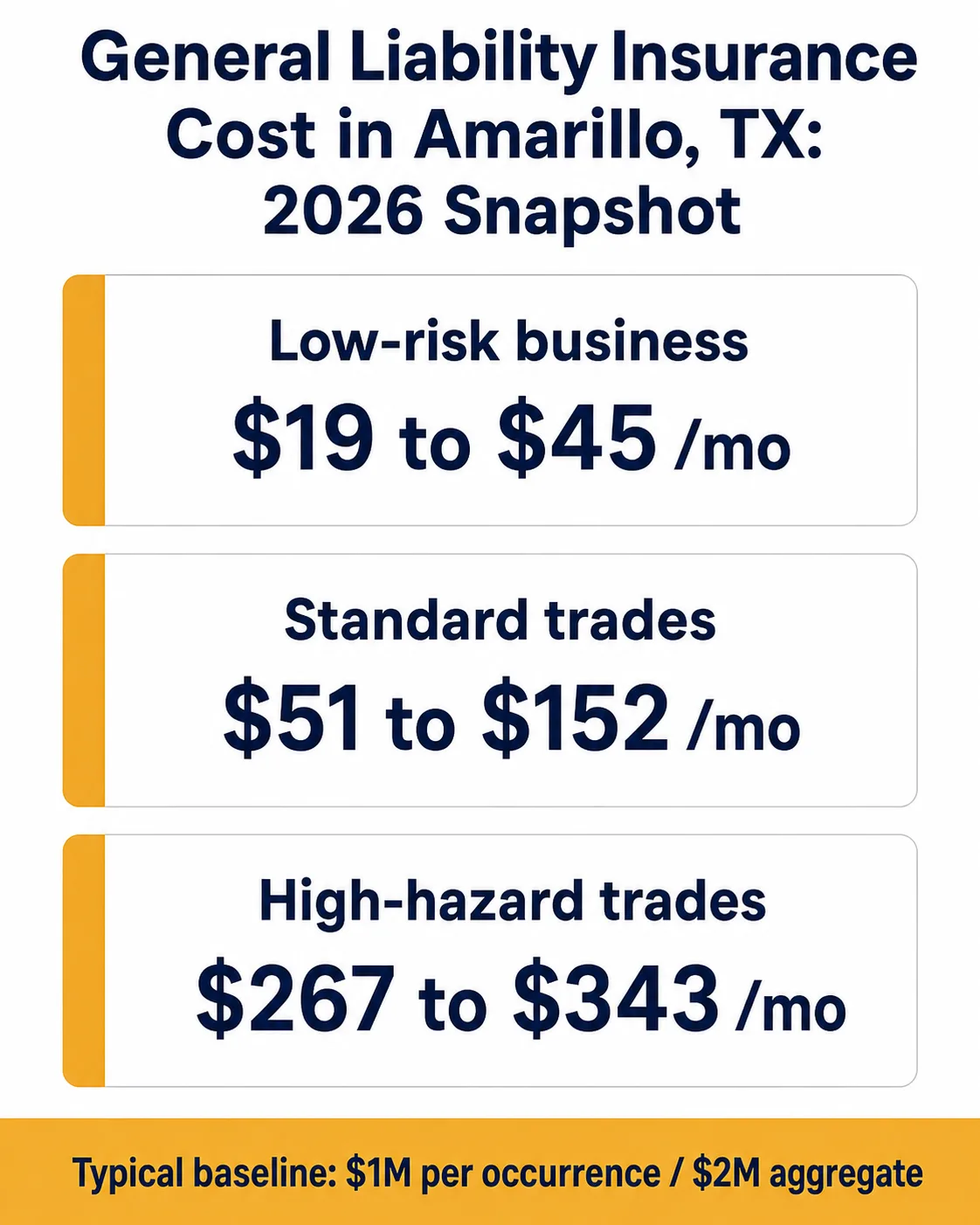
At a glance: No verified Amarillo-only premium average is publicly available. For practical planning, ERGO NEXT supports a $19 to $45 monthly band for low-risk businesses, Insureon supports $51 to $152 for standard trades, and Insureon plus MoneyGeek support $267 to $343 for higher-hazard construction. These are not guaranteed Amarillo quotes. Trade class, revenue, payroll, employees, subcontractor use, claims, limits, endorsements, and carrier appetite determine the actual price. A $1 million per-occurrence and $2 million aggregate policy is the common contractor baseline in current Insureon data, but each Amarillo contract and registration must be checked. As ContractorsInsured.net (CA #6015321, TX #3305690), we shop multiple Texas-admitted carriers for Amarillo contractors, quote the same business day, and issue the COI right after binding.
What general liability insurance covers (and what it is)
In brief: General liability insurance helps an Amarillo contractor respond when business operations allegedly injure a person who is not an employee, damage property belonging to someone else, cause a covered personal or advertising injury, or lead to a covered products and completed operations claim after the job is finished.
The Texas Department of Insurance commercial general liability guide describes CGL as protection against liability claims for bodily injury, property damage, and personal and advertising injury. It also separates premises and operations coverage from products and completed operations coverage. That distinction matters on a construction site because an accident can happen during the work or damage can appear after the crew leaves.
- Third-party bodily injury: A visitor trips over a cord, a delivery driver falls near stored material, or a customer alleges that site conditions caused an injury.
- Third-party property damage: A crew damages a client’s floor, wall, fixture, neighboring structure, or other property that the contractor does not own.
- Products and completed operations: Finished work allegedly causes later bodily injury or damage, subject to policy terms, exclusions, and the facts of the claim.
- Personal and advertising injury: A covered claim alleges libel, slander, or certain advertising offenses.
- Legal defense: The policy can respond to defense expenses for a covered suit, even before fault is determined, subject to the policy.
Declarations, classifications, endorsements, exclusions, the policy period, and claim facts control. A certificate of insurance is evidence of coverage on a date, not a policy rewrite. Our guide to what general liability covers explains the details to compare.
How much does general liability insurance cost in Amarillo in 2026?
In brief: We use $19 to $343 per month as a source-based planning span for Amarillo, not a local average: current national low-risk data begin at $19, while a current Texas model places construction at $343, and the contractor’s actual quote depends on operations, size, limits, losses, and carrier fit.
No carrier or regulator located during this research publishes a reliable Amarillo-only average, so this guide shows current datasets and their assumptions instead.
The live benchmarks differ because they measure different customer groups:
- ERGO NEXT says many small businesses pay $19 to $45 per month, and its data page says the figures reflect active United States customers over the prior twelve months, updated in April 2026.
- Insureon reports a $43 monthly average for Texas small-business general liability customers. Its broader cost study says annual policies range from $265 to $3,030 and identifies industry, location, operations, claims, revenue, employees, class code, payroll, limits, and deductible as pricing inputs.
- The Hartford reports that its small-business customers average $68 per month or $810 per year. Its page was updated May 20, 2026 and says location, type of business, risk exposure, coverage limits, and claims history influence price.
- Progressive Commercial reports a 2025 median of $55 per month and average of $79 per month for new customers, another reminder that a median and an average are not interchangeable.
- Hiscox says general liability starts at $30 per month and presents that as starting or illustrative pricing, not a promise for a construction business.
- MoneyGeek’s 2026 Texas model says costs commonly range from $28 to $350 per month, with a $122 statewide average and a $343 construction and contracting estimate. Its methodology models a business with one to four employees and a $1 million per-occurrence, $2 million aggregate policy.
For the snapshot infographic and this guide, the endpoints are deliberately traceable. The low-risk business band of $19 to $45 per month comes directly from ERGO NEXT. The standard-trade planning band of $51 to $152 per month uses Insureon’s $51 landscaping median and its $152 Texas general-contractor average. The higher-hazard band of $267 to $343 per month uses Insureon’s roofing median and MoneyGeek’s modeled Texas construction figure. These bands organize live evidence; they do not predict a particular Amarillo policy.
Multiplying the monthly endpoints by 12 produces a $228 to $540 ERGO NEXT low-risk band and a $612 to $1,824 standard-trade band. Insureon separately publishes $610 a year for landscaping, and that $2 difference is the source’s own rounding rather than an error. Insureon and MoneyGeek publish annual higher-hazard endpoints of $3,200 and $4,111. A quote can fall outside any of these bands.
Compare the same facts and limits across carriers. A lower result may reflect a different class, narrower scope, or missing endorsements. See general liability insurance for Texas contractors for state-level context.
Amarillo general liability cost by trade
In brief: Published trade benchmarks run from $51 per month for landscaping to $267 per month for roofing in current Insureon customer data, but no verified source provides controlled Amarillo monthly and annual ranges for every trade, so the table reports national benchmarks and flags the missing local range instead of inventing one.
Trade is one of the strongest pricing signals because it changes the frequency and potential severity of third-party injury and property-damage claims. A finish carpenter, roofer, electrician, and general contractor can all request the same policy limit while presenting very different operations. The table below uses a consistent source where possible: Insureon’s median customer cost data for policies commonly carrying $1 million per occurrence and $2 million aggregate limits.
| Trade | Published monthly benchmark | Published annual benchmark |
|---|---|---|
| Handyman | $81 median | $978 median |
| Painter | $72 median | $862 median |
| General contractor | $162 national median, $152 Texas average | $1,950 national median |
| Electrician | $61 median | $732 median |
| Plumber | $147 median | $1,768 median |
| Roofer | $267 median | $3,200 median |
| Concrete contractor | $119 median | $1,423 median |
| Masonry contractor | $88 median | $1,055 median |
| Landscaper | $51 median | $610 median |
| HVAC installation contractor | $78 median | $941 median |
| Carpenter | $94 median | $1,124 median |
Sources: Insureon’s live cost pages for handymen, painters, general contractors, electricians, plumbers, roofers, concrete contractors, masonry contractors, landscapers, HVAC installers, and carpenters. The $152 Texas general-contractor figure comes from Insureon’s Texas general contractor page, which words it as an average. Insureon states that its cost-page figures are sourced from the median cost of policies purchased by its customers, because a median excludes outlier high and low premiums, so this table reports them as medians. Figures re-verified against each source in August 2026.
Why general liability costs more (or less) in Amarillo
In brief: An Amarillo address is only one rating input: insurers price the contractor’s actual work, class code, revenue, payroll, employee and subcontractor exposure, claims, project types, contract requirements, and selected limits, while local job conditions and repair costs matter only to the extent a carrier’s underwriting model recognizes them.
Progressive’s contractor insurance cost guide says location, trade, projects, number of employees, payroll, coverage amount, and risk all influence cost. The Hartford likewise says business location can affect price, while Insureon identifies class code, revenue, payroll, employees, operations, claims history, limits, and deductible.
Underwriters may ask where work occurs, whether projects are residential or commercial, what is self-performed, and which higher-hazard scopes are subcontracted. No source reviewed here provides a verified Amarillo multiplier, so applying a cost-of-living percentage would create false precision.
City work is separate from private work. The City of Amarillo Purchasing Department says vendors working for the City must keep current insurance on file, comply with City Standard Insurance Spec 2.04 or have a waiver, and confirm coverage before starting work on City property. The exact solicitation and insurance exhibit control. A City vendor rule should never be rewritten as a rule for every private contractor.
Contractors comparing nearby markets can review Lubbock general liability costs and Fort Worth general liability costs. Those pages are context, not a rate card for Amarillo.
Cost by coverage limit ($1M/$1M vs $1M/$2M vs $2M/$4M)
In brief: Higher general liability limits usually cost more, but no live source located here publishes a controlled Amarillo price comparison for $1 million and $1 million, $1 million and $2 million, and $2 million and $4 million options, so choose the contract-compliant limit first and compare matched quotes second.
The shorthand lists the per-occurrence limit first and the aggregate limit second. Products and completed operations may carry a separate aggregate, and all limits remain subject to the policy terms.
| Limit structure | Common planning use | Published cost reference |
|---|---|---|
| $1 million per occurrence and $1 million aggregate | May appear where the contract accepts a lower aggregate, but the actual packet controls. | No major dataset located here publishes a separate figure for this structure, so compare matched quotes rather than assuming a lower aggregate reduces the premium |
| $1 million per occurrence and $2 million aggregate | Current Insureon data says 92% of its contractor and construction customers select this structure. | $45 monthly median across all Insureon small-business customers, not a contractor-only figure |
| $2 million per occurrence and $4 million aggregate | May be requested for larger commercial or public work, sometimes with umbrella or excess coverage. | $46 monthly median across all Insureon small-business customers, not a contractor-only figure |
The 92% selection figure comes from Insureon’s construction and contractor cost study. The $45 and $46 monthly figures come from Insureon’s $1 million liability cost page and describe all of its small-business customers rather than contractors specifically. MoneyGeek also uses $1 million per occurrence and $2 million aggregate as its standardized Texas model. Neither source proves that every Amarillo contract uses that limit. The Hartford and Progressive both state that higher limits generally increase premiums.
The Texas Department of Insurance says excess liability can pay covered loss above the CGL limit and umbrella can sit above CGL and commercial auto. Compare attachment points, exclusions, and endorsements. Our GL cost factors and limits guide goes deeper.
The 7 factors carriers use to price your policy
In brief: Carriers price an Amarillo contractor’s general liability policy primarily from trade and class code, annual revenue, payroll and employees, subcontractor use, claims history, selected limits and endorsements, and carrier appetite for the operations and job locations, with each factor changing expected claim frequency or severity.
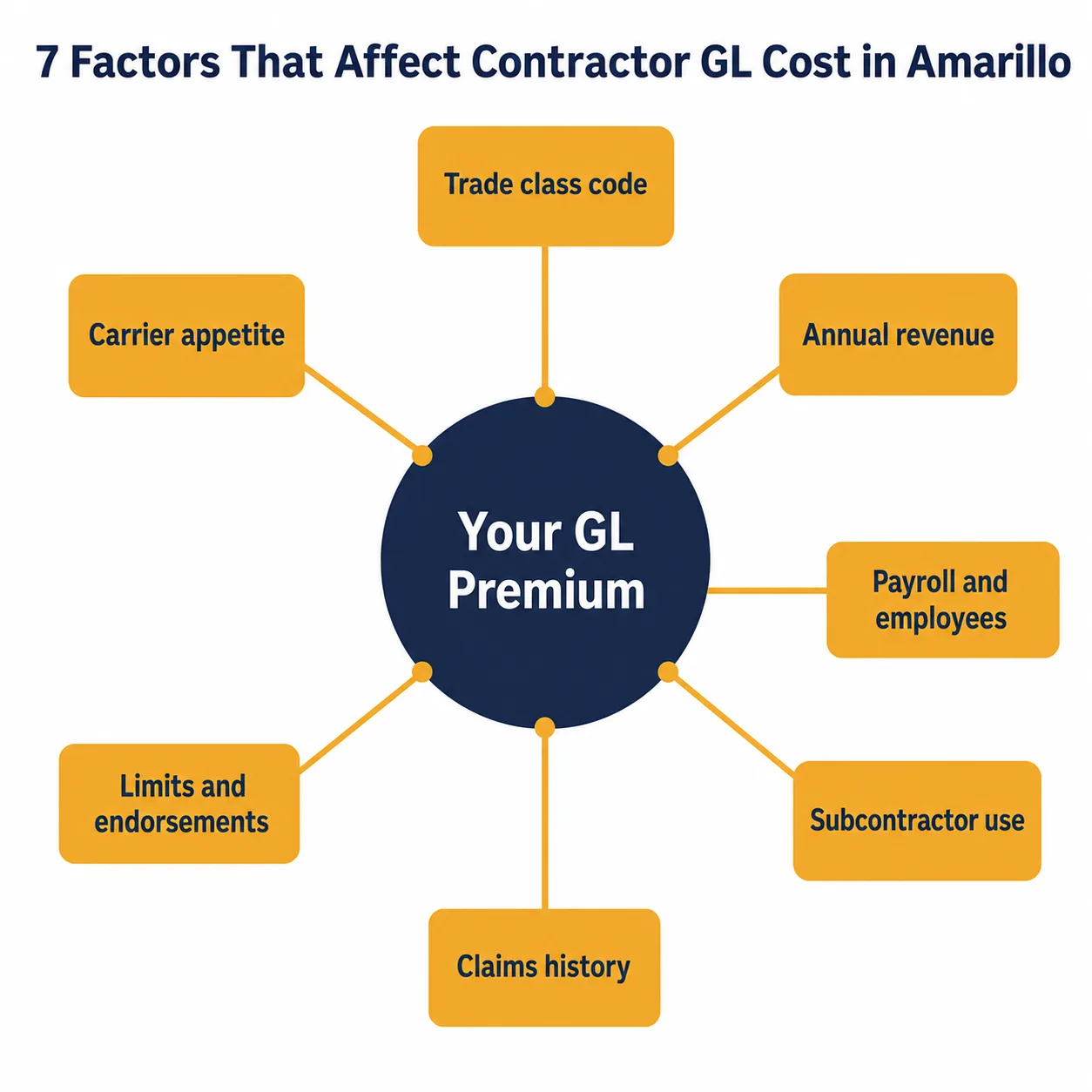
| Factor | Why it matters | What to prepare |
|---|---|---|
| Trade and class code | It identifies operations and their expected third-party exposure. | A scope listing what the company performs and subcontracts. |
| Annual revenue | More sales can mean more projects and completed work exposed to claims. | Prior revenue and a realistic policy-term projection. |
| Payroll and employees | Headcount and field activity indicate operational exposure. | Employee count, payroll by role, owner duties, and seasonal hiring. |
| Subcontractor use | Carriers assess subcontracted work and documented risk transfer. | Subcontracted cost, trade mix, agreements, and certificate controls. |
| Claims history | Prior losses show frequency, severity, and recurring hazards. | Loss runs and explanations of material claims and corrective action. |
| Limits and endorsements | More limit and broader requirements can increase carrier exposure. | The exhibit showing limits and required endorsement wording. |
| Carrier appetite and job location | Carriers accept different trades, projects, locations, and hazards. | Work radius, job types, project split, and unusual work. |
These factors appear across current carrier and marketplace guidance from The Hartford, Progressive, ERGO NEXT, and Insureon. The value of a broker is not changing the facts. It is presenting the facts accurately to carriers that actually want the class. Contractors can also review the Additional Insured endorsement guide and Waiver of Subrogation guide before sending a bid packet.
Amarillo and Texas insurance and contract requirements
In brief: We tell Amarillo contractors to check three layers separately: Texas does not license general contractors statewide, Amarillo requires city licensing or registration for listed contractor categories but applies different bond and insurance rules by trade, and private owners or City vendor contracts can impose their own coverage and COI terms.
The Texas Governor’s Texas Business Licenses and Permits Guide states that general contractors are not required to obtain a license to practice in Texas and may be subject to local city or county requirements. That is not the same as saying every construction trade is unregulated. Electrical and air-conditioning contractors have state licensing and insurance rules, while plumbers are regulated by the Texas State Board of Plumbing Examiners.
The live City of Amarillo Building Safety table says permits and contractor licensing are handled electronically through MGO Connect. More importantly, the table does not impose a blanket bond and GL rule:
- General and new residential contractors: City license required, an annual city license fee applies (the City publishes the requirement but not all current fee amounts online, so confirm your category’s fee with Amarillo Building Safety), no surety bond is listed, and no general liability minimum is listed.
- Residential remodel contractors: City license required, annual city fee applies, a $20,000 surety bond is listed, and no general liability minimum is listed.
- Glass and glazing contractors: The City table lists $500,000 in general liability.
- Insulation contractors: The City table lists a $20,000 surety bond and $300,000 in general liability.
- Residential roofers: The City table lists a $20,000 surety bond and $300,000 in general liability.
- Commercial roofers: The City table lists a $20,000 surety bond and $1 million in general liability.
The City’s roofing registration document adds useful detail. It says roofing work that requires a permit within city limits requires registration. It lists a $300,000 per-occurrence, $600,000 aggregate, and $300,000 products and completed operations structure for the residential category, while the commercial category lists $1 million in general liability. It also says qualifying coverage must come from an admitted company, eligible surplus lines carrier, or other insurer authorized to issue liability insurance in Texas.
State-licensed trades bring another layer:
- Electrical contractors: The Texas Department of Licensing and Regulation requires $300,000 per occurrence, $600,000 aggregate, and $300,000 products and completed operations aggregate in business liability coverage.
- HVAC contractors: The TDLR air-conditioning contractor page requires Class A licensees to maintain $300,000 per occurrence, $600,000 aggregate, and $300,000 products and completed operations aggregate. It lists $100,000, $200,000, and $100,000 respectively for Class B.
- Responsible Master Plumbers: The Texas State Board of Plumbing Examiners requires at least $300,000 in commercial liability insurance for the designation.
These are licensing or registration minimums, not a recommendation that every contractor buy the minimum. A job contract can require higher limits and endorsements. The City’s Purchasing Department says vendors must have current insurance on file, comply with Standard Insurance Spec 2.04 or hold a waiver, and update coverage before starting work on City property. No public countywide general contractor insurance minimum was located for Potter County or Randall County, so read the insurance exhibit in the specific bid packet rather than assuming one applies.
Compare the city category, state rule, permit, owner contract, and vendor packet. The contractor certificate of insurance guide explains why a COI does not create Additional Insured status. See Texas contractor GL requirements for state context.
What general liability does NOT cover
In brief: General liability is mainly third-party coverage and normally does not replace professional liability for design or advice errors, workers’ compensation for employee injuries, commercial auto for work vehicles, inland marine for mobile tools, or builder’s risk for the structure and materials during construction.
The coverage line matters because several losses can arise from one project. Whether any particular claim is paid depends on the issued policy, its endorsements and exclusions, and the facts of that claim, so treat the list below as general coverage-line boundaries rather than a determination about your own policy:
- Professional mistakes: If the claim alleges negligent design, consulting, scheduling, or professional advice without bodily injury or property damage covered by GL, professional liability or contractors errors and omissions may be the relevant policy.
- Employee injury: Workers’ compensation addresses covered employee job injuries. General liability is not a substitute for it.
- Vehicle accidents: Commercial auto is designed for liability and physical-damage exposures involving covered business vehicles. A GL policy does not turn a work truck into an insured auto.
- Tools and equipment: Inland marine or contractor tools and equipment coverage can protect mobile gear. GL generally addresses damage to property belonging to others, not theft of the contractor’s own tools.
- Work in progress: Builder’s risk is designed around covered damage to a structure and materials during construction. It is different from liability for damage to another party.
- Redoing defective work: GL is not a workmanship warranty. A covered resulting-damage claim and the cost to replace the contractor’s defective work are not the same thing.
The Hartford’s general liability guide likewise separates employee injury, service mistakes, company vehicles, and business property from GL.
How to lower your general liability costs in Amarillo
In brief: We help Amarillo contractors control general liability cost by classifying operations accurately, sending consistent revenue and payroll figures, documenting subcontractor insurance, preventing repeat claims, selecting contract-compliant limits, considering an eligible business owner’s policy, and comparing multiple carriers that actively write the trade.
- Use the correct class code. A broad description can place the business in the wrong underwriting lane. Describe every operation, especially roofing, structural work, excavation, demolition, design, and work performed by subcontractors.
- Keep application figures consistent. Revenue, payroll, employee count, and subcontracted cost should tell the same story across the application, financial records, and renewal audit.
- Document subcontractors. Collect contracts, current certificates, and endorsements required by the carrier or project. Missing documentation can create audit and claim problems.
- Address claim causes. A loss explanation is stronger when it shows what changed: training, site controls, contract language, supervision, or a discontinued service.
- Right-size limits to the work. Lower limits can reduce premium, but a cheap policy that fails the contract cannot get the contractor approved. Read the insurance exhibit before quoting.
- Ask whether a BOP fits. A business owner’s policy combines general liability and commercial property. Insureon says only smaller, lower-risk operations are typically eligible, so it is not available to every trade.
- Compare annual and monthly payment terms. Ask each carrier for the total policy cost, deposit, installment schedule, fees, and cancellation terms. A lower monthly payment does not always mean a lower total.
- Shop by carrier appetite. One carrier may price a clean carpenter well and decline roofing. Another may want a general contractor only if subcontractor controls meet its rules.
Progressive and ERGO NEXT both say higher limits generally raise premium and that risk controls can help. Insureon lists accurate class code, payroll, revenue, employees, claims, location, and limits among pricing inputs. A broker comparison is most useful when every carrier receives the same scope and requested endorsements. Learn more about general liability insurance for contractors before comparing forms.
What to prepare before requesting a quote
In brief: A complete Amarillo general liability submission includes the legal entity and DBA, contractor or trade license numbers, detailed operations, project types and locations, prior and projected revenue, payroll and employees, subcontractor cost and controls, claims history, current coverage, requested limits, and the contract’s exact COI and endorsement language.
Start with the legal name for the policy and COI. Add the DBA, entity type, addresses, years in business, owner experience, and applicable license number. Resolve any mismatch with the contract before binding.
Describe operations in plain English. Separate self-performed work from subcontracted work. Identify residential, commercial, industrial, public, new-construction, service, repair, and remodeling percentages where relevant. Tell the broker about any work at height, hot work, excavation, demolition, structural changes, design responsibility, or tract development. Omitting a difficult operation can produce a quote that does not fit the business.
Prepare the exposure figures the carrier will rate:
- Prior twelve-month revenue and projected revenue for the policy term.
- Field payroll, office payroll, owner payroll treatment, and employee count.
- Subcontracted cost, trades used, written agreements, COI collection, and endorsement standards.
- Typical project value, largest project, and annual work radius.
- Loss runs or a claims summary for the period the application requests.
Finally, attach the actual insurance exhibit or vendor portal checklist. Do not paraphrase “standard coverage” when the packet identifies Additional Insured, ongoing and completed operations, Primary and Noncontributory, Waiver of Subrogation, notice language, specific limits, or an umbrella. Contractors working as GCs can also review the general contractor insurance checklist, while roofers should review the roofing contractor insurance checklist.
Frequently asked questions
In brief: The short answers below address Amarillo cost benchmarks, the price of a $1 million policy, whether $200 monthly is high, ContractorsInsured timing, legal requirements, City registration and vendor rules, and the information needed for a same-day certificate after general liability coverage is bound.
How much is general liability insurance in Amarillo?
No verified Amarillo-only average is public, so current source-based planning benchmarks span $19 to $343 per month. ERGO NEXT reports $19 to $45 for many low-risk businesses, Insureon reports a $152 Texas general-contractor average and a $267 national roofing median, and MoneyGeek models Texas construction at $343. Those figures use different methods and are not Amarillo quotes. Your trade, revenue, payroll, subcontractors, claims, limits, endorsements, and carrier determine the actual price.
How much is a $1,000,000 general liability policy for an Amarillo contractor?
The Hartford reports that its small-business customers pay an average of $69 per month or $824 per year for a $1 million liability policy, but that is not an Amarillo contractor rate. Insureon’s contractor data shows much wider trade variation, including $61 monthly for electricians, $162 for general contractors, and $267 for roofers, commonly with $1 million per occurrence and $2 million aggregate limits. A matched quote is required for your operations and contract.
Is $200 a month a lot for general liability insurance?
$200 per month is high compared with several broad small-business averages but can be plausible for a contractor with greater jobsite exposure. The Hartford reports $68 monthly across its small-business customers, Insureon reports $152 for Texas general contractors, and its national roofing median is $267. Compare the class code, revenue, payroll, subcontractor use, claims, limits, deductible, and endorsements before judging the price. A lower quote with narrower coverage is not an equal comparison.
How fast can ContractorsInsured cover an Amarillo contractor?
ContractorsInsured quotes general liability for Amarillo contractors the same business day and issues the COI right after approved coverage is bound. Send the legal entity, trade and operations, revenue, payroll, employee and subcontractor details, claims history, desired effective date, and the GC’s insurance exhibit. The firm timing applies to general liability quotes. Workers’ compensation and commercial auto are handled fast, but timing depends on underwriting, required records, carrier approval, and when coverage is bound.
Do contractors in Amarillo legally need general liability insurance?
Not every Amarillo contractor has one blanket legal GL mandate, but trade, registration, permit, and contract rules can require it. The Texas Governor’s licensing guide says general contractors do not need a statewide license. Amarillo’s Building Safety table lists no GL minimum for general and new residential city licenses, while glazing, insulation, roofing, electrical, HVAC, plumbing, and other regulated categories have specific requirements. Private GCs, owners, landlords, and public contracts may demand higher limits and endorsements.
What insurance does Amarillo require to register or contract?
Amarillo applies different insurance rules by contractor category, and City vendors must keep current insurance on file or have an approved waiver. Building Safety lists $300,000 in GL for residential roofing, $1 million for commercial roofing, $300,000 for insulation, and $500,000 for glazing, while general and new residential licenses show no City GL minimum. The Purchasing Department requires City vendors to follow Standard Insurance Spec 2.04. Always read the current registration table and contract exhibit.
Does Amarillo require registration or a business license for contractors?
Amarillo requires a City license or registration for the contractor categories listed by Building Safety, even though Texas does not license general contractors statewide. The City’s current table marks general, new residential, residential remodel, electrical, glazing, HVAC, insulation, plumbing, roofing, sign, pool, and other listed categories for City licensing. Applications and permits are handled electronically through MGO Connect. Fees, bonds, state-license proof, and insurance vary by category, so contractors should confirm the live table before applying.
How can I get a same-day certificate of insurance (COI) in Amarillo?
We issue the COI right after approved general liability coverage is bound, and complete information is the fastest route. Send the insured’s exact legal name, certificate holder name and address, job name and address, required limits, Additional Insured and other endorsement wording, recipient emails, and deadline. If you already have active coverage with ContractorsInsured, use the Request a COI option in the band above. If you need a policy, start with the quote option so we can place coverage first.
Get an Amarillo general liability quote
In brief: ContractorsInsured helps Amarillo contractors compare general liability options from multiple Texas-admitted carriers, align the selected policy with the trade and contract, quote GL the same business day when the submission is complete, and issue the certificate of insurance right after approved coverage is bound.
A useful quote should identify the named insured, operations, class, limits, deductible, key exclusions, subcontractor conditions, audit basis, payment terms, and endorsement availability. A low number can become expensive if the policy fails the bid packet or classifies the work incorrectly.
Send the business details and insurance requirement page. We will compare available carrier options and help match selected coverage to the COI request. Coverage and pricing remain subject to underwriting and the issued policy.