
Published September 10, 2026. Rules and issuer data re-verified August 20, 2026. Written and reviewed by Pascal Burke, Licensed Insurance Broker (CA #6015321, TX #3305690).
TL;DR: There is no defensible one-size-fits-all average for general contractor insurance. In our experience quoting California and Texas general contractors, class codes, payroll, gross receipts, subcontractor costs, limits, vehicles, and loss history shape the premium. General liability is only one line in the stack, which can also include workers compensation, commercial auto, builders risk, and umbrella coverage. California and Texas also apply different rules: California requires an active contractor license bond and workers compensation when a construction employer has an employee, while Texas lets most private employers choose whether to carry workers compensation but requires it on covered public construction work. ContractorsInsured.net is a licensed brokerage in both states (CA #6015321, TX #3305690): we quote general contractor GL the same business day and issue your COI right after binding.
| Coverage line | US average | California | Texas |
|---|---|---|---|
| General liability | $162 / mo | $144 / mo | $152 / mo |
| Workers compensation | $196 / mo | $590 / mo | $306 / mo |
| Commercial auto | $287 / mo | $270 / mo | $254 / mo |
| Builders risk | $136 / mo | Not published | Not published |
| Commercial umbrella | $140 / mo | Not published | Not published |
| Tools and equipment | $42 / mo | Not published | Not published |
| Business owner's policy | $125 / mo | Not published | Not published |
| Surety bond | $10 / mo | Not published | Not published |
Averages Insureon publishes for its general contractor customers, checked August 2026. "Not published" means Insureon does not publish a state figure for that line.
How much does general contractor insurance cost in 2026?
In brief: In our experience quoting general contractors in California and Texas, a blanket average is less useful than a quote built from the contractor’s actual work, payroll, revenue, subcontractor costs, vehicles, limits, and loss history. Those inputs explain why two businesses with the same license can receive very different prices.
The table below reflects Contractors Insured’s first-party quoting experience. It does not reuse marketplace averages or promise a price before underwriting.
| Pricing input | Why it matters | What to have ready |
|---|---|---|
| Class codes and trade mix | Different operations present different injury and property-damage exposures | A clear description of every type of work you perform |
| Payroll and gross receipts | Many contractor policies use one or both as rating bases | Current totals and realistic projections for the policy term |
| Subcontractor costs | Carriers review how much work is subcontracted and whether subs carry coverage | Subcontractor payments and current certificates of insurance |
| Vehicles and equipment | Owned vehicles and mobile tools can require separate coverage lines | Vehicle schedules, driver details, and equipment values |
| Limits and loss history | Contract requirements and prior claims affect market options | The insurance section of your contract and available loss runs |
That is the honest framing we give every general contractor who calls us. A published average cannot tell whether you self-perform roofing, subcontract all field work, run a fleet, or need special endorsements for a contract. A broker prices the business you actually operate.
Your class codes, payroll, gross receipts, and subcontractor spend are four core inputs. Clean, consistent records help the broker approach the right carriers and reduce surprises when the policy is audited.
Pascal Burke’s practical advice: A cheap deposit premium can become an audit bill if the payroll, receipts, or subcontractor costs on the application do not match the completed policy term. Keep current subcontractor certificates and report the business accurately from the start.
If you want the coverage explained rather than priced, start with our general liability insurance page, then come back here for the rest of the stack.
The full coverage stack a general contractor actually carries
In brief: General liability is the line a certificate holder often asks about first, but a working general contractor may need several policies. In our quoting experience, pricing the full stack before a bid or renewal is more useful than comparing a general liability average that leaves payroll, vehicles, projects, and contract requirements out.
Here is the stack we review with general contractors. The exact combination comes from the business, the project, and the written contract.
| Coverage line | Primary cost drivers | When it commonly enters the conversation |
|---|---|---|
| General liability | Operations, receipts, payroll, subcontractor costs, limits, and loss history | A contract or certificate holder requires liability limits and endorsements |
| Workers compensation | Payroll, worker classifications, experience, and state rules | The contractor has employees, works under a contract that requires it, or performs covered public work |
| Commercial auto | Vehicles, drivers, radius, use, limits, and loss history | Business-owned vehicles or contracts create a commercial auto exposure |
| Builders risk | Completed value, construction type, location, term, and safeguards | An owner, lender, or contract requires project property coverage |
| Commercial umbrella or excess | Requested limits and the underlying policies | A contract asks for limits above the available primary coverage |
| Tools and equipment | Equipment schedule, values, mobility, and theft controls | Tools and mobile equipment need protection away from the shop |
General liability: the line on the certificate
This is the coverage many certificate holders mean when they say “send me your insurance.” It can respond to covered third party bodily injury and property damage arising out of your operations. In our experience quoting general contractors, contracts often request $1 million per occurrence and $2 million aggregate. The contract controls the required limits and endorsements. Details on what general liability covers and excludes.
Workers compensation: the line that splits California and Texas
Workers compensation can pay covered medical costs and wage-replacement benefits after a work injury. The state rules diverge: CSLB says California construction employers must carry it even with one employee, while TDI says most Texas private employers may choose whether to carry it. Covered Texas public construction work is an important exception. See our workers compensation page for how class codes and payroll affect a quote.
Commercial auto: trucks, trailers, and rising verdicts
A personal auto policy may not cover the way a vehicle is used for work. If a truck is titled to the business, carries tools, transports a crew, or appears on a contract schedule, tell the broker exactly how it is used so the correct policy can be considered. Commercial auto pricing depends on the vehicles, drivers, radius, limits, and loss history. More on our commercial auto page.
Builders risk: the project you are standing in
Builders risk is project property coverage, not a substitute for general liability. It can cover specified property during construction, subject to the policy’s terms, conditions, and exclusions. In our experience placing this coverage, completed value, construction type, location, term, and site safeguards matter more than a generic monthly average. An owner, lender, or contract may require it. See builders risk.
Umbrella and excess: when the contract asks for higher limits
An umbrella or excess policy can provide limits above scheduled underlying policies, subject to its own terms. It enters the conversation when a general contractor, lender, or project owner writes a limit into the contract that the primary policy does not meet. In our quoting experience, comparing an umbrella or excess option with higher primary limits is worthwhile because the carrier results vary. See umbrella and excess liability.
California general contractor requirements: CSLB B license, bond, workers comp
In brief: A California general building contractor normally works under a CSLB Class B license. CSLB requires a $25,000 contractor license bond for an active license, California construction employers must carry workers compensation even with one employee, and separate liability insurance and bond rules apply to LLC licensees.
The Class B license and the $1,000 threshold
CSLB defines the Class B General Building Contractor classification around work on a structure that requires at least two unrelated building trades or crafts, with additional rules for framing, carpentry, and specialty work. That is the California classification this guide means when it refers to a general building contractor.
The licensing threshold matters here. CSLB’s Assembly Bill 2622 implementation bulletin announced the threshold change effective January 1, 2025. Current Business and Professions Code Section 7048 says the exemption applies only when the aggregate contract price is less than $1,000, the work does not require a building permit, and the unlicensed person does not employ anyone to perform or assist with the work. A project at $1,000 or more falls outside the exemption, as does work that is part of a larger project or divided to evade licensing law.
The $25,000 contractor license bond
CSLB’s bond requirements page states that the contractor bond must be $25,000, effective January 1, 2023. A separate $25,000 bond of qualifying individual is required for an RME and for an RMO who does not own at least 10 percent of the corporation’s voting stock. The contractor bond is not general liability insurance, and CSLB says it is filed for the benefit of consumers and unpaid employees.
Workers compensation: what CSLB actually says
CSLB’s current workers compensation page states that active C-8 Concrete, C-20 Warm-Air Heating, Ventilating and Air-Conditioning, C-22 Asbestos Abatement, C-39 Roofing, and C-61/D-49 Tree Service contractors must carry workers compensation insurance or hold a valid Certification of Self-Insurance whether or not they have employees. CSLB also states that California construction employers must carry workers compensation even with one employee.
For a Class B licensee with no employees, CSLB allows a signed exemption only if no disqualifying condition applies. Its live page says an exemption cannot be filed when the license is qualified by an RME or when the license includes one of the classifications listed above. Once the licensee employs anyone subject to California workers compensation law, the exemption is no longer valid. CSLB’s March 2026 board packet says current law schedules all licensed contractors to have proof of workers compensation by January 1, 2028, even without employees. Because that is a future requirement, confirm the live rule before renewal.
The LLC rule most general contractors miss
CSLB’s LLC license page states that an LLC licensee must carry liability insurance with a cumulative limit of at least $1 million when five or fewer people are listed as personnel of record. The requirement rises by $100,000 for each additional person and is not required to exceed $5 million. CSLB also requires a $100,000 employee or worker surety bond in addition to the $25,000 contractor bond.
Why California workers compensation is climbing
WCIRB reports that the Insurance Commissioner adopted an average advisory pure premium rate of $1.65 per $100 of payroll, effective September 1, 2026, which is 6.6 percent above the approved September 1, 2025 rate. The California Department of Insurance confirms the figure and stresses that it is advisory, so it is not a carrier quote or a promise of what any contractor will pay. Our California general contractor page covers what we can place in state.
Texas general contractor requirements: no state license, but nobody skips insurance
In brief: TDLR’s current regulated-program list does not include a statewide general contractor credential, though Texas licenses specific trades. TDI says private employers may choose workers compensation in most cases. Local requirements, public-project rules, and contracts can still create separate obligations.
There is no statewide general contractor license
The Texas Department of Licensing and Regulation publishes its current regulated-program list. It includes air conditioning and refrigeration contractors, electricians, industrialized housing and buildings, mold assessors and remediators, and water well drillers. The list does not include a general contractor or general building contractor credential.
Do not read “no statewide general contractor credential” as “no requirements.” A specific trade license, local registration or permit, and the insurance section of a project contract are separate questions. Check the city or county that controls the permit and read the contract before bidding.
Workers compensation is elective, with a real exception
The Texas Department of Insurance states that private employers can choose to carry workers compensation insurance coverage and that it is not required in most cases. TDI calls employers without that coverage nonsubscribers and publishes separate notice and reporting duties for them.
The public-project exception is written into Texas Labor Code Section 406.096 in the Texas Workers’ Compensation Act published by TDI. A governmental entity entering a building or construction contract must require the contractor to certify in writing that it provides workers compensation coverage for each employee working on the public project. Each subcontractor must provide its certificate to the general contractor, who provides it to the governmental entity. The current statute text is also available here.
Nonsubscriber status is a real decision, not a free pass
Going without workers compensation in Texas is legal for most private employers, but it is still a liability decision. TDI says workers compensation coverage limits an employer’s liability in most employee lawsuits, except when gross negligence results in a fatality. An occupational accident program is not workers compensation and does not satisfy a request for a workers compensation certificate.
The contractual reality
A statewide general contractor credential does not set the insurance requirement in Texas. In our quoting experience, owners, lenders, and upstream contractors may still request certificates, additional insured endorsements, primary and noncontributory wording, and specified limits. The written contract controls what is required for that project. Our Texas general contractor page covers what we place in state.
For current rate context, TDI Commissioner’s Bulletin B-0001-26 says TDI accepted an NCCI filing effective July 1, 2026 that proposes an overall average 3.8 percent decrease in advisory loss costs. Advisory loss costs are not the final rates charged by insurers, so the filing should not be treated as a contractor premium forecast.
No policy yet but a GC, lender, or project owner wants a COI?
We are licensed in California and Texas. We quote general contractor general liability the same business day and issue your certificate right after binding.
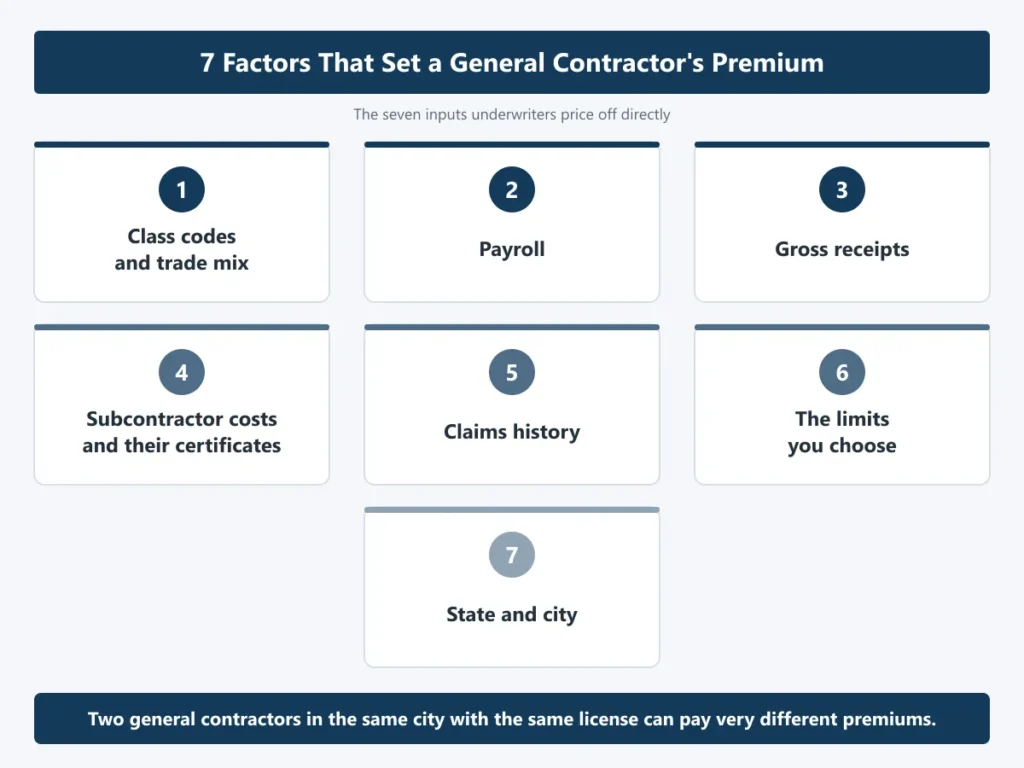
7 factors that set a general contractor's premium
In brief: Two general contractors in the same city with the same license can pay very different premiums, and the reason is almost always one of seven inputs that underwriters price off directly: class codes and trade mix, payroll, gross receipts, subcontractor costs and their certificates, claims history, the limits you choose, and where the work happens.
1. Class codes and trade mix
In our quoting experience, the classification assigned to the work is a major lever on both general liability and workers compensation. Roofing, structural work, work at height, and interior finish work present different exposures. Describe every operation accurately so the broker can seek the correct classifications and avoid preventable audit problems.
2. Payroll
Workers compensation class pricing is commonly expressed against payroll. For statewide context, the California Department of Insurance adopted an average advisory pure premium rate of $1.65 per $100 of payroll effective September 1, 2026. That statewide advisory figure is not a contractor quote. Payroll can also be a rating input for contractor general liability, depending on the carrier and class.
3. Gross receipts
Many contractor general liability policies use gross receipts or total cost of work as a rating input. Rapid growth can therefore change the renewal substantially. Use a realistic projection and update the broker when the business changes instead of waiting for the audit.
4. Subcontractor costs and their certificates
In our experience helping general contractors through premium audits, carriers ask for subcontractor certificates and payment records. Missing or expired certificates can cause subcontracted work to be treated as an uncovered exposure and can increase the audit bill, depending on the policy and carrier rules. Collect the certificate before the subcontractor starts, retain it with the job records, and confirm that its dates cover the work. Our page on the certificate of insurance explains what to review.
5. Claims history
Underwriters review prior losses and open claims. In our quoting experience, a clean and well-documented loss history can improve the available options, while a serious open claim can narrow them until the carrier understands the current status.
6. The limits you choose
In our experience quoting general contractors, project contracts often request $1 million per occurrence and $2 million aggregate for general liability. Higher limits, lower deductibles, and broader endorsements can change the price. Ask the broker to compare higher primary limits with an umbrella or excess option instead of assuming one structure will always cost less.
7. State and city
State rules, where the work occurs, and carrier appetite can change the available options. California and Texas treat workers compensation differently, and local permit or contract requirements can affect the coverage a general contractor must show. The next section links to city-specific guides without forcing a statewide average onto every business.
What it costs in your city
In brief: State rules are a useful starting point, but the quote can still change with where the work occurs, the available carriers, and local permit or contract requirements. We publish city-level cost guides for the California and Texas markets where we place general contractor business most often.
In California, the two markets we get asked about most are Los Angeles and the Bay Area. If you are bidding there, read our Los Angeles general liability cost guide or the San Francisco general liability cost guide for local pricing and the permit realities in each. They go into the city level detail that a statewide guide cannot.
In Texas, the split runs along the two big metros. Our Dallas general liability cost guide and Houston general liability cost guide cover what general contractors in each market pay and what the local registration and certificate expectations look like. If you work in both, read both, because they do not behave the same way.
If your city is not listed, use the state rule sections above as the compliance starting point and request a quote for the actual operation. Our general contractors page covers the trade as a whole.
How to pay less for general contractor insurance
In brief: The reliable ways to cut a general contractor’s insurance bill are not tricks, they are housekeeping: get your classifications right, report payroll and receipts honestly the first time, collect subcontractor certificates before the audit, put your lines with one broker, pay annually, and raise deductibles on purpose rather than by accident.
Get the class codes right
Ask your broker to walk you through every code on the policy and what work it is supposed to cover. Misclassification can make a general contractor’s policy inaccurate or unnecessarily expensive. Correcting the operations and records gives underwriters a cleaner account to review.
Report payroll and receipts honestly the first time
A low estimate can produce a low deposit premium and a painful audit bill after the policy term. Estimating accurately does not erase the exposure, but it can remove the surprise.
Collect subcontractor certificates before the work starts
In our experience helping general contractors with audits, collecting subcontractor certificates before work starts is one of the most useful recordkeeping habits. Carriers review certificates and subcontractor payments under their own audit rules. Build a folder, get the certificate before the subcontractor starts, and check that the policy dates cover the job.
Put the lines with one broker
Placing general liability, workers compensation, commercial auto, and umbrella through one broker can make the account easier to coordinate. It also gives one person a chance to compare the policies with the contract before a certificate is issued.
Pay annually and set deductibles deliberately
Some carriers charge installment fees, so ask whether annual payment changes the total. A higher deductible may lower the premium, but only take that trade if the business can pay the deductible after a loss.
Do not buy the cheapest certificate you can find
A policy that excludes the work you actually do is not cheap, it is decorative. We would rather quote you honestly and lose on price than hand you a certificate that fails when a claim lands.
Frequently asked questions
How much does general contractor insurance cost?
How much does general contractor insurance cost?
There is no reliable one-size-fits-all price for general contractor insurance. In our experience quoting contractors in California and Texas, the premium depends on the work performed, payroll, gross receipts, subcontractor costs, vehicles, limits, loss history, and required endorsements. General liability is only one line in the stack, so a business with employees and vehicles should not use a general liability average as its total insurance budget. A quote based on current business records is the defensible answer.
How much is general contractor insurance in California?
How much is general contractor insurance in California?
California general contractor insurance does not have one statewide retail price. In our quoting experience, class codes, payroll, receipts, subcontractor costs, vehicles, limits, and loss history determine the result. The California Department of Insurance adopted an average advisory workers compensation pure premium rate of $1.65 per $100 of payroll effective September 1, 2026, but the Department says the figure is advisory and insurers set their own rates. It is market context, not a quote for a general contractor.
How much is general contractor insurance in Texas?
How much is general contractor insurance in Texas?
Texas general contractor insurance does not have one defensible statewide average. In our quoting experience, operations, payroll, receipts, subcontractor costs, vehicles, limits, and loss history shape the price. TDLR's regulated-program list does not include a statewide general contractor credential, but specific trades can require licenses and insurance. Local requirements and project contracts can also require liability limits, additional insured wording, workers compensation, or certificates, so the written requirements must be checked before quoting.
What insurance does a general contractor need in California?
What insurance does a general contractor need in California?
A California general building contractor normally works under a CSLB Class B license and posts the $25,000 contractor license bond CSLB requires for an active license. CSLB states that construction employers must carry workers compensation even with one employee, and that active C-8, C-20, C-22, C-39, and C-61/D-49 licensees must carry it whether or not they have employees. CSLB also requires LLC licensees to carry at least $1 million in liability insurance, with the required limit rising as personnel of record increases.
Does Texas require general contractors to carry insurance?
Does Texas require general contractors to carry insurance?
The Texas Department of Insurance states that private employers can choose to carry workers compensation and that it is not required in most cases. Texas Labor Code Section 406.096 requires a governmental entity entering a building or construction contract to obtain written workers compensation certification covering each contractor employee on the public project, with subcontractor certificates passed through the general contractor. Separate trade licenses, local requirements, and project contracts may also require insurance or certificates.
How fast can ContractorsInsured cover a general contractor?
How fast can ContractorsInsured cover a general contractor?
Same business day for general liability in most cases. We are a licensed brokerage in California and Texas (CA #6015321, TX #3305690), so we can quote your general contractor GL the same business day you send class codes, payroll, and gross receipts, then issue your certificate of insurance right after binding. Workers compensation, commercial auto, and builders risk move fast as well, though those lines depend on carrier underwriting and on how quickly we get your payroll and vehicle detail.
How much does a $1 million general liability policy cost for a general contractor?
How much does a $1 million general liability policy cost for a general contractor?
A $1 million per occurrence and $2 million aggregate general liability policy does not have one standard contractor price. In our experience quoting general contractors, project contracts often request that limit structure, but operations, payroll, gross receipts, subcontractor costs, loss history, and endorsements still drive the quote. Ask the broker to price the exact contract requirements and compare any umbrella or excess option needed above the primary policy. A marketplace average cannot answer that account-specific question.
How do I get a same-day COI as a general contractor?
How do I get a same-day COI as a general contractor?
Send us your business name, the project, and exactly what the certificate holder wants to see, including any additional insured or primary and noncontributory wording. If you already hold a policy with us, we issue the certificate of insurance the same business day. If you do not have a policy yet, we quote general contractor general liability the same business day, bind it, and issue your COI right after binding, which is usually the fastest honest route to a certificate.
Get covered before your next bid
If you are pricing a job right now and the owner has already asked for a certificate, the fastest path is a quote, not more reading. Send us your class codes, payroll, and gross receipts, and we will come back the same business day with general liability pricing, then build the rest of the stack around it.
We are licensed in both states that this guide covers, California license #6015321 and Texas license #3305690, which means the same broker can handle a CSLB Class B licensee in Los Angeles and a nonsubscriber general contractor in Houston without handing you off. That is unusual, and it is the reason we can tell you honestly where each state costs more and why.
Get a general contractor insurance quote
Written and reviewed by Pascal Burke, Licensed Insurance Broker. Pascal Burke is the founder of ContractorsInsured.net, a licensed insurance brokerage serving contractors in California and Texas. CA License #6015321. TX License #3305690.