
TL;DR: Flooring installers pay a median of about $63 per month for general liability, based on Insureon flooring and carpet installer policy data. Revenue, payroll, location, subcontractor use, claims, limits, and the exact flooring operations move the final price. The common $1M/$2M standard limits satisfy many contract requests, but the policy generally pays for covered injury or damage to other property, not the cost of redoing your own faulty floor. California regulates qualifying flooring work through CSLB, while Texas has no statewide flooring license and relies more heavily on city permits and contracts. ContractorsInsured.net is a licensed brokerage in California and Texas (CA #6015321, TX #3305690): we quote flooring general liability the same business day and issue your COI right after binding.
What insurance does a flooring contractor actually need?
In brief: General liability is the core policy because it can respond when flooring work causes third-party injury or damage, including certain completed-operations claims after handoff, while installation floaters, commercial auto, workers’ compensation, and umbrella coverage address materials, vehicles, employees, and contract limits that GL does not.
General liability is the core policy
A flooring installer works inside finished homes, stores, offices, and occupied multifamily buildings. One dropped grinder can damage a countertop. Adhesive or debris can create a slip hazard. A connection or moisture-control mistake can lead to damage beyond the flooring. A well-matched contractor general liability policy can respond to covered third-party bodily injury, third-party property damage, personal and advertising injury, and legal defense, subject to the policy’s limits, exclusions, and endorsements.
Completed operations deserves special attention. The floor may look fine when the crew leaves, yet a loose transition, cracked tile, failed adhesive, or moisture-related movement can surface later. Products-completed operations coverage can address covered bodily injury or property damage caused by completed work after handoff. The Hartford’s completed-operations guidance confirms that the claim must involve completed work causing bodily injury or property damage and that exclusions still apply.
Installation floater and inland marine
Hardwood, tile, carpet, underlayment, and adhesives may belong to the contractor or client while moving from a supplier to a temporary storage area and then to the job. General liability is not first-party property coverage for that stock. An installation floater can protect covered materials in transit, at temporary locations, and at the jobsite until installation and signoff. Travelers describes installation floater coverage as protection for direct physical loss or damage to materials, supplies, and certain labor costs, subject to exclusions.
Commercial auto, workers’ compensation, and umbrella
A personal auto policy may not cover a business-owned van or truck used to haul flooring and equipment. Commercial auto addresses covered liability and physical damage involving scheduled business vehicles. Hired and non-owned auto may be relevant when the business uses personal, rented, or leased vehicles. Workers’ compensation handles employee work injuries and illnesses, which general liability excludes.
An umbrella adds limits above qualifying underlying liability policies. It matters when a project owner or one of the general contractors you work for requires limits above the base policy. Do not assume an umbrella fixes missing wording or an excluded operation. The underlying policy, umbrella, and contract must be reviewed together.
General liability is not a blanket statutory requirement for every flooring contractor nationwide. California requires liability insurance for contractor LLC licensees, and some cities impose their own insurance conditions. More often, GCs, landlords, commercial clients, and vendor portals require GL through a contract and ask for a certificate of insurance as proof.
How much does flooring contractor insurance cost in 2026?
In brief: Flooring and carpet installers pay a median of about $63 per month, or $759 per year, for general liability through Insureon, and we use that flooring-class figure as a benchmark before ContractorsInsured shops the contractor’s actual operations, state, revenue, payroll, claims, and contract requirements.
Insureon’s live flooring cost page reports a $63 monthly median for a policy with $1 million per occurrence, $2 million aggregate, and a $500 deductible. That is a useful starting point, not a promise. It reflects businesses that purchased through the marketplace, and a new installer with low revenue can price differently from a commercial flooring company with crews, subcontractors, high material values, or prior losses.
| Provider or marketplace | Published figure | What the figure actually represents |
|---|---|---|
| Insureon | $63 per month, $759 per year | Median flooring and carpet installer GL premium. The displayed policy has $1 million per occurrence, $2 million aggregate, and a $500 deductible. |
| NEXT | No published price | NEXT’s tile, stone, and flooring installer page describes coverages and advertises discounts of up to 25%, but publishes no dollar premium, so there is nothing here that can be compared honestly with Insureon’s median. Pricing is shown only after you run a quote. |
| Thimble | $108 per month | Generic contractor general liability average, not a flooring-class figure. Thimble’s flooring page does not publish a flooring-specific price. |
| biBERK | No published price | biBERK’s installation page describes installer coverages and advertises savings of up to 20% against other carriers, but that promotional claim is not a flooring premium and no dollar figure is published. |
| TechInsurance | $63 per month, $759 per year | Median flooring-contractor GL premium, with $1 million per occurrence, $2 million aggregate, and a $500 deductible. |
The matching Insureon flooring page also reports medians of $193 per month for workers’ compensation, $185 per month for commercial auto, and $14 per month for tools and equipment coverage. These are separate policy medians. Adding them together does not create a valid package quote because not every buyer purchases every policy, and each policy uses different rating inputs.
Pricing data note: Insureon flooring-class medians. General liability is $63 per month, workers’ compensation is $193 per month, commercial auto is $185 per month, and tools and equipment is $14 per month. Each is a flooring-class median. The common $1M/$2M standard limits shown are $1 million per occurrence and $2 million aggregate. Prices are medians, not quotes.
What moves a flooring insurance quote?
- Silica dust: Cutting and grinding concrete, stone, mortar, and tile can create respirable crystalline silica. OSHA’s construction silica standard requires covered employers to limit exposure and implement protective measures. The work method and controls can affect an underwriter’s view of the operation.
- Water damage on installs: Wet subfloors, leaks, and uncontrolled moisture can damage flooring and adjacent finishes. The 2025 NWFA Installation Guidelines explain that installing wood flooring before adequate subfloor drying can lead to gaps, expansion, and other failures.
- Completed-operations claims: Injury or damage can appear after the installer has left. Limits, exclusions, residential versus commercial work, and any completed-operations restriction therefore matter as much as jobsite accident coverage.
- Materials value on site: A truckload of hardwood or tile creates a different first-party property exposure from a few hand tools. The quote should separate tools, materials awaiting installation, and property owned by others.
- Business profile: Annual revenue, payroll, subcontractor cost, location, years in business, claims, project size, and requested endorsements all affect underwriting. Insureon and TechInsurance list these factors on their flooring cost pages.
Marketplaces publish medians. We quote the contractor in front of us. ContractorsInsured checks the operations description, class code, state, contract limits, additional-insured request, and completed-operations wording before comparing available carrier options. A low headline price is not useful if the policy excludes the work or cannot produce the endorsement the GC requires.
California vs Texas: two opposite rulebooks for flooring contractors
In brief: California generally requires the proper CSLB classification when a flooring project reaches $1,000 in combined labor and materials or uses workers or a permit, while Texas has no statewide flooring license, leaving city registration, permit rules, client contracts, and GC insurance requirements to control much of the job.
| Issue | California | Texas |
|---|---|---|
| State flooring license | C-15 covers flooring and floor covering, except ceramic tile. C-54 covers ceramic and mosaic tile. | No statewide flooring license appears on TDLR’s current list of regulated programs. |
| Small-job threshold | The minor-work exemption is below $1,000 and has conditions. A license is required if the project reaches $1,000, needs a permit, or uses employee labor. | No comparable statewide flooring-license threshold. |
| Bond and GL | Licensed contractors need a $25,000 contractor bond. LLC licensees also need a $100,000 employee or worker bond and at least $1 million in liability insurance for five or fewer personnel of record. | No statewide flooring bond or GL mandate. City permit registrations and private contracts can impose insurance conditions. |
| What blocks the job | CSLB classification, license status, bond, workers’ compensation status, and project-specific permits. | City registration or permits when applicable, plus the GC’s subcontract and COI requirements. |
California: C-15, the $1,000 line, and required bonds
The CSLB C-15 classification covers surface preparation and the installation of carpet, resilient sheet goods, resilient tile, wood floors, and other floor-covering materials. It expressly excludes ceramic tile. Contractors installing ceramic or mosaic tile should review the separate C-54 classification rather than assuming C-15 covers every product called flooring.
California’s old $500 threshold is stale. CSLB’s AB 2622 implementation bulletin says the minor-work exemption increased to $1,000 on January 1, 2025. Current Business and Professions Code section 7048, amended again effective January 1, 2026, keeps the aggregate price below $1,000 and denies the exemption when a permit is required, when the person employs someone on the work, when contracts are split to evade licensing, or when other listed conditions apply.
Every active CSLB contractor license needs a $25,000 contractor bond. A California contractor LLC has extra requirements: CSLB lists a $100,000 employee or worker surety bond in addition to the contractor bond, plus liability insurance with a cumulative limit of at least $1 million for an LLC with five or fewer personnel of record. The required liability limit rises with additional personnel under CSLB’s schedule.
Licensing errors can also affect payment rights. Business and Professions Code section 7031 generally bars an unlicensed contractor from recovering compensation for work that required a license and permits a customer to seek recovery of compensation paid, subject to the statute’s exceptions. This is often called disgorgement risk. Flooring contractors should confirm classification and license status before bidding, not after a payment dispute.
For broader California insurance context, see ContractorsInsured’s California contractor GL page and the local Los Angeles contractor cost guide. Those pages explain insurance practice, while CSLB and the Legislature control the licensing rules.
Texas: no state flooring license, but local and contract rules still matter
The TDLR list of licensed and regulated programs includes trades such as air conditioning, electricians, and water-well drilling, but it does not list flooring. That supports the limited statement that Texas has no TDLR statewide flooring license. It does not mean every flooring job is permit-free or that a city, property owner, or GC must accept an uninsured installer.
- Houston: The city’s official new-business guide states that prime and general contractors are not professionally licensed in Houston and that there is no general contractor license. Project permits and separately licensed trade work can still apply.
- Austin: Austin Development Services says a GC does not need a state license, but a GC must register before being assigned to and activating a building permit. The registration is not an annual flooring license.
- San Antonio: San Antonio Development Services says commercial GCs have no license or registration requirement, but permitted residential nonstructural home-improvement work requires registration. That registration currently calls for liability limits of $300,000 per occurrence, $600,000 total, and $300,000 for products and completed operations.
Private requirements can be stricter than the city rule. A GC may ask a flooring subcontractor for the common $1 million per occurrence and $2 million aggregate limits, products-completed operations, and additional-insured status. A COI proves policy information; it does not create an endorsement or rewrite coverage. Contractors should send the insurance exhibit before binding.
For Texas placement context, use ContractorsInsured’s Texas contractor GL page and Houston contractor cost guide. Less state occupational licensing does not mean less insurance in practice. It means the controlling requirement may sit in a city portal, subcontract, lease, or bid packet rather than a statewide flooring statute.
No policy yet but a GC or property manager wants a COI?
Send us the insurance page from the contract with your flooring operations, state, revenue, payroll, and claims details. We can quote eligible general liability the same business day, then issue the COI right after binding. Endorsements remain subject to carrier approval and policy terms.
Workers' comp: California's mandate vs the Texas opt-out
In brief: California employers need workers’ compensation with one employee, and its contractor-license rules become stricter for all classifications in 2028, while Texas private employers can opt out but face notice duties and lose specified common-law defenses if an uncovered employee proves negligence in an injury lawsuit.
California flooring contractors
The California Department of Industrial Relations states that an employer must maintain workers’ compensation even with only one employee. That rule already applies to a C-15 flooring business with employees. Do not treat a 1099 label as automatic proof that a worker is an independent contractor. Classification depends on the actual relationship and applicable law.
CSLB adds a licensing layer. SB 216 made workers’ compensation mandatory regardless of employee count for C-8 Concrete, C-20 HVAC, C-22 Asbestos Abatement, C-39 Roofing, and D-49 Tree Service classifications. Flooring C-15 is not on that five-class list, so an eligible no-employee C-15 licensee may still file an exemption under the current rules.
SB 1455 moved the all-classifications mandate from January 1, 2026 to January 1, 2028. The later SB 291, signed October 7, 2025, did not extend that deadline. It increased penalties for false exemptions and requires CSLB by January 1, 2027 to establish and report an evidence-based exemption-verification process. CSLB’s March 2026 board packet confirms that the existing exemption ends and all licensees must carry coverage beginning January 1, 2028 under current law.
Texas flooring contractors
The Texas Department of Insurance says private employers may choose whether to provide workers’ compensation. An employer that declines becomes a non-subscriber and must give required notices and make required state reports. An opt-out is a legal choice, not a zero-risk substitute for coverage.
Texas Labor Code section 406.033 removes specified defenses in an employee injury action against an employer without workers’ compensation. The employer cannot defend on the ground that the employee was contributorily negligent, assumed the risk, or was hurt by a fellow employee’s negligence. The employee still must prove employer negligence, subject to the statute.
Many GCs require subcontractors to carry workers’ compensation even when Texas law lets the employer opt out. Some sole operators seek a minimum-premium or no-payroll arrangement commonly called a ghost policy, but availability, audit treatment, and contract acceptance vary. ContractorsInsured can move workers’ compensation and commercial auto submissions fast, but the firm same-business-day promise applies only to eligible GL.
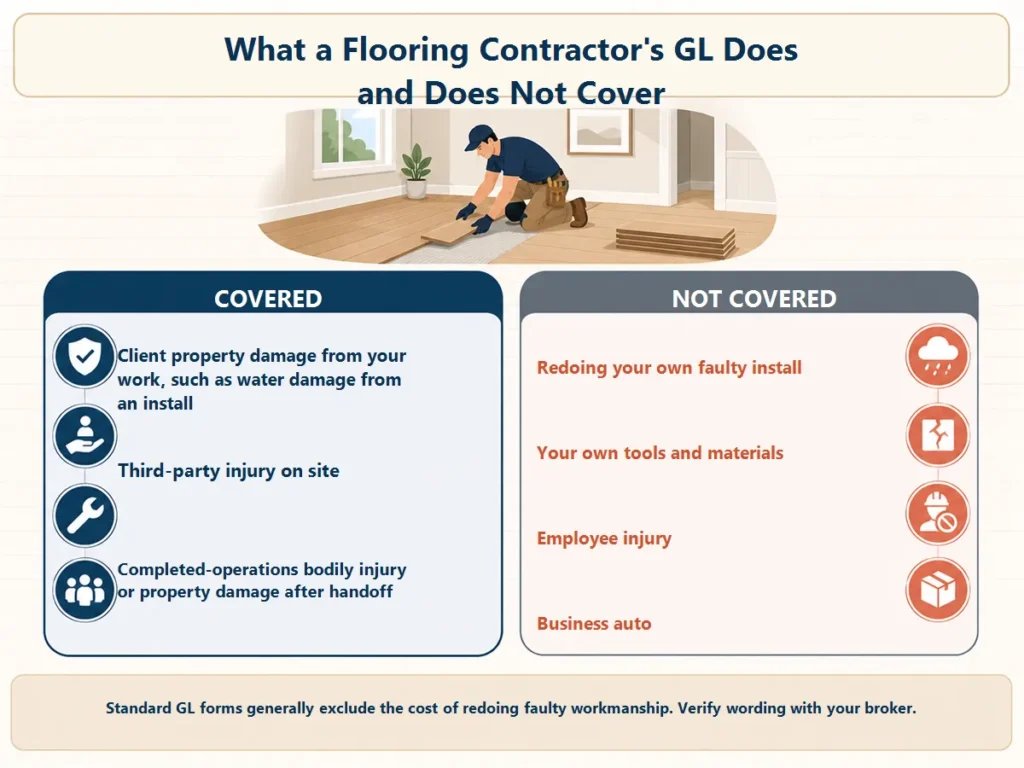
What flooring contractor GL does NOT cover
In brief: Flooring general liability can cover qualifying third-party injury and damage to property beyond the contractor’s work, but it generally does not pay to rip out and relay the contractor’s own defective installation, replace owned tools or materials, cover employee injuries, or insure business-auto accidents.
The clearest way to read a flooring claim is to separate resulting damage from the failed work itself. If a covered occurrence tied to an installation causes water damage to the client’s walls, cabinets, or unit below, GL may respond to that other-property damage. The cost of ripping out and relaying the defective floor itself is generally a workmanship or your-work problem, subject to the actual form and endorsements.
A Hartford commercial general liability specimen form shows why wording matters. Its exclusions address property that must be repaired or replaced because work was incorrectly performed, damage to “your work” within completed operations, and impaired property. The form also includes exceptions, including a subcontractor exception to its your-work exclusion. Policies and endorsements vary, so no summary can replace the issued form.
Covered, subject to policy terms
- Client property damage from your work, such as water damage from an install: Other-property damage may qualify when caused by a covered occurrence and not removed by another exclusion.
- Third-party injury on site: A client or visitor who trips over flooring materials may have a bodily injury claim. Employees belong under workers’ compensation.
- Completed-operations bodily injury or property damage after handoff: The claim can qualify when completed work causes covered injury or damage after the job is done and completed operations has not been excluded or restricted.
Not covered by standard GL
- Redoing your own faulty install: GL is not a performance warranty. Use correct installation procedures, written scope, moisture records, product documentation, and any applicable contractors’ E&O coverage to manage that exposure.
- Your own tools and materials: Contractor tools coverage and an installation floater address covered first-party losses. The Hartford also notes that contractor GL does not cover the contractor’s own property or tools.
- Employee injury: Workers’ compensation pays covered medical and wage benefits for work-related employee injuries. GL excludes employee injury in the course of employment.
- Business auto: Commercial auto, hired auto, or non-owned auto coverage is needed for covered vehicle liability. Carrying planks in a work van does not turn GL into auto insurance.
Professional design advice creates another gap. If the contractor selects an incompatible system, gives a moisture or substrate recommendation, or is accused of a professional mistake that causes financial loss without covered bodily injury or property damage, standard GL may not respond. NEXT describes contractors’ E&O as separate protection that may address certain workmanship errors, defense costs, and professional mistakes. Coverage depends on the E&O form.
Bottom line: GL may pay for covered water damage the installation caused to the client’s other property. It generally does not pay for ripping out and relaying the faulty floor itself. Standard GL forms generally exclude the cost of redoing faulty workmanship. Verify wording with your broker.
Review the actual general liability coverage, completed-operations terms, your-work wording, care-custody-control restrictions, residential exclusions, and endorsements before relying on a certificate. The policy and endorsements control the claim, not the COI or this guide.
How to pay less for flooring contractor insurance
In brief: Flooring contractors can often improve pricing by using an accurate operations class, reporting revenue and payroll honestly, comparing eligible carriers, bundling property with GL when a BOP fits, choosing a sustainable deductible, paying annually when the discount is real, and preventing rushed COI corrections.
- Use the right class description. Flooring installation, tile work, refinishing, floor cleaning, and general carpentry are not interchangeable. We classify the work actually performed and disclose side operations. A misleading cheaper class can create audit, cancellation, or claim problems.
- Report revenue, payroll, and subcontractor cost accurately. Understating exposure can produce an unpleasant premium audit. Separate employee payroll from subcontracted cost and keep certificates for insured subs.
- Compare the package, not one premium. A carrier that is cheap for GL may not offer the completed-operations wording, additional-insured endorsement, or state appetite the contract requires.
- Test a BOP when eligible. Insureon reports a $109 monthly flooring BOP median and says a BOP combines GL and commercial property at a discount. Compare its property coverage, limits, and exclusions with separate policies rather than assuming the bundle always wins.
- Price annual pay and deductibles. Ask for the total annual cost under monthly and annual billing. Then test a higher deductible only if the business could comfortably fund it after a loss.
- Keep COI details clean. Save certificate-holder names, addresses, job numbers, insurance exhibits, and recurring endorsement requests. Better information does not guarantee a lower premium, but it reduces urgent rewrites and helps us choose a policy that can meet the contract before binding.
We shop the real flooring operation, not a generic carpentry label chosen for convenience. ContractorsInsured will tell you when an online median is relevant, when a carrier class is a mismatch, and when the contract asks for coverage that the lowest quote does not include.
Frequently asked questions
In brief: The most important answers are that flooring GL has a $63 monthly marketplace median, California and Texas use different licensing systems, faulty-work replacement is generally not a GL benefit, workers’ compensation rules differ sharply, and ContractorsInsured can quote eligible GL the same business day.
How much is flooring contractor insurance?
Flooring and carpet installers pay a median of $63 per month, or $759 per year, for general liability through Insureon. Its displayed policy carries $1 million per occurrence, $2 million aggregate, and a $500 deductible. Your quote can move with state, services, revenue, payroll, subcontractors, claims, project size, limits, and endorsements. Workers’ compensation, auto, tools, and installation-floater premiums are separate
Do flooring contractors need a license in California?
Yes, California generally requires the proper CSLB license when a flooring project reaches $1,000 in combined labor and materials, requires a permit, or uses employee labor. AB 2622 raised the old $500 line on January 1, 2025, subject to the minor-work exemption’s conditions. C-15 covers flooring and floor covering except ceramic tile, and licensed contractors need a $25,000 contractor bond.
Do you need a license to install flooring in Texas?
Texas does not issue a statewide flooring contractor license through TDLR. Local rules still matter: Austin requires GC registration before permit assignment, while San Antonio requires registration and specified liability insurance for certain permitted residential home-improvement work. Houston has no general contractor license. A GC or property owner can separately require GL, workers’ compensation, additional-insured status, and a compliant COI by contract.
How fast can ContractorsInsured cover a flooring contractor?
ContractorsInsured can quote eligible flooring general liability the same business day and issue the COI right after binding. We need complete operations, state, revenue, payroll, claims, limits, and contract requirements to keep that timeline. Workers’ compensation and commercial auto submissions also move fast, but they do not carry the firm same-business-day promise because underwriting and carrier documentation can take longer.
Does flooring contractor insurance cover water damage?
General liability may cover water damage that your flooring work causes to the client’s other property, subject to the occurrence, exclusions, limits, and endorsements. For example, covered damage to walls, cabinets, or a unit below is different from the cost of replacing the failed flooring installation. The floor itself may fall under faulty-work or your-work exclusions, so send the facts and policy forms to your broker.
Does general liability pay to replace a failed flooring install?
General liability generally does not pay to rip out and replace your own faulty flooring installation. Standard forms contain incorrectly-performed-work, your-work, and impaired-property exclusions, although wording and exceptions vary. GL may still respond when the failed install causes covered bodily injury or damage to other property. Contractors’ E&O may address some workmanship allegations, but only its actual terms determine coverage.
Do flooring contractors need workers' comp in California and Texas?
California flooring employers need workers’ compensation with one employee, while an eligible no-employee C-15 licensee may currently file a CSLB exemption. Current law ends that exemption for all classifications on January 1, 2028. Texas private employers may opt out and become non-subscribers, but they face notice and reporting duties and lose specified defenses if an employee brings and proves a negligence claim.
How do I get a same-day COI as a flooring contractor?
Send us your legal business name, flooring operations, job state, required limits, certificate-holder details, project address, and the contract’s insurance page. If you already have an active policy that supports the request, we can process your COI request quickly during business hours. If you have no policy, we first quote and bind eligible GL, then issue the certificate right after binding.
Get covered before your next install
In brief: ContractorsInsured helps flooring contractors match GL, completed operations, inland marine, workers’ compensation, auto, and COI requirements to the actual work, with Pascal Burke binding eligible GL in California and Texas the same business day and issuing the certificate right after binding.
Bring the contract before the deadline, not after a rejected COI. We will review the flooring operations, location, revenue, payroll, subcontractors, material exposure, limits, and endorsement requests, then compare available options. Start with a flooring contractor insurance quote.
If you are comparing coverage, read the full general liability guide and send us the insurance exhibit. Pricing, eligibility, forms, endorsements, and binding remain subject to carrier underwriting. This article is educational insurance information, not legal advice, and the issued policy controls coverage.
Written and reviewed by Pascal Burke, Licensed Insurance Broker. Pascal Burke is the founder of ContractorsInsured.net, a licensed insurance brokerage serving contractors in California and Texas. CA License #6015321. TX License #3305690.