

Last updated: August 2026
Reviewed by: Pascal Burke, Licensed Insurance Broker (CA License #6015321, TX License #3305690)
Most Beaumont general contractors typically pay $150 to $400 per month ($1,800 to $4,800 per year) for a standard $1M per occurrence / $2M aggregate general liability policy, with roofers, structural trades, refinery-adjacent contractors, petrochemical-plant vendors, and contractors on Port of Beaumont or Golden Triangle projects often paying more. Gulf Coast named-storm requirements sit on the property and builder’s risk side of the insurance program rather than on the general liability policy itself. As ContractorsInsured.net (TX Lic #3305690), we shop multiple Texas-admitted carriers for Beaumont contractors, quote the same business day, and issue the COI right after binding.
Beaumont presents a unique insurance environment compared to many Texas markets. Contractors operating in Beaumont and the surrounding three-county Southeast Texas region of Jefferson, Orange, and Hardin counties frequently encounter refinery owner-controlled insurance requirements, Port of Beaumont vendor standards, named additional insured obligations, waiver of subrogation language, hot-work requirements, and hurricane-related underwriting considerations. Standard residential contractors often remain near Texas averages, while refinery and petrochemical contractors can see substantially higher premiums.
What general liability insurance covers
In brief: General liability insurance protects contractors against third-party bodily injury, property damage, and personal and advertising injury claims arising from business operations.
General liability insurance is a third-party liability policy that responds to claims arising from a business’s operations, including bodily injury to non-employees, property damage to third parties, and personal and advertising injury. For contractors, it is one of the most commonly required coverages in contracts, leases, vendor portals, and city permit packets.
Common Beaumont claim scenarios include:
- A delivery driver visiting a Beaumont refinery project slips and breaks an ankle.
- A plumbing contractor performing renovation work in Nederland damages finished flooring.
- A contractor on a Groves job uses copyrighted marketing photography in its own advertisement without authorization.
- A roofing contractor in Lumberton completes work that later allows water intrusion after severe weather, damaging the building owner’s interior finishes and contents.
- A general contractor in Vidor is named in litigation involving a subcontractor’s alleged negligence.
In these scenarios general liability may respond to defense costs and covered third-party damages if the claim fits the policy language, but it does not reach every construction loss. Under the standard form, damage to the contractor’s own completed work is excluded unless that work was performed on the contractor’s behalf by a subcontractor, so repairing your own installation is normally your cost while resulting damage to other property is what the policy addresses. The standard form also excludes most intellectual property claims, with an exception for infringement of copyright, trade dress, or slogan in your own advertisement. The policy wording, the endorsements, and the allegations control.
How much does general liability insurance cost in Beaumont?
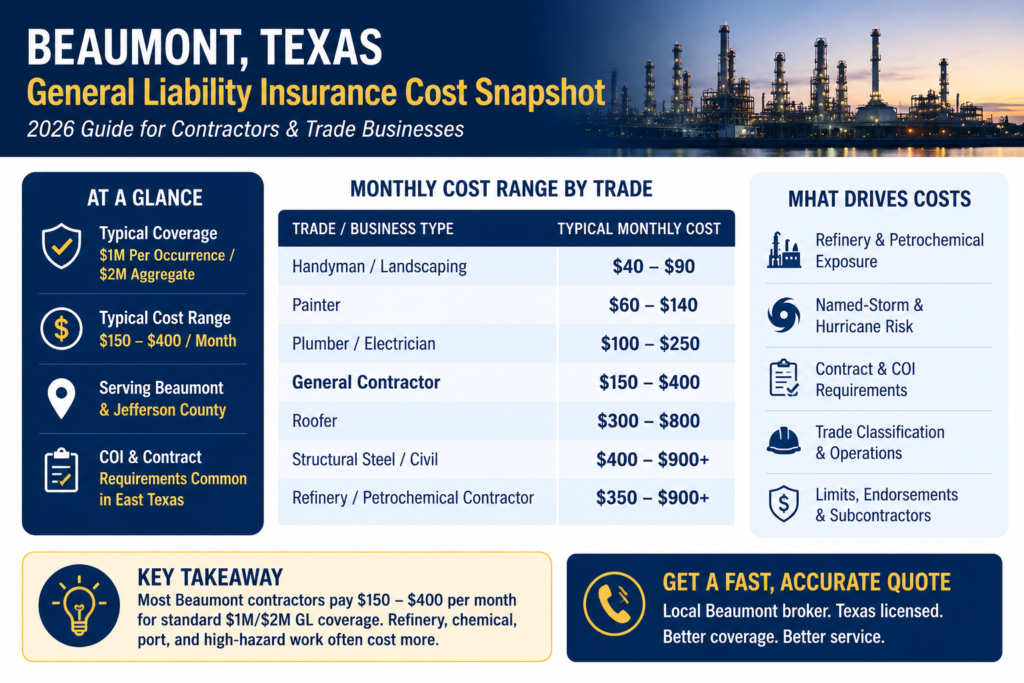
In brief: Most Beaumont contractors purchasing standard $1 million / $2 million coverage pay between $150 and $400 monthly, although refinery, petrochemical, port, and hurricane-related exposures frequently increase premiums.
Most Beaumont general contractors should expect to pay approximately $150 to $400 per month ($1,800 to $4,800 annually) for standard general liability insurance coverage.
Typical Beaumont contractor pricing:
Low-risk specialty trades:
$40 to $150 monthly
Standard residential and commercial contractors:
$150 to $400 monthly
Refinery, petrochemical, roofing, structural, and port contractors:
$300 to $900+ monthly
Examples by trade:
Handyman: $40 to $90 monthly
Painter: $60 to $140 monthly
Plumber: $100 to $250 monthly
General contractor: $150 to $400 monthly
Roofer: $300 to $800 monthly
Structural steel contractor: $400 to $900+ monthly
Refinery contractor: $350 to $900+ monthly
A contractor-focused broker can review refinery contract requirements, additional insured wording, and the property or builder’s risk terms a Gulf Coast contract asks for before coverage is bound.
Why contractor GL pricing reflects Gulf Coast refinery reality in Beaumont
In brief: Beaumont’s location within the Golden Triangle petrochemical corridor creates unique insurance exposures not commonly found in inland Texas markets.
Beaumont anchors one of the largest petrochemical regions in North America. Contractors regularly work near ExxonMobil Beaumont Refinery, Port Arthur refining operations, petrochemical facilities, marine terminals, and the Port of Beaumont.
Key pricing factors include:
- Hot-work exposure
- High-value industrial property
- Refinery owner contract requirements
- Coastal catastrophe concentration and carrier appetite
- Hurricane-related underwriting restrictions
- Port vendor requirements
- Complex additional insured schedules
“In 15+ years writing Texas contractor GL, the number one reason Beaumont refinery and petrochemical contractor COIs get rejected isn’t the policy. It’s missing the operator’s exact Additional Insured, Hot Work, and Named-Storm wording. Read the schedule before you bind.”
Pascal Burke, Licensed Insurance Broker (CA #6015321, TX #3305690)
Cost by coverage limit
In brief: Refinery and port contractors often require limits beyond standard $1 million / $2 million coverage.
$1M / $2M limits:
$150 to $400 monthly
$2M / $4M limits:
$250 to $700 monthly
$5M+ combined GL and excess:
$500 to $1,500+ monthly
Many refinery operators, port authorities, and petrochemical facilities require umbrella or excess liability coverage in addition to primary general liability insurance.
The 7 factors carriers use to price your policy
In brief: Carriers weigh trade classification, operations, and contract requirements alongside revenue and payroll.
Carriers evaluate:
Trade classification
Annual revenue
Payroll and subcontractor usage
Claims history
Geographic service area
Required coverage limits
Contractual risk transfer obligations

Beaumont contract, lease, and COI requirements
In brief: Beaumont contractors frequently encounter more complex certificate requirements than contractors in inland Texas markets.
Common requirements include:
- Additional Insured endorsements
- Primary and Noncontributory wording
- Waiver of Subrogation
- Specific certificate holder language
- Higher aggregate limits
- Named-Storm provisions on the property or builder’s risk side of the package
- Hot-work documentation
These requirements commonly appear in refinery contracts, Port of Beaumont vendor agreements, municipal contracts, and large commercial construction projects. The City of Beaumont adds a step of its own: it issues commercial building permits only to contractors who are bonded and registered with the city, which is a bond requirement rather than a general liability limit.
What general liability does NOT cover
In brief: General liability does not cover every construction-related loss.
General liability typically excludes:
- Employee injuries
- Professional errors
- Damage to your own work
- Commercial auto claims
- Pollution liability
- Intentional acts
- Storm and wind damage to property, including named-storm losses, which are first-party property claims rather than third-party liability claims
- Cyber incidents
Contractors should also evaluate workers’ compensation, commercial auto, inland marine, pollution liability, and umbrella coverage.
How Beaumont contractors can lower GL costs without creating coverage gaps
In brief: Reducing premium should never come at the expense of refinery or contract compliance.
Strategies include:
- Improve subcontractor management
- Bundle policies
- Maintain strong loss history
- Review contract requirements before binding
- Avoid unnecessary endorsements
- Separate high-risk operations
- Verify refinery and port requirements before issuing COIs
What to prepare before requesting a quote
In brief: Complete information produces faster quotes and fewer coverage disputes.
Prepare:
- Business legal name
- Texas contractor license information
- Revenue projections
- Payroll estimates
- Subcontractor usage
- Claims history
- Project types
- Coverage limits required
- Refinery/petrochemical/Port vendor portal participation (Y/N)
- Property or builder’s risk named-storm requirements (Y/N)
- Hot-work permit requirements (Y/N)
“In Gulf Coast construction, contractors save the most money by submitting complete operational information up front. Underwriters price uncertainty aggressively.”
Pascal Burke, Licensed Insurance Broker (CA #6015321, TX #3305690)
Frequently asked questions about general liability insurance cost in Beaumont TX
How much does general liability insurance cost for a Beaumont contractor in 2026?
Most Beaumont contractors pay between $150 and $400 monthly for standard coverage, while refinery and petrochemical contractors often pay substantially more due to elevated risk profiles.
Is general liability insurance legally required by Texas state law for a Beaumont contractor?
Texas has no blanket statewide requirement that every contractor carry general liability, but three licensed trades must carry it as a condition of the state license. The Texas Department of Licensing and Regulation requires electrical, electrical sign, and residential appliance installation contractors to hold at least $300,000 per occurrence, $600,000 aggregate, and $300,000 for products and completed operations (16 TAC 73.40), and air conditioning and refrigeration contractors to hold $300,000 per occurrence and $600,000 aggregate on a Class A license, or $100,000 and $200,000 on a Class B license (16 TAC 75.40). A responsible master plumber must maintain at least $300,000 in commercial general liability under Texas Occupations Code 1301.552. Outside those trades it is contracts, municipalities, lenders, and project owners that require coverage.
What GL limits do Port of Beaumont and refinery contracts typically require?
Limits are set by the individual contract, not by a published Port or refinery standard. Refinery, petrochemical, and Port vendor agreements often ask for more than a standard $1 million per occurrence and $2 million aggregate, usually by adding umbrella or excess liability. Read the insurance exhibit for the specific job before you bind.
How does refinery, petrochemical, or hot-work exposure affect a Beaumont contractor's GL premium?
These exposures increase underwriting scrutiny due to fire, explosion, and catastrophic loss potential.
How does Named-Storm or hurricane coverage interact with general liability in Beaumont?
Named-storm deductibles, sublimits, and endorsements belong to property, builder’s risk, and inland marine coverage, not to general liability. General liability responds to third-party bodily injury and property damage claims, so a Beaumont contract asking for named-storm terms is asking about the property side of your insurance program, not about your GL premium.
Can a Beaumont contractor get a same-day COI for a refinery or Port vendor portal?
Yes, if the contractor already has compliant coverage and provides the required certificate wording.
Does general liability cover damage I cause to my own work in Beaumont?
Generally no. Damage to your own completed work is excluded under the standard form, unless that work, or the work that caused the damage, was performed on your behalf by a subcontractor. Resulting damage to other property is treated separately.
What information speeds up a Beaumont contractor GL quote?
Revenue, payroll, subcontractor usage, claims history, project types, the limits you need, and any contract-required endorsements are the standard inputs.
Why is contractor GL in Beaumont often more expensive than inland Texas metros?
Refinery, petrochemical, and marine operations are underwritten differently from lower-hazard residential work. Location by itself does not set the price, and hurricane exposure mainly affects property coverage rather than general liability.
Get a Beaumont general liability quote
Whether you work in residential construction, petrochemical facilities, refineries, or Port of Beaumont projects, obtaining accurate coverage requires understanding both Texas contractor requirements and Gulf Coast exposure factors. Get a quote and we will confirm what your contract actually requires before you bind. Or request a certificate of insurance for a job you have already been awarded.Disclaimer: Coverage examples and pricing ranges are estimates only and vary by carrier, underwriting guidelines, claims history, operations, and contract requirements. This content is educational and does not constitute insurance, legal, or risk management advice.
Working outside Beaumont as well? See how much contractor insurance costs.