
Last updated: August 2026
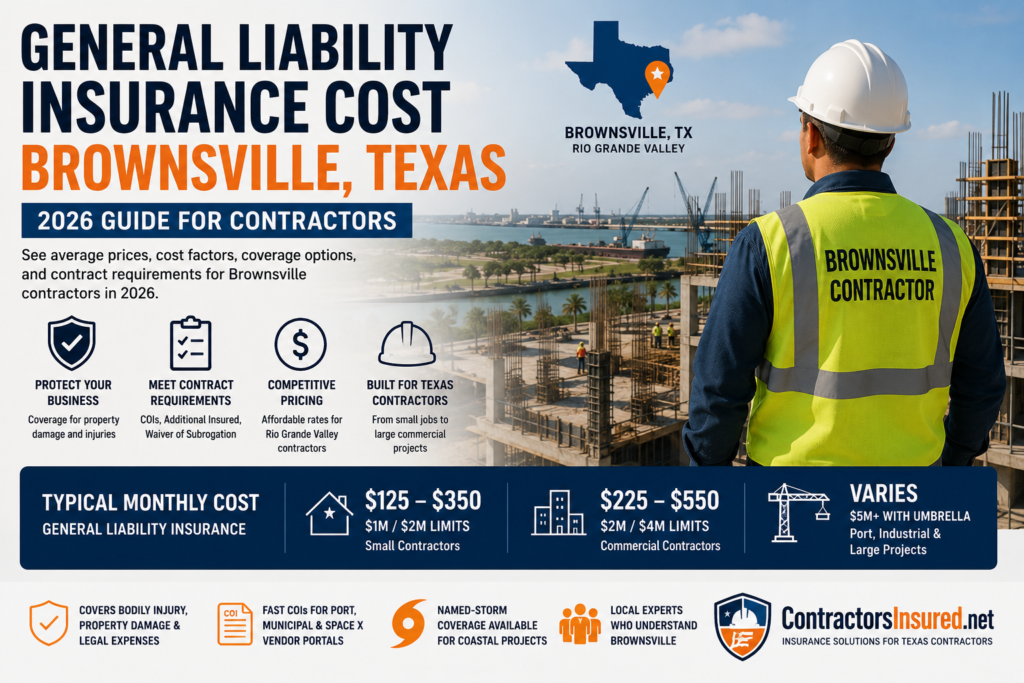
Most Brownsville general contractors typically pay $125 to $350 per month ($1,500 to $4,200 per year) for a standard $1 million per occurrence and $2 million aggregate general liability policy, with roofers, structural trades, Port-adjacent, SpaceX-adjacent, and contractors on cross-border or coastal projects often paying more, and coastal catastrophe concentration can narrow which carriers will quote the risk. As ContractorsInsured.net (TX Lic #3305690), we shop multiple Texas-admitted carriers for Brownsville contractors, quote the same business day, and issue the COI right after binding.
Brownsville contractors benefit from operating in a lower-cost insurance market than many larger Texas metros, but local conditions still influence pricing. Work involving the Port of Brownsville, Boca Chica, SpaceX-adjacent projects, coastal construction, public infrastructure, or commercial contracts often requires higher liability limits, specialized endorsements, and carefully prepared Certificates of Insurance (COIs). Understanding how insurers evaluate your business before requesting quotes can help you secure competitive pricing while avoiding costly coverage gaps that delay bids or vendor approvals.
What general liability insurance covers
In brief: General liability insurance protects Brownsville contractors against third-party bodily injury, third-party property damage, and personal and advertising injury claims. It is a core component of a contractor insurance program.
General liability insurance is a third-party liability policy that responds to claims arising from a business’s operations, including bodily injury to non-employees, property damage to third parties, and personal and advertising injury. For contractors, it is one of the most commonly required coverages in contracts, leases, vendor portals, and city permit packets.
Whether you remodel homes in Los Fresnos, perform maintenance at the Port of Brownsville, complete tenant improvements downtown, or work on commercial facilities throughout Cameron County, your general liability policy is often the first document clients request before allowing work to begin.
Typical protection includes:
Third-party bodily injury
Third-party property damage
Legal defense costs
Settlements and judgments
Personal and advertising injury
Products-completed operations coverage
Scenario 1: Visitor injured at a Port of Brownsville project
A delivery driver trips over temporary materials while walking through your designated work area at a Port of Brownsville construction site, suffering a broken ankle. Your general liability policy may pay medical expenses, legal defense costs, and covered damages if your company is found legally responsible.
Scenario 2: Property damage during a Los Fresnos remodel
While replacing plumbing inside a residence, your employee accidentally cracks tile flooring that another contractor installed and that is not part of your work. That is a claim for damage to someone else’s property rather than to your own work. Whether the policy responds depends on the facts and on policy terms, including the exclusions for property in your care, custody or control and for the particular part being worked on.
Scenario 3: Advertising injury
Your company uses another business’s copyrighted project photograph in your own advertising, and the copyright holder sues for infringement. The standard form excludes intellectual property claims but carves back infringement of copyright, trade dress or slogan committed in your advertisement, so personal and advertising injury coverage may respond, subject to the policy’s definitions, exclusions and other terms.
Scenario 4: Completed operations claim
A roofing contractor completes work on a South Padre Island property. Six months later, a roof leak allegedly causes interior water damage. The cost of correcting the contractor’s own defective roof work is generally excluded, while the resulting damage to other property may be covered under the completed operations portion of the policy. Where a subcontractor performed the work, the standard subcontractor exception can apply, though an endorsement can remove it.
Scenario 5: Lawsuit involving subcontractor work
An Olmito general contractor is named in a lawsuit after a subcontractor allegedly performs defective work that results in damage to another party’s property. Under the standard form the insurer has a duty to defend a suit seeking damages that the policy potentially covers, even where the allegations later prove unfounded, and no duty to defend a suit seeking damages the policy does not cover. That defense obligation is one of the more valuable parts of a general liability policy.
How much does general liability insurance cost in Brownsville?
In brief: Most Brownsville contractors purchasing standard $1 million/$2 million coverage can expect premiums between $125 and $350 per month, while higher-risk coastal, structural, Port-related, and SpaceX-adjacent operations frequently pay substantially more.
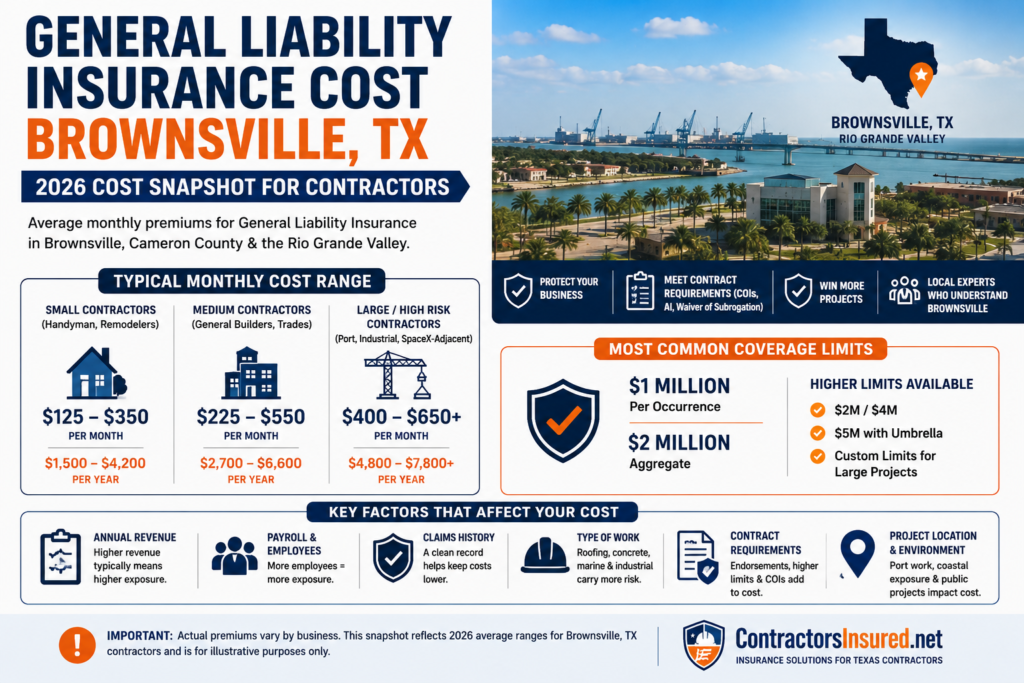
Most Brownsville general contractors typically pay between $125 and $350 per month, or approximately $1,500 to $4,200 annually, for a standard $1 million per occurrence and $2 million aggregate general liability policy.
Brownsville is often a lower-cost Texas insurance market for contractors than the largest metros, although published contractor pricing data are reported statewide rather than city by city. However, premium savings can disappear quickly when projects involve:
Port of Brownsville facilities
Brownsville Navigation District projects
Boca Chica and SpaceX-adjacent construction
Coastal developments
Public infrastructure
Higher-value commercial properties
Hot work
Elevated work
Roofing
Steel erection
Structural concrete
Insurers also evaluate annual revenue, payroll, subcontractor usage, claims history, years in business, and requested coverage limits before determining final premiums.
Estimated Brownsville contractor GL pricing
Contractor type | Typical monthly premium | Typical annual premium |
|---|---|---|
Handyman or small residential contractor | $40 to $150 | $480 to $1,800 |
General contractor | $125 to $350 | $1,500 to $4,200 |
Commercial remodeler | $175 to $450 | $2,100 to $5,400 |
Roofing contractor | $250 to $650+ | $3,000 to $7,800+ |
Structural steel, marine, Port, or heavy civil contractor | $350 to $900+ | $4,200 to $10,800+ |
Premiums are estimates only. Every insurer uses its own underwriting model, classification system, payroll assumptions, and claims data.
What drives premium differences?
Several contractors may all identify themselves as “general contractors” yet receive dramatically different quotes because insurers evaluate far more than job title alone.
A contractor who performs mostly residential remodeling in Brownsville may qualify for considerably lower premiums than a contractor performing marine work, structural steel installation, or projects inside the Port of Brownsville requiring specialized contractual endorsements.
Likewise, companies working near Boca Chica or supporting aerospace-related construction often encounter stricter insurance specifications than contractors completing routine residential renovations throughout Cameron County.
Brownsville compared with other Texas markets
Texas market | Typical general contractor premium |
|---|---|
Brownsville | $125 to $350/month |
Corpus Christi | Slightly higher because of larger coastal industrial exposure |
San Antonio | Moderate, depending on commercial mix |
Higher because of payroll, litigation trends, and commercial complexity | |
Higher because of contractor density and project values |
The comparisons above are directional underwriting observations, not measured premium differentials. Published contractor pricing is reported nationally or statewide, so no citable dataset compares Brownsville with Corpus Christi, San Antonio, Houston, or Dallas-Fort Worth. What this guide adds is the local context that shapes a submission: coastal exposure, Port projects, SpaceX-adjacent development, and Rio Grande Valley construction activity.
Contractors bidding municipal work or commercial projects should also understand that insurance requirements often extend beyond simply carrying general liability coverage. Many bid packages require endorsements such as Additional Insured status, Primary and Noncontributory wording, Waiver of Subrogation, or higher aggregate limits before work can begin.
Why contractor GL pricing reflects Rio Grande Valley reality in Brownsville
In brief: Brownsville contractors may see lower baseline premiums than contractors in the largest Texas metros, but Port operations, coastal exposure, cross-border logistics, and SpaceX-related construction frequently require broader coverage and specialized endorsements that increase premiums.
Brownsville sits in a unique insurance environment unlike almost any other Texas construction market. While labor costs, payroll, and operating expenses are generally lower than those in larger metropolitan areas, insurers evaluate several local exposures that can significantly influence general liability pricing.
The city’s position along the Gulf Coast, its proximity to the international border, and ongoing industrial expansion create insurance requirements that differ from those of inland Texas communities.
Several local conditions commonly influence underwriting decisions:
Port of Brownsville commercial and marine projects
Brownsville Navigation District vendor insurance requirements
SpaceX Starbase and Boca Chica construction activity
Cross-border transportation and logistics
Coastal catastrophe concentration and carrier appetite
Municipal infrastructure projects
Commercial development throughout Cameron County
Residential growth across the Rio Grande Valley
For many residential remodelers or small general contractors, these exposures may have little effect. However, once a contractor begins bidding larger public, industrial, marine, or coastal projects, insurance requirements usually become much more detailed.
“In 15+ years writing Texas contractor GL, the number one reason Brownsville Port and SpaceX-adjacent Certificates of Insurance get rejected is rarely the policy itself. It is almost always missing the owner’s exact Additional Insured wording, Primary and Noncontributory language, or Named-Storm requirements. Contractors should review the insurance schedule before binding coverage, not after winning the bid.”
Pascal Burke, Licensed Insurance Broker, CA License #6015321, TX License #3305690
Brownsville remains less expensive than many Texas metros
Weighing a Brownsville risk against a Dallas, Houston, or Austin one, underwriters typically look at:
Lower average payroll
Smaller annual contractor revenues
Fewer large commercial projects
Lower average replacement costs
Local claims and litigation patterns
Those factors often help keep standard general contractor premiums within the $125 to $350 monthly range for businesses with clean loss histories.
Coastal exposure changes the equation
Brownsville’s location along the Gulf Coast introduces risks that inland contractors rarely face. Most of them attach to the property side of a contractor’s program rather than to general liability, which is a third-party liability policy.
Across a coastal contractor’s policies, carriers may evaluate:
Hurricane exposure
Wind-driven rain losses
Coastal commercial properties
Marine operations
Flood-prone project locations
Named-Storm deductibles and sublimits on the property and builder’s risk policies
Named-Storm provisions are a property, builder’s risk and inland marine mechanism. The standard ISO commercial general liability form contains no named-storm deductible or sublimit, so these provisions do not change a contractor’s general liability premium. They become relevant to the property and builder’s risk coverage a contract requires on coastal commercial buildings, public infrastructure, or industrial facilities. Cameron County sits in the Texas Windstorm Insurance Association catastrophe area, and TWIA writes wind and hail property coverage, not contractor liability.
Port and industrial work typically carries higher insurance requirements
Contractors working around the Port of Brownsville often encounter insurance specifications requiring:
Higher aggregate limits
Additional Insured endorsements
Primary and Noncontributory wording
Waiver of Subrogation
Completed operations coverage
Higher umbrella limits
Meeting contractual insurance requirements is just as important as carrying adequate limits. A competitively priced policy can still delay a project if endorsements do not match the owner’s insurance specifications.
Cost by coverage limit
In brief: Choosing higher liability limits improves protection and helps satisfy commercial contract requirements, but premiums increase as coverage limits rise.
Most Brownsville contractors purchase a $1 million per occurrence and $2 million aggregate policy, while larger commercial, Port, and SpaceX-adjacent contractors often carry $2 million/$4 million limits or umbrella policies exceeding $5 million.
Coverage limits should reflect the size of projects your company performs rather than simply selecting the lowest available premium.
Estimated premium by coverage limit
Coverage limits | Typical Brownsville premium |
|---|---|
$1M / $2M | $125 to $350 per month |
$2M / $4M | $225 to $550 per month |
$5M with umbrella | Varies based on trade, revenue, and project exposure |
Higher limits are commonly requested for:
Port of Brownsville contractors
Brownsville Navigation District work
Commercial developers
Municipal construction
Industrial maintenance
Marine facilities
Aerospace-related construction
Multi-family developments
Some contracts may also specify minimum umbrella liability requirements in addition to standard general liability coverage.
Remember that increasing policy limits alone does not automatically satisfy contract requirements if endorsements such as Additional Insured status or Waiver of Subrogation are missing.
The 7 factors carriers use to price your policy
In brief: Insurance companies evaluate much more than your trade classification. Revenue, payroll, claims history, subcontractors, and project type all influence pricing.
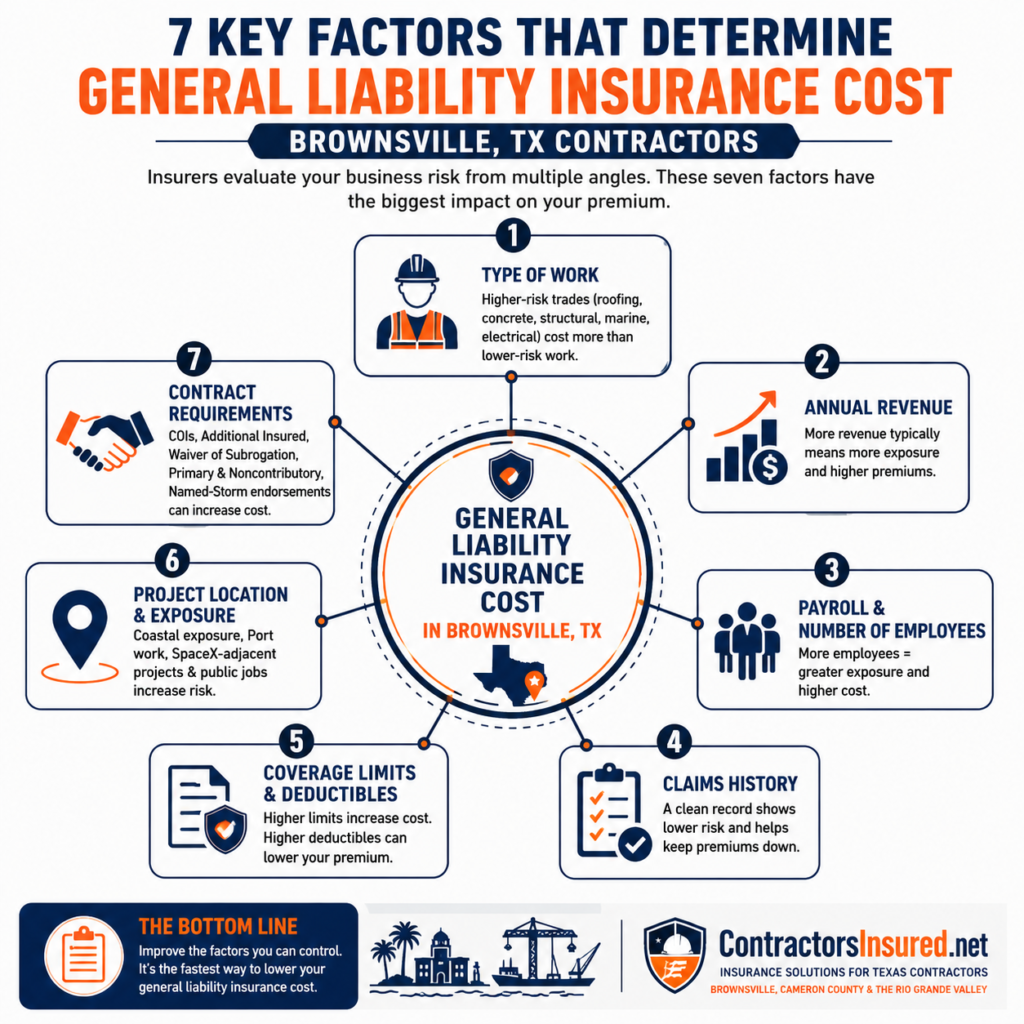
Every insurer follows its own underwriting model, but these seven factors consistently have the greatest influence on contractor general liability pricing.
Pricing factor | Why it matters | Potential premium impact |
|---|---|---|
Contractor trade | Roofing, structural steel, marine work, and concrete generally present higher risk than interior remodeling. | High |
Annual revenue | More completed work generally creates greater exposure. | High |
Payroll and employees | Larger crews increase potential claim frequency. | High |
Claims history | Prior losses often result in higher renewal pricing. | High |
Subcontractor usage | Heavy reliance on uninsured subcontractors increases underwriting concerns. | Moderate to High |
Coverage limits and endorsements | Higher limits and additional contractual endorsements increase premium. | Moderate |
Project location and operations | Port facilities, coastal work, SpaceX-adjacent projects, and public infrastructure often require broader coverage. | Moderate to High |
Revenue
Higher annual revenue generally results in higher premiums because insurers assume more completed operations and more opportunities for third-party claims.
Trade classification
A handyman performing light residential repairs presents a very different exposure than a structural steel contractor working on industrial facilities near the Port of Brownsville.
Payroll
Growing payroll usually indicates larger operations, additional job sites, and greater exposure.
Claims history
Even one significant liability claim can affect renewal pricing for several years.
Subcontractors
Insurers prefer contractors who verify every subcontractor carries current liability insurance and workers’ compensation coverage when applicable.
Coverage selection
Higher limits, broader endorsements, and umbrella liability all increase premiums but may be necessary to qualify for larger commercial projects.
Project environment
Projects involving industrial facilities, marine infrastructure, coastal development, airports, municipal construction, or aerospace-related work generally receive closer underwriting review than routine residential remodeling.
Understanding these seven underwriting factors before requesting quotes allows contractors to provide complete information, avoid underwriting delays, and compare proposals based on coverage quality instead of premium alone.
Brownsville contract, lease, and COI requirements
In brief: Many commercial, municipal, Port, and industrial projects require more than a standard general liability policy. Contractors should expect Certificates of Insurance (COIs), Additional Insured endorsements, Primary and Noncontributory wording, and Waiver of Subrogation before work begins, and on coastal projects a separate property or builder’s risk requirement alongside the liability one.
Winning a project is only the first step. Before a contractor is allowed on-site, owners frequently review insurance documents to confirm that the policy meets contract specifications.
Brownsville contractors commonly encounter insurance requirements when working for:
Brownsville Navigation District
Commercial property owners
Industrial facilities
Healthcare organizations
Educational institutions
Typical insurance requirements include:
Requirement | Why it is requested |
|---|---|
Confirms active coverage before work begins | |
Additional Insured endorsement | Extends certain liability protection to the project owner |
Primary and Noncontributory wording | Ensures your policy responds first |
Waiver of Subrogation | Limits recovery actions after covered losses |
Higher aggregate limits | Required on larger commercial or industrial projects |
Umbrella liability | Provides additional protection above GL limits |
The City of Brownsville publishes its own numbers. Its procurement policy requires a contractor to carry statutory workers’ compensation, comprehensive general liability of $1,000,000 each occurrence and $2,000,000 general aggregate, and $500,000 combined single limit automobile liability, with the City named as an additional insured on the general and auto liability and a waiver of subrogation in its favor. Separately, the City’s Planning and Redevelopment Department requires contractor registration before permitted work: general, concrete, demolition and foundation contractors pay a $250 registration fee, electrical, plumbing and irrigation contractors must show proof of insurance, electrical sign contractors must show a certificate of liability of at least $1,000,000, and billboard sign contractors at least $2,000,000.
Before submitting a COI, compare every insurance requirement in the contract with your policy endorsements. Small wording differences can delay project approval even when liability limits are sufficient.
What general liability does NOT cover
In brief: General liability insurance is essential, but it is only one part of a contractor’s insurance program. Several important exposures require separate policies.
General liability insurance does not cover every financial loss your business may experience.
Common exclusions include:
Exposure | Coverage generally needed |
|---|---|
Employee injuries | Workers’ compensation |
Damage to company vehicles | Commercial auto insurance |
Contractor tools and equipment | Inland marine coverage |
Professional design errors | Professional liability or E&O |
Intentional acts | Not covered |
Employee theft | Crime coverage |
Damage to your own faulty workmanship | The cost to repair your own faulty work is generally excluded; resulting damage to other property may be covered |
Contractors working near the coast should also check whether the contract asks for Named-Storm terms. Those sit on the property, builder’s risk or inland marine policies, not on general liability, so a compliant liability policy does not by itself satisfy a hurricane-related insurance requirement.
As your business grows, adding complementary policies often provides better protection than simply increasing general liability limits.
How Brownsville contractors can lower GL costs without creating coverage gaps
In brief: Lower premiums come from reducing underwriting risk, not removing valuable coverage.
Many contractors focus exclusively on premium price. A better strategy is improving the factors insurers reward during underwriting.
Practical ways to reduce premiums include:
Maintain a clean claims history.
Verify every subcontractor carries current insurance.
Keep payroll and revenue records accurate.
Choose deductibles appropriate for your business.
Implement documented jobsite safety programs.
Review classifications annually.
Bundle multiple business insurance policies when appropriate.
Avoid requesting unnecessary endorsements that your contracts do not require.
Review Port and municipal bid specifications before purchasing coverage.
Reducing coverage solely to obtain a lower premium can create much larger costs later if a claim occurs or a project owner rejects your insurance certificate.
What to prepare before requesting a quote
In brief: Complete information allows underwriters to provide faster, more accurate quotes and reduces delays during policy issuance.
The more complete your submission, the easier it is for insurers to evaluate your business.
Brownsville contractor quote checklist
Information | Needed? |
|---|---|
Business name and legal entity | Yes |
Texas contractor license information (if applicable) | Yes |
Annual revenue | Yes |
Estimated payroll | Yes |
Number of employees | Yes |
Years in business | Yes |
Description of operations | Yes |
Claims history | Yes |
Current insurance declarations page | Recommended |
Port or SpaceX-adjacent vendor portal? | Yes / No |
Separate property or builder’s risk coverage required? | Yes / No |
Additional Insured required? | Yes / No |
Primary and Noncontributory wording required? | Yes / No |
Waiver of Subrogation required? | Yes / No |
Providing this information during the first conversation allows underwriters to prepare more accurate proposals and helps avoid unnecessary follow-up requests.
“The fastest Brownsville quotes come from contractors who submit complete information the first time. Revenue, payroll, subcontractor details, and the project’s insurance requirements tell underwriters far more than simply describing yourself as a general contractor.”
Pascal Burke, Licensed Insurance Broker, CA License #6015321, TX License #3305690
Get a Brownsville general liability quote
Whether you build custom homes, renovate commercial properties, perform municipal work, or support industrial projects throughout Brownsville and Cameron County, the right general liability policy should do more than satisfy minimum contract requirements.
It should also help protect your business from unexpected lawsuits, property damage claims, and costly legal expenses while positioning you for future growth.
ContractorsInsured works with contractors across Texas to help match coverage with actual project risks, contract language, and budget goals.
Get a Brownsville general liability quote
Request a Certificate of Insurance (COI)
Disclaimer
The information in this guide is provided for educational purposes only and should not be considered legal or insurance advice. Coverage availability, policy language, underwriting guidelines, premiums, deductibles, endorsements, and eligibility vary by insurer and individual business. Actual pricing depends on factors including trade classification, annual revenue, payroll, claims history, project type, location, and requested coverage. Always review policy documents carefully and consult a licensed insurance professional before purchasing coverage or relying on insurance requirements contained in contracts or bid documents.
Frequently asked questions about general liability insurance cost in Brownsville, TX
Brownsville numbers sit inside a wider picture: see what contractor insurance costs nationally.
How much does general liability insurance cost for a Brownsville contractor in 2026?
Most Brownsville general contractors can expect to pay between $125 and $350 per month, or approximately $1,500 to $4,200 annually, for a standard general liability policy with $1 million per occurrence and $2 million aggregate limits. Smaller contractors such as handymen may pay less, while roofers, structural contractors, marine contractors, and businesses working on Port of Brownsville or SpaceX-adjacent projects often pay $250 to $650 or more per month because of higher-risk operations and additional contractual insurance requirements.
Is general liability insurance legally required by Texas state law for a Brownsville contractor?
Texas has no statewide general contractor license and no blanket general liability mandate for every contractor, but several licensed trades must carry it. Under 16 TAC 73.40, electrical, electrical sign and residential appliance installation contractors must maintain at least $300,000 per occurrence, $600,000 aggregate, and $300,000 aggregate for products and completed operations. Under 16 TAC 75.40, air conditioning and refrigeration contractors must maintain $300,000 / $600,000 / $300,000 for Class A licensees and $100,000 / $200,000 / $100,000 for Class B. Under Texas Occupations Code 1301.552, a city or county that requires a plumbing permit must confirm the responsible master plumber has a certificate of insurance providing commercial general liability of not less than $300,000 for all claims arising in a one-year period. Beyond the licensed trades, many project owners, municipalities, lenders, landlords, and commercial clients require proof of liability coverage before awarding contracts or allowing work to begin. Carrying general liability insurance is often essential for competing for commercial work, protecting business assets, and meeting contractual insurance obligations throughout Brownsville and Cameron County.
What GL limits do Port of Brownsville and Brownsville Navigation District contracts typically require?
They are set solicitation by solicitation, so the schedule in the specific bid package governs. Brownsville Navigation District packages published in 2024 and in June 2026 both call for statutory workers’ compensation, $1,000,000 employer’s liability, comprehensive general liability of $1,000,000 per occurrence for bodily injury and $1,000,000 per occurrence for property damage, and $1,000,000 automobile liability, with the District named as an additional insured and a waiver of subrogation on all policies. Neither package states a general aggregate figure or a primary and noncontributory requirement, so do not assume either is present. Larger industrial, marine or infrastructure work can carry higher limits and further endorsements, and those appear in the individual solicitation.
How does hurricane and Named-Storm exposure affect a Brownsville contractor's GL coverage?
Mostly it affects a different policy. Named-storm deductibles, sublimits and endorsements are a commercial property, builder’s risk and inland marine mechanism, and the standard ISO commercial general liability form contains no named-storm provision at all. Cameron County is inside the Texas Windstorm Insurance Association catastrophe area, and TWIA writes wind and hail property coverage rather than contractor liability. A general liability policy can still respond to otherwise covered third-party claims that arise after a storm, subject to its terms and exclusions, but it does not insure the contractor’s own storm-damaged property. Where a coastal contract asks for Named-Storm terms, read them against the property or builder’s risk requirement rather than the liability one.
Does SpaceX-adjacent or Port-adjacent work change a Brownsville contractor's GL premium?
It can, though there is no published surcharge for it. Contractors working near the City of Starbase at the Boca Chica site, or inside the Port of Brownsville, generally meet larger project values, stricter contractual insurance requirements, and more complex jobsite exposures, and those can increase underwriting scrutiny. No published Brownsville or Port-specific premium schedule sets a fixed uplift, so any effect comes out of the individual submission. Insurers also review project type, subcontractor usage, payroll, and required endorsements before determining final pricing.
Can a Brownsville contractor get a same-day COI for a Port or SpaceX vendor portal?
In many cases, yes. Contractors with an active policy that already includes the required endorsements can often receive a same-day Certificate of Insurance. However, if additional endorsements, higher limits, or policy changes are needed, processing may take longer. Reviewing project insurance requirements before requesting the certificate helps avoid delays that could postpone jobsite access or vendor approval.
Does general liability cover damage I cause to my own work in Brownsville?
Generally, no. General liability insurance is designed to cover claims involving bodily injury or damage to another person’s property. It does not typically pay to repair or replace your own defective workmanship. However, if faulty work results in covered damage to other property, portions of the resulting claim may be covered depending on the policy language, completed operations provisions, and the specific facts surrounding the loss. Where the work was performed by a subcontractor, the standard form’s subcontractor exception may apply, although an endorsement can remove it.
What information speeds up a Brownsville contractor GL quote?
Providing complete business information allows insurers to prepare more accurate proposals more quickly. Helpful information includes annual revenue, payroll, number of employees, years in business, claims history, subcontractor usage, project descriptions, current insurance declarations, and whether upcoming jobs involve Port of Brownsville work, SpaceX-adjacent construction, municipal contracts, coastal projects, or any separate property, builder’s risk or wind coverage the contract requires alongside general liability. Complete submissions reduce underwriting questions and speed policy issuance.
Why is contractor GL in Brownsville often priced lower than in DFW or Houston but with coastal-specific endorsements?
Published contractor pricing is reported nationally or statewide, so no citable dataset shows Brownsville is cheaper than Dallas-Fort Worth or Houston. What underwriters do weigh here is lower local payroll, smaller contractor operations and lower operating expenses, which tend to hold baseline premiums down. Pulling the other way are Port operations, aerospace-related development and specialized commercial contracts, which often require additional endorsements or higher limits. Coastal storm requirements pull on the property and builder’s risk side rather than on general liability. The net effect comes out of the individual submission, not the postcode.