

Last updated: August 2026
Reviewed by: Pascal Burke, Licensed Insurance Broker. CA License #6015321. TX License #3305690.
What general liability insurance covers
In brief: General liability helps Corpus Christi contractors pay for covered third-party injury, third-party property damage, personal and advertising injury, medical payments, and legal defense, subject to policy terms, exclusions, and limits.
General liability insurance is a third-party liability policy that responds to claims arising from a business’s operations, including bodily injury to non-employees, property damage to third parties, and personal and advertising injury. For contractors, it is one of the most commonly required coverages in contracts, leases, vendor portals, and city permit packets.
For a Corpus Christi contractor, this usually means protection when a customer, property owner, general contractor, landlord, refinery operator, Port vendor portal, or municipal contract requires proof that your business can respond to third-party claims. TDI describes CGL as coverage for claims involving bodily injury, property damage, personal injury, advertising injury, premises and operations exposure, products and completed operations, and excess or umbrella layers when limits are not enough.
If you want the full coverage breakdown, start with what general liability covers before you compare price. The lowest premium is not useful if the contract needs an endorsement your policy does not include.
Scenario card 1: Port jobsite trip and fall
A delivery driver enters a Port of Corpus Christi jobsite and trips over materials left near an access path. The driver breaks an ankle and alleges your crew failed to maintain a safe work area. A general liability policy can help pay covered defense costs and damages if your company is legally liable, subject to the policy terms, exclusions and limits.
Scenario card 2: Flour Bluff remodel property damage
A plumbing crew working on a Flour Bluff remodel cracks a homeowner’s tile floor while moving equipment through the entry. The owner demands payment for repair and replacement. GL can respond to third-party property damage, subject to exclusions and the policy’s deductible or self-insured retention.
Scenario card 3: Padre Island advertising injury
A Padre Island contractor uses a copyrighted jobsite photo in its own promotional social post without permission. The photographer sends a demand letter alleging copyright infringement. The standard general liability form excludes intellectual property claims but carves back infringement of copyright, trade dress or slogan in your own advertisement, so whether personal and advertising injury coverage responds depends on the policy wording and the facts.
Scenario card 4: Portland TX completed work issue
A Portland TX roofing crew finishes a project. Six months later, a leak causes interior damage, and the next storm raises questions about whether the loss came from faulty work, wind-driven rain, or storm damage. Products and completed operations coverage may help with resulting third-party damage, but the contractor’s own defective work is usually treated differently.
Scenario card 5: Calallen GC defense costs
A Calallen general contractor is named in a lawsuit over a subcontractor’s work on a commercial finish-out. Even if the GC did not perform the disputed work directly, legal defense costs can start immediately. GL can pay covered defense costs, which is one reason general contractors often need carefully written additional insured and subcontractor requirements.
How much does general liability insurance cost in Corpus Christi?
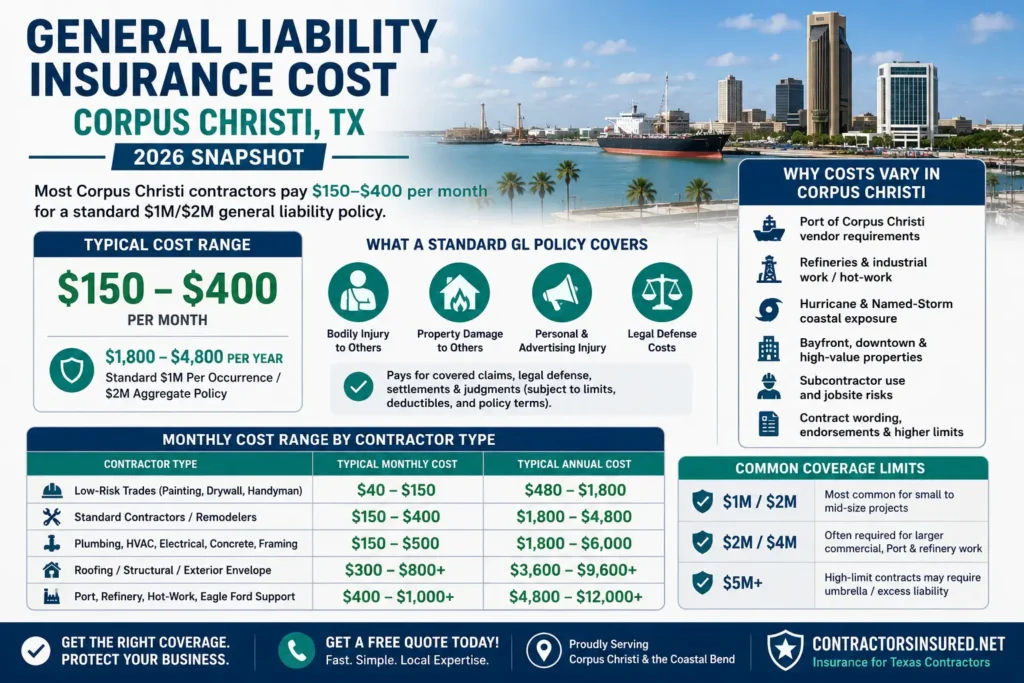
In brief: Most Corpus Christi contractors should budget $150 to $400 per month for standard $1M/$2M GL, with low-risk trades below that range and roofers, structural trades, Port-adjacent work, hot-work, and refinery contractors above it.
Most Corpus Christi general contractors typically pay $150 to $400 per month ($1,800 to $4,800 per year) for a standard $1M per occurrence / $2M aggregate general liability policy.
That is the practical Corpus Christi baseline for a clean-risk general contractor, remodeler, or trade business doing standard commercial or residential work in Nueces County. The range changes when the work involves roofing, exterior envelope, elevated work, structural trades, refinery access, hot-work, high-value coastal property, Port of Corpus Christi vendor packets, or bayfront and Padre Island projects with Named-Storm concerns.
Corpus Christi contractor profile | Typical monthly GL cost | Typical annual GL cost | Why the range moves |
Low-risk artisan trade, small payroll | $40 to $150 | $480 to $1,800 | Lower hazard class, limited subcontractors, smaller jobs |
Standard general contractor or remodeler | $150 to $400 | $1,800 to $4,800 | Normal residential and light commercial exposure |
Plumbing, HVAC, electrical, concrete, framing | $150 to $500 | $1,800 to $6,000 | Higher property damage and completed operations exposure |
Roofing, structural, exterior envelope | $300 to $800+ | $3,600 to $9,600+ | Height, water intrusion, completed work, storm questions |
Port, refinery, hot-work, Eagle Ford support | $400 to $1,000+ | $4,800 to $12,000+ | Contract wording, refinery schedules, hot-work endorsements, high severity exposure |
Trade or operation | Common Corpus Christi cost band | Coverage notes |
Painting and drywall | $75 to $225 per month | Usually moderate risk unless exterior, industrial, or large commercial |
Flooring and tile | $90 to $250 per month | Property damage claims often drive underwriting questions |
Handyman and small repairs | $40 to $175 per month | Scope of work must be tightly described |
Plumbing and HVAC | $150 to $500 per month | Water damage and completed operations matter |
General contractor | $150 to $400 per month | Subcontractor controls and contracts influence pricing |
Roofing | $300 to $800+ per month | Coastal storm and leak allegations can increase scrutiny |
Structural, concrete, excavation | $350 to $900+ per month | Severity exposure and jobsite hazard matter |
Refinery or Port-adjacent work | $400 to $1,000+ per month | COI wording, hot-work, waiver, and high limits matter |
Aggregator quote pages often show broad national averages that do not price Corpus Christi as a Coastal Bend contractor market. This guide is built around contractor-specific local exposure, so it is more useful than a generic lead-form estimate or a statewide page when your COI must satisfy a Port, refinery, city, or bayfront project requirement.
For a broader state view, compare this page with general liability insurance for Texas contractors, then use the local ranges here for Corpus Christi, Nueces County, San Patricio County, Portland, Ingleside, Aransas Pass, Flour Bluff, Calallen, Annaville, Padre Island, North Beach, and Coastal Bend job sites.
Why contractor GL costs reflect Coastal Bend reality in Corpus Christi
In brief: Corpus Christi GL pricing is not just a Texas average. Port activity, refineries, hot-work, hurricane season, bayfront property, Padre Island residential construction, and Eagle Ford logistics can change underwriting.
Corpus Christi sits at the intersection of coastal construction, industrial work, energy logistics, military-adjacent services, and hurricane exposure. The Port of Corpus Christi describes itself as a leading United States energy export gateway and the third largest port in the United States in total waterborne tonnage, and its procurement and tariff materials show why vendor access often comes with insurance, financial responsibility, security, and documentation requirements.
That local context matters because carriers price contractors based on the chance and severity of third-party claims. A painter doing single-family interiors in Calallen is not the same risk as a welding contractor entering a refinery, a roofer working on Padre Island, or a GC trying to satisfy a Port vendor packet.
“In 15+ years writing Texas contractor GL, the #1 reason Corpus Christi Port and refinery contractor COIs get rejected is not the policy; it is missing the operator’s exact Additional Insured, Hot Work, and Named Storm wording. Read the schedule before you bind.”
Pascal Burke, Licensed Insurance Broker (CA #6015321, TX #3305690)
Several Corpus Christi-specific forces affect premium:
- Port of Corpus Christi exposure: Access-controlled facilities, ship channel work, cargo movement, TWIC security areas, and high-value property increase contract scrutiny.
- Refinery and energy work: Citgo, Flint Hills Resources, Valero Bill Greehey Refinery, and Eagle Ford Shale logistics create higher-severity jobsite and hot-work questions.
- Hurricane and Named-Storm concerns: The 2026 South Texas Hurricane Guide from the National Weather Service states that hurricane season starts June 1 and ends November 30 and that the peak threat for the Texas coast exists from August through September. Carriers and contract owners may scrutinize wind, water intrusion, and Named-Storm wording on coastal jobs.
- Downtown bayfront and Padre Island property values: High-value commercial and residential work can increase claim severity.
- Subcontractor reliance: GCs using uninsured or poorly insured subcontractors may be rated up, restricted, or required to show stronger subcontractor controls.
- COI compliance: Contract owners often require exact wording for additional insured, primary and noncontributory, waiver of subrogation, completed operations, and notice of cancellation.
Contractors working beyond Corpus Christi may also compare coastal and inland pricing. For example, general liability insurance cost in Houston reflects a larger metro and petrochemical market, while general liability insurance cost in San Antonio reflects a different South Texas risk mix without the same Port and bayfront profile.
Cost by coverage limit
In brief: A $1M/$2M GL policy is the Corpus Christi baseline, but Port, refinery, airport, municipal, and larger commercial contracts may require $2M/$4M, $5M, or higher total liability limits through umbrella or excess coverage.
A standard $1M per occurrence / $2M aggregate policy is usually the starting point for Corpus Christi contractors, while $2M/$4M and $5M+ requirements can raise total cost through higher GL limits, umbrella, or excess liability.
Coverage structure | Common use in Corpus Christi | Typical cost impact | Watch-outs |
$1M per occurrence / $2M aggregate | Standard residential, small commercial, landlord COIs, routine subcontracting | Baseline | May not satisfy Port, refinery, airport, or larger GC contracts |
$2M per occurrence / $4M aggregate | Larger commercial, municipal, Port-adjacent, refinery vendor schedules | Higher than the baseline premium, by an amount that depends on carrier, class and exposure | Carrier may require stronger contracts and subcontractor controls |
$1M/$2M GL plus $1M umbrella | Contracts needing more total liability protection | Varies by operation and auto exposure | Umbrella may follow exclusions in the underlying policy |
$5M+ total limits | Refinery, energy, Port, industrial, and major GC requirements | Can materially increase total premium | Requires exact review of primary, umbrella, waiver, and additional insured wording |
Named-Storm terms asked for by a coastal contract | Coastal, bayfront, Padre Island, and storm-sensitive jobs | No effect on the general liability premium | A named-storm endorsement or deductible attaches to a commercial property, builder’s risk or inland marine policy, not to general liability |
Higher limits do not fix an excluded operation. If your work involves roofing, torch-applied material, welding, environmental exposure, marine work, or refinery operations, review GL cost factors and limits with a broker before you bind coverage.
The 7 factors carriers use to price your policy
In brief: Corpus Christi GL pricing depends on trade class, revenue, payroll, subcontractors, jobsite type, prior claims, coverage limits, endorsements, and whether the work touches Port, refinery, coastal, or Named-Storm-sensitive projects.
A Corpus Christi contractor with clean claims, lower-risk work, insured subcontractors, and standard $1M/$2M limits may stay near the $150 to $400 per month baseline, while hot-work, roofing, Port, refinery, structural, and high-revenue accounts move higher.
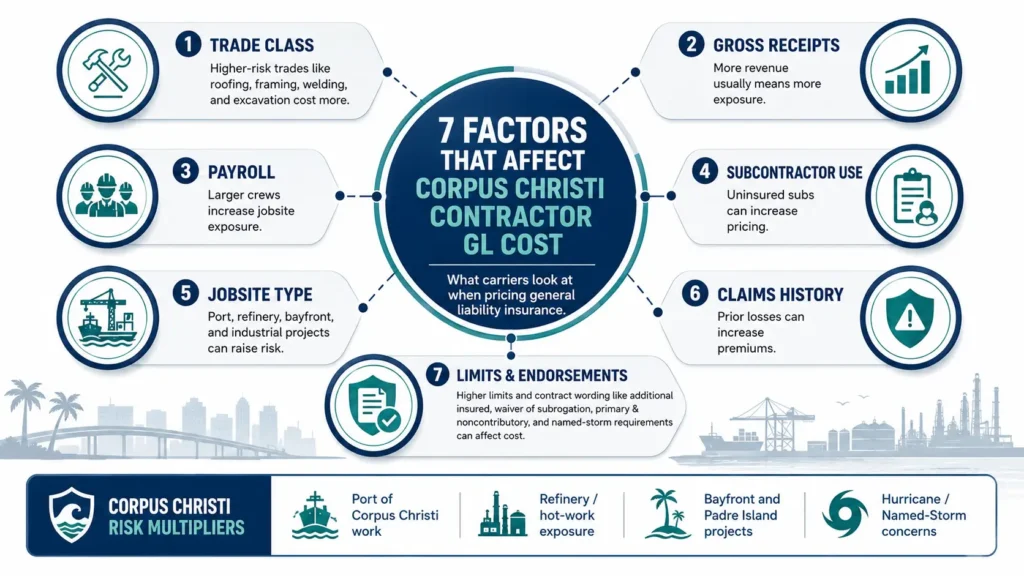
Pricing factor | Why carriers care | Corpus Christi example |
Trade class | Some trades create more frequent or severe claims | Roofing, framing, excavation, welding, and structural work price higher than painting or drywall |
Gross receipts | More work creates more exposure | Higher annual revenue generally means more of the exposure carriers are rating |
Payroll | Labor intensity affects jobsite exposure | Larger crews create more opportunities for third-party injury or property damage |
Subcontractor use | Uninsured subs can push claims back to the GC | GCs should collect COIs and written agreements before subs start |
Jobsite type | Industrial, Port, refinery, and airport sites create higher severity | Port of Corpus Christi or refinery work may require special wording |
Claims history | Prior losses signal future risk | Water intrusion, trip-and-fall, or property damage claims can affect eligibility |
Limits and endorsements | Higher limits and broader wording cost more | Additional insured, waiver, primary noncontributory, and completed operations wording may affect carrier selection |
The best carrier for one Corpus Christi contractor may be wrong for another. A small remodeler, a Port vendor, and a refinery-adjacent welding contractor may all ask for GL, but their applications should not be submitted the same way.
Contractors should also separate liability policies from property policies. The SBA’s business insurance overview lists general liability, product liability, professional liability, commercial property, and home-based business insurance as different coverage types, and the Insurance Information Institute explains that CGL generally addresses third-party injury, property damage, personal injury, advertising injury, legal defense, and related damages, subject to policy wording.
Corpus Christi contract, lease, and COI requirements
In brief: Corpus Christi contractors often buy GL because a contract, lease, bid packet, Port vendor requirement, refinery portal, landlord, or GC requires proof of coverage, not because Texas has a universal contractor GL statute.
Texas does not impose one statewide general liability insurance mandate on every Corpus Christi contractor. In practice, GL becomes required through contracts, leases, lender requirements, bid documents, permit packets, vendor portals, and owner-controlled insurance schedules.
A City of Corpus Christi contractor insurance exhibit states that the contractor must not commence work under the contract until all required insurance has been obtained and approved by the City, and that no subcontractor may start until its own insurance is in place. That exhibit sets commercial general liability at $500,000 per occurrence and $1,000,000 aggregate, business auto at a $500,000 combined single limit, statutory workers’ compensation with employer’s liability of $500,000/$500,000/$500,000, the City named as an additional insured on the general and auto liability policies by endorsement, and a waiver of subrogation on all applicable policies. Limits differ by contract and department, so read the exhibit attached to your own solicitation rather than assuming a figure. The Port of Corpus Christi Authority publishes its own schedule in Tariff 200, where an applicant must agree to meet the appropriate insurance requirements of the Port Authority and provide proof of adequate insurance coverage as required in Item 2.250.
COI requirements are set by the individual contract, permit or tariff, not by a Corpus Christi standard. The items they most often specify are:
- A general liability limit stated in the contract, which is $1,000,000 per occurrence and a $2,000,000 general aggregate in the Port of Corpus Christi Tariff 200 schedule
- Higher limits where the specific contract calls for them, so read the schedule rather than assuming a figure
- Additional insured wording for the owner, GC, landlord, Port authority, operator, or municipality
- Primary and noncontributory wording
- Waiver of subrogation
- Completed operations coverage
- Workers’ compensation where required by contract, and on a building or construction contract with a governmental entity, where Texas Labor Code 406.096 requires the contractor to certify coverage for each employee on the public project
- Commercial auto for owned, hired, and non-owned vehicles
- Umbrella or excess liability for $5M+ total requirements
- Hot-work, refinery or environmental wording when the contract requires it, plus any named-storm terms the contract asks for, which sit on the property or builder’s risk policy rather than on general liability
Before you send a certificate, review Certificate of Insurance basics and confirm whether the contract requires an Additional Insured endorsement or a Waiver of Subrogation. A certificate alone does not change coverage. The endorsement must match the contract.
What the City of Corpus Christi actually requires (verified August 2026)
Corpus Christi does not publish one universal liability limit for every contractor. What it does require is specific, and it is worth getting right before you pull a permit:
- Registration is mandatory. Contractors must register with the city’s Development Services Department before a permit will be issued (City Code, Chapter 14).
- Licensed trades file a COI with the city. The city’s contractor registration form requires mechanical and electrical contractors to submit a Certificate of Liability naming the City of Corpus Christi as certificate holder. General contractors register with identification only; no citywide GL dollar minimum is published.
- State trade limits still apply. TDLR requires licensed electrical contractors to carry $300,000 per occurrence, $600,000 aggregate, and $300,000 for completed operations. HVAC Class A licenses carry the same limits and Class B is $100,000/$200,000/$100,000. A Responsible Master Plumber must keep at least $300,000 in commercial liability on file with the state.
- Right-of-way work has its own rule. Work in city right-of-way requires annual registration with Public Works plus evidence of insurance, and the city risk manager can raise required coverage to match the exposure.
- Coastal paperwork is real here. Nueces County is one of the 14 Texas coastal counties in TWIA windstorm territory (TDI, updated June 2026). Standard property policies often exclude wind and hail on the coast, remodel projects can require a TDI WPI-1 windstorm certificate, and beachfront jobs may need a Beachfront Construction Certificate or dune protection permit.
What this means for your premium. Hurricane exposure mainly moves property, builders risk, tools and equipment, and commercial auto pricing rather than your base GL rate. Your GL premium is driven by trade classification, payroll, receipts, and claim history, and port, refinery, and hot-work classifications carry the largest GL surcharges in this metro.
Current benchmarks and local volume. Texas general contractors buying through national digital brokers report a median near $152 per month for a $1 million per occurrence and $2 million aggregate GL policy (Insureon customer data, July 2026). The local market stayed busy: the city issued 18,007 building permits worth $553.8 million in fiscal year 2024-25, and federal data shows 1,384 housing units authorized in Corpus Christi in 2025, 1,220 of them single-family (U.S. Census Building Permits Survey, May 2026).
What general liability does NOT cover
In brief: GL is not workers’ compensation, commercial auto, professional liability, builder’s risk, pollution, tools coverage, or a guarantee of your own work. Corpus Christi contractors should match exclusions to the job contract before quoting.
General liability is broad, but it is not all-risk contractor insurance. TDI and III both describe CGL as third-party liability coverage, not a replacement for every policy a contractor may need.
Exposure | Usually not handled by standard GL | Policy to consider |
Employee injuries | GL generally excludes bodily injury to an employee arising out of employment, subject to the policy wording | Workers’ compensation or occupational accident, depending on structure and contract |
Business vehicles | GL generally excludes injury or damage arising from the use of an auto owned, operated, rented or loaned to an insured, subject to policy exceptions | Commercial auto |
Your own tools and equipment | GL is third-party liability, not tools property coverage | Inland marine |
Your own defective work | GL may cover resulting third-party damage, but not simply redoing your own bad work | Contractor quality control, warranty process, and coverage review |
Professional design errors | GL excludes many professional services exposures | Errors and omissions or professional liability |
Pollution or contamination | Standard GL often restricts pollution claims | Pollution liability |
Flood, wind, or storm damage to your property | GL is not commercial property insurance | Commercial property, windstorm, flood, or builder’s risk |
Cyber or data breach | Standard GL generally does not cover cyber incidents | Cyber liability |
For Corpus Christi, the storm distinction matters. A named-storm endorsement or deductible attaches to a commercial property or builder’s risk policy rather than to general liability, so a wind exclusion, a property policy limitation, or a completed operations question can become important after a leak, hurricane, or bayfront water intrusion claim. Contractors should review Texas contractor GL requirements and the actual project contract before assuming a low-cost policy satisfies the job.
How Corpus Christi contractors can lower GL costs without creating coverage gaps
In brief: The safest way to lower GL cost is to improve the application, contracts, subcontractor controls, claims history, and carrier fit, not to delete endorsements that a Corpus Christi contract requires.
Corpus Christi contractors can often reduce premium or improve eligibility by giving underwriters a cleaner risk story. The goal is not to buy the cheapest certificate. The goal is to buy the least expensive policy that still satisfies the job, owner, GC, Port, refinery, landlord, or municipal requirement.
Practical steps:
- Classify the work accurately. Do not describe a roofing, hot-work, or structural job as general remodeling.
- Separate high-risk operations. Tell the broker what percentage of work is residential, commercial, industrial, Port, refinery, roofing, welding, or exterior envelope.
- Collect subcontractor COIs. Require subs to carry equal or appropriate limits and name your company as additional insured where possible.
- Use written contracts. Good contracts can help underwriters understand risk transfer.
- Avoid uncovered work. Do not accept refinery, Port, marine, hot-work, or Named-Storm-sensitive work until the policy wording is reviewed.
- Maintain jobsite safety. Claims frequency affects price and renewal eligibility.
- Bundle when useful. Some contractors can improve pricing by combining GL with commercial auto, tools, property, or umbrella, but only if the coverage still fits.
- Quote before the bid deadline. Last-minute COI requests can limit options, especially when the contract requires specific endorsements.
- Review carrier exclusions. A cheap policy with an exterior work, roofing, residential, subcontractor, or designated operations exclusion may not be usable.
If you are comparing options, use our complete contractor general liability guide to understand the policy first, then price the Corpus Christi endorsement package second.
What to prepare before requesting a quote
In brief: The fastest Corpus Christi quote comes from a complete submission: trade, revenue, payroll, job locations, subcontractor use, claims history, contracts, COI wording, and any Port, refinery, hot-work, or Named-Storm requirements.
A complete Corpus Christi GL quote submission can mean the difference between same-day pricing and repeated carrier follow-up, especially for Port of Corpus Christi, refinery, municipal, and bayfront projects.
Quote item | What to provide | Why it matters |
Legal business name | Entity name, DBA, FEIN, mailing address | Needed for application and policy issue |
Texas license or registration details | Any applicable TX license number or trade registration | Helps align operations and contracts |
Owner experience | Years in trade, prior business names | Carriers evaluate experience |
Trade description | Exact work performed and excluded | Prevents wrong class codes |
Annual gross receipts | Current and projected revenue | Major pricing factor |
Payroll | Owner, employee, and field payroll | Major exposure factor |
Subcontractor cost | Annual sub cost and COI controls | Important for GC and remodeler pricing |
Job locations | Corpus Christi, Nueces County, San Patricio County, Padre Island, Port, refinery, bayfront | Local exposure affects underwriting |
Contract or COI sample | Upload the insurance requirements page | Lets broker match endorsements |
Port / refinery vendor portal? Y/N | Yes or no, plus portal wording | Determines carrier and endorsement needs |
Hot-work exposure? Y/N | Welding, torch, cutting, refinery work | Can affect eligibility and pricing |
Named-Storm terms in the contract? Y/N | Based on contract or coastal job | Tells the broker which policy the requirement belongs on, usually property or builder’s risk |
Prior claims | Date, amount, description, status | Carriers need loss history |
Desired effective date | When the job or contract starts | Prevents COI timing problems |
“Before you ask for a Corpus Christi GL quote, collect the contract insurance page, job description, payroll, subcontractor certificates, and any Port or refinery portal wording. That lets the broker price the actual requirement instead of guessing from a trade class.”
Pascal Burke, Licensed Insurance Broker (CA #6015321, TX #3305690)
Existing clients who only need proof of coverage can Request a COI
New contractors or contractors changing job types should quote the policy first.
Frequently asked questions about Corpus Christi general liability insurance cost
In brief: These answers are written for Corpus Christi, Nueces County, Coastal Bend, Port, refinery, residential, and commercial contractor insurance searches.
How much does general liability insurance cost for a Corpus Christi contractor in 2026?
Most Corpus Christi general contractors pay about $150 to $400 per month, or $1,800 to $4,800 per year, for a standard $1M per occurrence / $2M aggregate general liability policy. Lower-risk artisan trades may fall closer to $40 to $150 per month. Roofers, structural trades and contractors working on bayfront or Padre Island projects often pay $300 to $800+ per month, and Port-adjacent, refinery and hot-work contractors often pay $400 to $1,000+ per month, because the work can carry higher claim severity and stricter COI requirements.
Is general liability insurance legally required by Texas state law for a Corpus Christi contractor?
Texas has no statewide general contractor license and no blanket general liability mandate for every contractor, but several licensed trades must carry it. Under 16 TAC 73.40, electrical, electrical sign and residential appliance installation contractors must maintain at least $300,000 per occurrence, $600,000 aggregate, and $300,000 aggregate for products and completed operations. Under 16 TAC 75.40, air conditioning and refrigeration contractors must maintain $300,000 / $600,000 / $300,000 on a Class A license and $100,000 / $200,000 / $100,000 on a Class B. Under Texas Occupations Code 1301.552, a city or county that requires a plumbing permit must confirm the responsible master plumber has a certificate of insurance providing commercial general liability of not less than $300,000 for all claims arising in a one-year period. Beyond the licensed trades, the requirement comes from contracts, leases, bid packets, Port or refinery vendor portals, landlords, lenders, and general contractors. Workers’ compensation is elective for most private Texas employers, but Texas Labor Code 406.096 requires a governmental entity entering a building or construction contract to obtain the contractor’s written certification of workers’ compensation coverage for each employee on the public project, and a subcontractor must give the general contractor the same certificate. Even where general liability is not mandated by statute, many Corpus Christi contractors cannot win or start jobs without a compliant COI.
What GL limits do Port of Corpus Christi and refinery contracts typically require?
The limits come from the specific contract or tariff, so read the schedule attached to it. The Port of Corpus Christi Authority publishes one. Tariff 200, Item 2.250, requires a stevedore or freight handler licensee to carry commercial general liability on an occurrence basis of at least $1,000,000 per occurrence with a general aggregate of at least $2,000,000, business auto of at least $1,000,000, umbrella liability of at least $5,000,000 above the underlying primary limits, employer’s liability of at least $500,000, and, where the operation has pollution potential, pollution legal liability of up to $5,000,000 per occurrence. It also requires the Port Authority parties to be named as additional insured, the licensee’s policies to be primary and the Authority’s insurance non-contributory, a waiver of subrogation, and thirty days notice of cancellation. Private refinery and industrial contracts set their own limits, which can be higher. The limit is only one part of compliance, so check the additional insured wording, primary and noncontributory wording, waiver of subrogation, completed operations and hot-work requirements as well.
How does Named-Storm or hurricane exposure affect a Corpus Christi contractor's GL coverage?
Named-Storm and hurricane exposure can affect underwriting because Corpus Christi contractors often work near the bayfront, Padre Island, North Beach, Flour Bluff, and other coastal or storm-sensitive areas. GL is third-party liability coverage, not property insurance, but storms can complicate leak, water intrusion, completed operations, and causation disputes. A carrier may ask more questions about roofing, exterior envelope, structural, or waterfront work. A named-storm endorsement or deductible attaches to a commercial property, builder’s risk or inland marine policy and not to a general liability policy, so a contract asking for named-storm terms is asking about the property side of your insurance program. Contractors should confirm which policy the contract is addressing before binding coverage.
Does refinery or Eagle Ford Shale work change a Corpus Christi contractor's GL premium?
Yes, refinery, energy, and Eagle Ford Shale support work can change both premium and eligibility. Carriers may treat welding, hot-work, confined spaces, heavy equipment, environmental exposure, and high-value industrial property differently from ordinary residential remodeling. A contractor performing work near Citgo, Flint Hills, Valero, Port facilities, or energy logistics sites may need higher limits, umbrella coverage, additional insured wording, waiver of subrogation, and operator-specific endorsements. That extra compliance can increase cost compared with inland or lower-risk trade work.
Can a Corpus Christi contractor get a same-day COI for a Port project or refinery vendor portal?
Often, yes, but only if the policy already includes the required coverage and endorsements. A same-day COI is realistic when the contractor has active coverage, the certificate holder details are correct, and the contract wording matches available endorsements. It can take longer if the Port project, refinery portal, or GC requires additional insured, primary and noncontributory, waiver of subrogation, completed operations, hot-work wording, or higher limits that the current policy does not include.
Does general liability cover damage I cause to my own work in Corpus Christi?
Usually not in the way contractors expect. GL may cover resulting third-party property damage, but it typically does not pay simply to repair or replace your own defective work. For example, if faulty work causes damage to other property, the resulting damage may be analyzed under the policy. But redoing your own poor workmanship is often excluded. Corpus Christi contractors should review completed operations, subcontractor work, exclusions, and warranty obligations before assuming GL will cover every construction defect dispute.
What information speeds up a Corpus Christi contractor GL quote?
The fastest quote submissions include the legal business name, trade description, annual gross receipts, payroll, subcontractor costs, owner experience, prior claims, requested limits, desired effective date, and job locations. For Corpus Christi, it also helps to include whether the work involves Port of Corpus Christi access, a refinery vendor portal, hot-work, bayfront property, Padre Island projects, roofing, exterior envelope, or Named-Storm wording. Uploading the contract insurance page early helps the broker quote the actual requirement instead of guessing.
Why can contractor GL cost more in Corpus Christi than in inland Texas metros?
Corpus Christi contractors can face local risks that do not apply the same way in inland Texas metros. Port of Corpus Christi activity, refinery work, energy logistics, bayfront commercial property, Padre Island residential construction, roofing, exterior envelope work, hurricane season, and coastal catastrophe concentration can all increase underwriting scrutiny. A small interior trade may still price near the lower end of the ranges on this page, but Port, refinery, structural, roofing, and coastal projects often require broader wording, higher limits, and more careful carrier selection.
Get a Corpus Christi general liability quote
In brief: Corpus Christi contractors should quote GL before they bid or start work when the job involves a Port packet, refinery portal, City contract, GC requirement, lease, bayfront project, roofing, hot-work, or Named-Storm wording.
ContractorsInsured helps Corpus Christi and Coastal Bend contractors compare carrier options for general liability, COIs, additional insured wording, waiver of subrogation, umbrella or excess liability, commercial auto, workers’ compensation, and related contractor insurance requirements.
Use this page as a pricing guide, then send the contract insurance page before you bind. That is the best way to avoid paying for a policy that cannot satisfy the job.
Start Your Corpus Christi Quote
Disclaimer: Insurance premiums, eligibility, terms, exclusions, endorsements, and limits vary by carrier, underwriting class, location, payroll, revenue, claims history, subcontractor use, and contract requirements. This article is for general informational purposes only and is not legal, tax, or insurance coverage advice. Review your policy, endorsements, and project contract with a licensed insurance professional before relying on coverage.
Working outside Corpus Christi as well? See national general liability insurance cost benchmarks.