

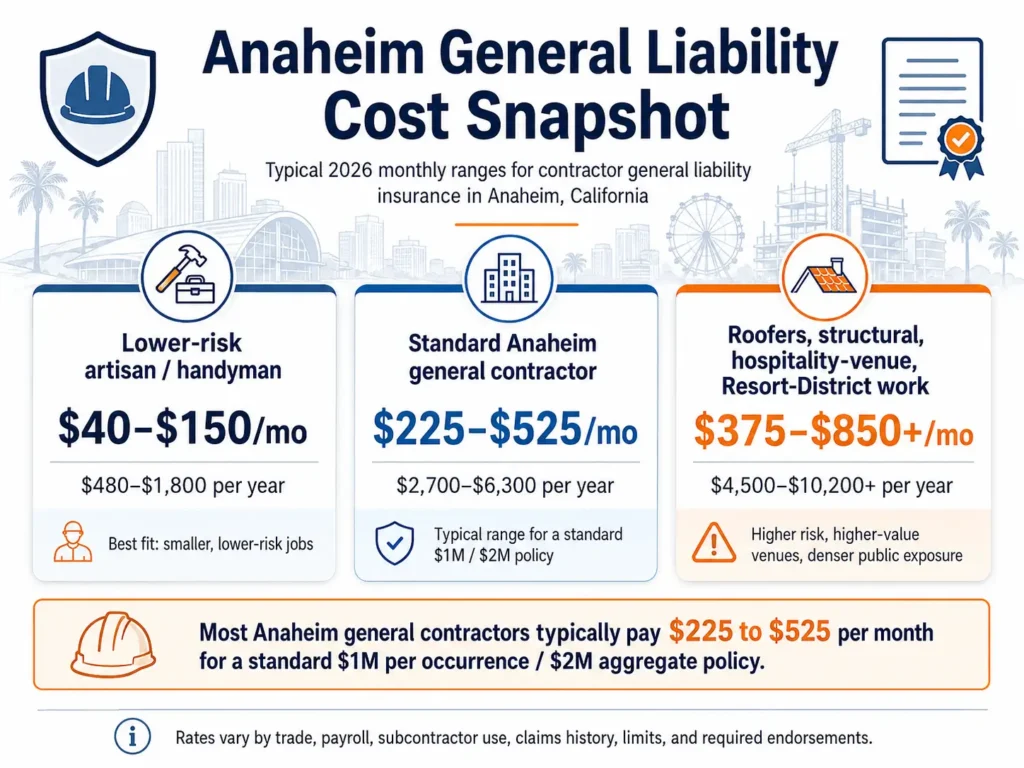
Last updated: June 2026 Reviewed by: Pascal Burke, Licensed Insurance Broker. CA License #6015321. TX License #3305690.Quick answer / TLDR Most Anaheim general contractors typically pay $225 to $525 per month ($2,700 to $6,300 per year) for a standard $1M per occurrence / $2M aggregate general liability policy, with roofers, structural trades, hospitality-venue contractors, and contractors on Anaheim Resort District projects often paying more. Lower-risk artisan contractors may see lower premiums, while contractors working around Disneyland Resort, Disney California Adventure, Anaheim Convention Center, Honda Center, Angel Stadium, hospitality properties, restaurants, and retail tenant improvements may need tighter COI wording, higher limits, or umbrella coverage. For fast carrier comparison, use .
On this page As ContractorsInsured.net (CA Lic #6015321), we shop multiple California-admitted carriers for Anaheim contractors, quote the same business day, and issue the COI right after binding.
Trade-specific guides: general liability for general contractors in Anaheim
Anaheim numbers sit inside a wider picture: see how much contractor insurance costs.
What general liability insurance covers
How much does general liability insurance cost in Anaheim?
| Contractor type in Anaheim | Typical monthly GL range | Typical annual GL range | Common notes |
| Lower-risk artisan or handyman work | $40 to $150 | $480 to $1,800 | Usually smaller jobs, lower payroll, limited subcontractor exposure |
| Standard Anaheim general contractor | $225 to $525 | $2,700 to $6,300 | Common $1M/$2M baseline for residential and light commercial jobs |
| Residential remodeler or tenant improvement contractor | $175 to $500 | $2,100 to $6,000 | Pricing depends heavily on subcontractors, payroll, and project type |
| Plumbing, HVAC, electrical, finish trades | $150 to $475 | $1,800 to $5,700 | Water, fire, electrical, or completed operations exposure can raise rates |
| Roofers, structural, hospitality-venue, Resort-District work | $375 to $850+ | $4,500 to $10,200+ | Higher claim severity, venue requirements, height exposure, and crowd exposure |
| Anaheim business profile | Expected GL pricing direction | Why carriers care |
| Solo finish carpenter with no employees | Lower | Lower payroll, limited jobsite foot traffic, smaller project values |
| Licensed B general contractor using subs | Middle to upper-middle | Subcontractor controls, certificates, and additional insured requirements matter |
| Roofer or structural contractor | Higher | Height, water intrusion, completed operations, and severity potential |
| Hotel or restaurant tenant improvement contractor | Higher | High-value interiors, business interruption concerns, public-facing spaces |
| Convention, venue, or Resort-District vendor contractor | Higher | COI wording, larger venues, dense foot traffic, and stricter contract requirements |
Why contractor GL costs more in Anaheim and the Resort District
- Crowd-density liability. Projects near hotels, restaurants, retail centers, convention facilities, and sports venues create more third-party foot traffic.
- High-value property damage. Hospitality interiors, commercial kitchens, retail spaces, event facilities, and finished guest areas can increase claim severity.
- Completed operations exposure. Plumbing, roofing, HVAC, electrical, fire protection, waterproofing, and structural work can produce claims months after the job is finished.
- Contract-driven coverage. Resort entities, public agencies, landlords, property managers, and venue operators may require Additional Insured, Primary Noncontributory, Waiver of Subrogation, or higher limits.
- California safety environment. Construction employers must comply with Cal/OSHA construction employer guidance, and safety history can influence carrier appetite, loss control review, and quote competitiveness.
Cost by coverage limit
| Coverage limit | Typical Anaheim use case | Expected cost impact | Notes |
| $1M per occurrence / $2M aggregate | Standard residential, light commercial, and many trade contracts | Baseline | Common starting point for many contractors |
| $2M per occurrence / $4M aggregate | Larger commercial jobs, property manager contracts, hospitality tenant improvements | Moderate increase | May be required before work starts |
| $1M/$2M plus umbrella | Contracts requiring $3M to $5M total liability | Higher | Umbrella may sit over GL, auto, and employers liability |
| $5M+ total liability | Some Resort-District, major venue, public entity, or high-value contracts | Highest | Usually requires carrier review, underwriting detail, and clean documentation |
The 7 factors carriers use to price your policy
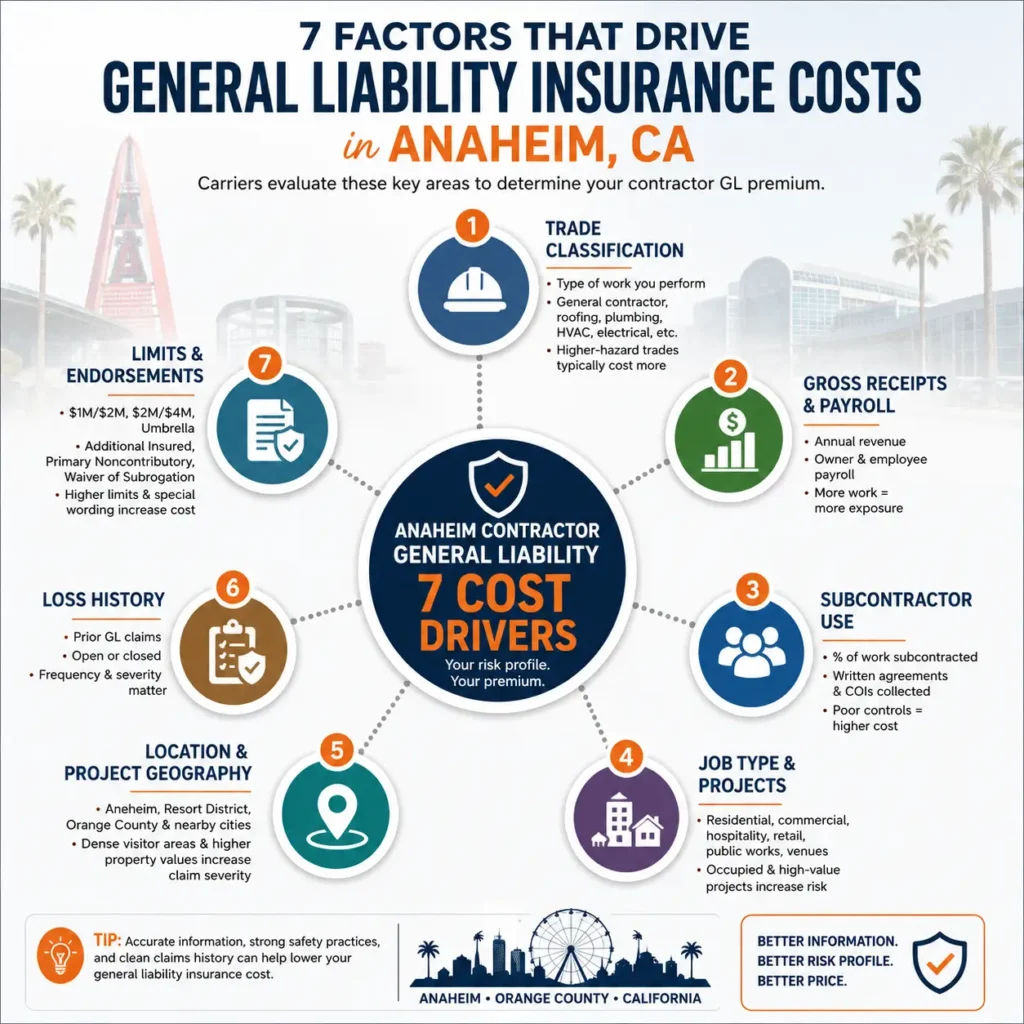
| Pricing factor | What the carrier reviews | Why it affects Anaheim GL cost |
| Trade classification | General contractor, roofing, plumbing, HVAC, electrical, carpentry, drywall, flooring, demolition, handyman | Higher-hazard trades usually cost more |
| Gross receipts and payroll | Annual revenue, owner payroll, employee payroll, project volume | More work usually means more exposure |
| Subcontractor use | Percentage subcontracted, written agreements, COIs collected, additional insured status | Poor subcontractor controls can increase premium or limit carrier options |
| Job type | Residential, commercial, hospitality, restaurant, retail, public works, venue work | Occupied buildings and high-value venues increase scrutiny |
| Location and project geography | Anaheim, Orange County, Resort District, Garden Grove, Santa Ana, Fullerton, Orange, Buena Park, Cypress, Yorba Linda | Dense visitor areas and higher property values can increase claim severity |
| Loss history | Prior GL claims, open claims, water damage, injury claims, completed operations claims | Clean history improves quote competitiveness |
| Limits and endorsements | $1M/$2M, $2M/$4M, umbrella, Additional Insured, Primary Noncontributory, Waiver of Subrogation | Higher limits and stricter wording can increase cost and require special forms |
| Cost driver | Lower-cost profile | Higher-cost profile |
| Work performed | Finish carpentry, painting, flooring, low structural exposure | Roofing, structural, waterproofing, demolition, exterior work |
| Customer type | Homeowners, small private commercial clients | Hotels, restaurants, venues, public agencies, large property managers |
| Jobsite condition | Unoccupied, controlled access | Occupied, public-facing, high foot traffic |
| COI requirements | Basic certificate | AI, PNC, WOS, higher limits, special manuscript wording |
| Claims history | No recent GL claims | Water intrusion, trip and fall, property damage, completed operations claims |
Anaheim contract, lease, and COI requirements
- Certificate holder name and mailing address
- Required GL limits
- Additional Insured wording
- Primary Noncontributory wording
- Waiver of Subrogation wording
- Completed operations requirement
- Umbrella or excess requirement
- Project description
- Vendor portal upload format
- Notice of cancellation language
- Subcontractor insurance requirements
What general liability does NOT cover
- Employee injuries. Workers’ compensation is the relevant policy for employee injuries.
- Business vehicles. Commercial auto is needed for owned, hired, or non-owned vehicle exposure.
- Tools and equipment. Inland marine or contractor’s equipment coverage usually protects tools, materials, and mobile equipment.
- Your own defective work. GL may respond to resulting damage to other property, but it usually does not pay simply to redo your faulty work.
- Professional design errors. Architects, engineers, design-build professionals, and consultants may need professional liability or E&O.
- Pollution claims. Fuel spills, mold, silica, asbestos, and other pollution exposures may need separate coverage or endorsements.
- Surety obligations. Bonds are different from insurance and may be required by public owners or prime contractors.
- Cyber and privacy claims. Vendor portals, customer data, and payment systems may require cyber liability.
- Employment claims. Discrimination, harassment, wrongful termination, and wage disputes need separate employment practices or related coverage.
How Anaheim contractors can lower GL costs without creating coverage gaps
- Classify your operations correctly. Do not let a broad description make you look like a higher-risk contractor if your work is narrower.
- Separate subcontracted work. Track subcontractor costs and collect COIs from every subcontractor.
- Use written agreements. Written contracts with insurance and indemnity requirements can improve the risk profile.
- Avoid last-minute COI surprises. Review Resort-District, Convention Center, hotel, restaurant, and property manager requirements before binding.
- Maintain a safety program. Cal/OSHA compliance, toolbox talks, documentation, and jobsite controls matter.
- Report accurate payroll and revenue. Understating exposure can lead to audit problems and coverage disputes.
- Bundle intelligently. Some contractors can improve pricing by packaging GL with commercial auto, inland marine, workers’ comp, or umbrella coverage.
- Quote before renewal pressure hits. A rushed renewal gives carriers less time to compete.
- Do not strip completed operations coverage. A cheaper policy that fails after the job is complete can be more expensive than a properly structured policy.
What to prepare before requesting a quote
| Information to prepare | Example | Why it matters |
| Legal business name | ABC Builders Inc. | Must match policy and contracts |
| DBA name | ABC Anaheim Remodels | Helps avoid certificate mismatch |
| CSLB license number | Active license number and classification | Confirms trade and California licensing details |
| Trade description | B general contractor, plumbing, roofing, HVAC, finish carpentry | Drives classification and carrier appetite |
| Annual gross receipts | Projected 2026 revenue | Major rating factor |
| Payroll | Owner, employee, and field payroll estimates | Helps carrier rate exposure |
| Subcontractor cost | Annual subcontracted labor spend | Carriers review subcontractor controls |
| Job mix | Residential, commercial, hospitality, restaurant, public works | Anaheim job type affects pricing |
| Largest project size | Largest expected contract value | Higher project values can change underwriting |
| Prior claims | Dates, amount paid, open or closed status | Claims history affects carrier options |
| Requested limits | $1M/$2M, $2M/$4M, $5M+ with umbrella | Must match contract requirements |
| Endorsements needed | AI, PNC, WOS, completed operations | Prevents COI rejection |
| Resort District / Convention Center vendor portal? Y/N | Yes, Anaheim Convention Center upload required | Helps broker check wording before bind |
| Current policy | Declarations page and loss runs | Allows better comparison |
Frequently asked questions about general liability insurance cost in Anaheim CA
How much does general liability insurance cost for an Anaheim contractor in 2026?
Most Anaheim general contractors typically pay $225 to $525 per month, or $2,700 to $6,300 per year, for a standard $1M per occurrence / $2M aggregate general liability policy. Lower-risk artisan contractors may pay less, while roofers, structural trades, hospitality-venue contractors, and Resort-District contractors often pay $375 to $850+ per month. Actual pricing depends on trade, revenue, payroll, subcontractor use, claims history, limits, and required endorsements.
Is general liability insurance legally required by California for an Anaheim contractor?
California does not generally require every licensed contractor to carry general liability insurance in the same way it regulates workers’ compensation and contractor licensing. One important exception applies to limited liability companies: under California Business and Professions Code section 7071.19, a licensed contractor LLC must maintain liability insurance with an aggregate limit of at least $1 million for five or fewer members of its personnel of record, plus $100,000 for each additional person listed, up to a maximum of $5 million. In practice, Anaheim contractors often need GL because project owners, landlords, public agencies, vendor portals, property managers, and prime contractors require it before work starts. City permits, commercial leases, hospitality jobs, Resort-District vendor packets, and larger contracts may require specific limits, Additional Insured wording, and certificates.
What GL limits do Anaheim Resort District and Convention Center contracts typically require?
Many Anaheim contractors start with $1M per occurrence / $2M aggregate, but Resort-District, Convention Center, Honda Center, hotel, restaurant, retail, and public entity contracts may require $2M/$4M or higher total limits. Some contracts require umbrella or excess liability to reach $5M or more. The exact requirement depends on the contract, certificate holder, job type, venue, and risk profile, so the insurance page should be reviewed before binding the policy.
How does hospitality or Disney-tenant work affect an Anaheim contractor's GL premium?
Hospitality and Disney-tenant work can increase underwriting scrutiny because it often involves high-value interiors, dense public traffic, strict vendor requirements, and business interruption concerns if property damage delays operations. A contractor working in a hotel, restaurant, attraction-adjacent retail space, or Convention Center environment may need higher limits and tighter endorsement wording. Carriers may also ask more questions about subcontractor controls, after-hours work, completed operations, and prior claims.
Can an Anaheim contractor get a same-day COI for a Resort District or Convention Center vendor portal?
A same-day COI may be possible if the policy is active, the requested wording is available, the certificate holder details are complete, and the required endorsements are already included or can be added quickly. Delays happen when the vendor portal requires special Additional Insured, Primary Noncontributory, Waiver of Subrogation, completed operations, or higher-limit wording that the current policy does not provide. Send the full insurance requirements page, not just a screenshot.
Does general liability cover damage I cause to my own work in Anaheim?
General liability usually does not pay simply to repair or replace your own defective work. It may respond when your work causes resulting damage to other property, subject to policy language and exclusions. For example, a roofing defect may not be covered as a redo of the roof itself, but resulting interior damage may trigger a covered claim. Contractors should review completed operations, exclusions, and warranties with a licensed broker before assuming coverage applies.
How does CSLB workers' comp compliance interact with general liability for Anaheim contractors?
Workers’ compensation and general liability solve different problems. GL covers certain third-party injury and property damage claims, while workers’ comp covers employee job-related injuries. CSLB compliance affects license standing, and some contractor classifications must carry workers’ comp or valid self-insurance even without employees. Anaheim project owners may request both GL and workers’ comp certificates, so a contractor can have a valid GL policy and still fail a compliance review if workers’ comp is missing.
What information speeds up an Anaheim contractor GL quote?
The fastest GL quotes usually include the legal business name, DBA, CSLB license number, trade classification, annual revenue, payroll, subcontractor costs, job mix, largest project size, prior claims, requested limits, and required endorsements. For Anaheim Resort-District, Convention Center, hotel, restaurant, or public works jobs, include the full contract insurance page and vendor portal requirements. This helps the broker confirm forms before binding and reduces the chance of COI rejection.
Why is contractor GL often more expensive in Anaheim than in inland Orange County?
Anaheim can price higher than some inland Orange County areas because the work mix often includes hospitality, restaurants, entertainment-adjacent retail, convention facilities, sports venues, public-facing commercial work, and higher-value properties. Dense foot traffic and stricter contract requirements can increase both claim severity and underwriting scrutiny. A contractor doing Resort-District tenant improvements or hotel work is usually viewed differently from a contractor doing lower-traffic residential work farther inland.
Get an Anaheim general liability quote
- What work do you actually perform?
- Where do you perform it?
- What does the contract or vendor portal require?
- Which policy and endorsements satisfy the job without creating gaps?
Disclaimer: This article is for general educational purposes only and does not provide legal, tax, or insurance coverage advice. Insurance availability, pricing, terms, exclusions, endorsements, and eligibility vary by carrier, trade, location, claims history, and underwriting review. Always review your policy, contracts, and certificates with a licensed insurance professional before relying on coverage for any specific project.