

Last updated: August 2026 Reviewed by: Pascal Burke, Licensed Insurance Broker, CA License #6015321, TX License #3305690
At a glance
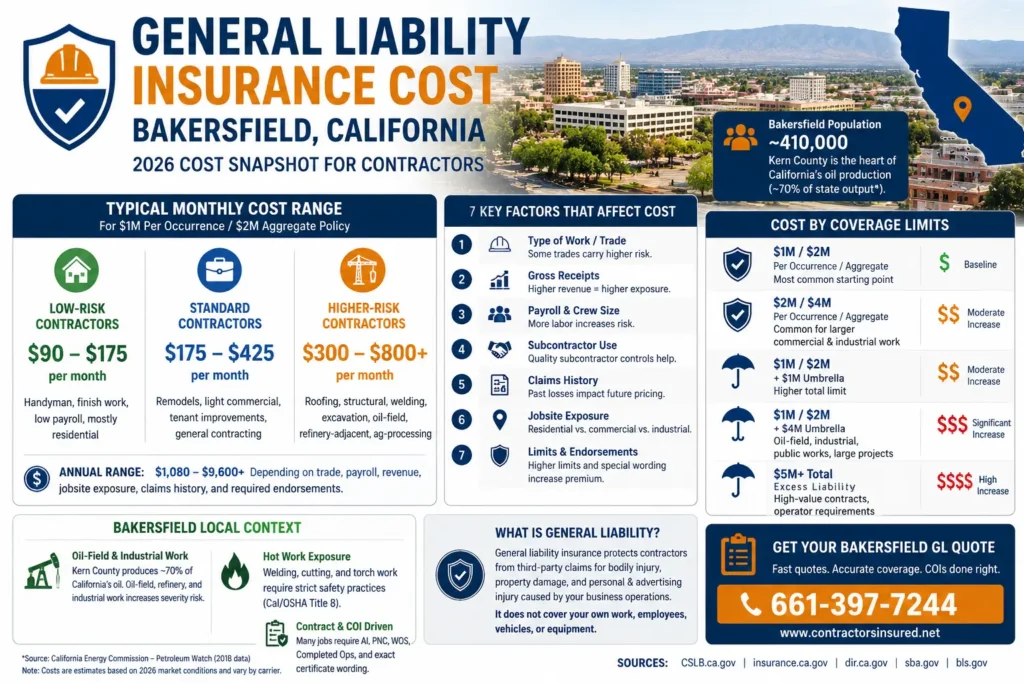
- Typical cost: Most Bakersfield contractors pay $175 to $425 per month ($2,100 to $5,100 per year) for standard $1M/$2M general liability; high-risk trades often run $300 to $800+ per month.
- What moves the price: trade classification, gross receipts and payroll, subcontractor use, claims history, requested limits, and the exact COI endorsements your contract requires.
- Why Bakersfield is different: oil-field, refinery-adjacent, roofing, structural, and hot-work exposures can push premiums above the standard local range.
- Fastest path to a quote: work with a contractor-focused broker who can match your license, limits, and certificate wording before you bind.
What general liability insurance covers
In brief: General liability covers third-party injury, third-party property damage, personal and advertising injury, and defense costs. It does not replace workers’ comp, commercial auto, inland marine, professional liability, or warranty coverage for your own defective work.
General liability insurance is a third-party liability policy that responds to claims arising from a business’s operations, including bodily injury to non-employees, property damage to third parties, and personal and advertising injury. For contractors, it is one of the most commonly required coverages in contracts, leases, vendor portals, and city permit packets.
In practical terms, general liability insurance for contractors is the policy that helps pay for covered claims when someone outside your business alleges your work caused injury, property damage, or certain non-physical harms. The SBA describes general liability insurance as coverage that can protect against financial loss from bodily injury, property damage, medical expenses, libel, slander, defending lawsuits, and settlement bonds or judgments. California’s Department of Insurance also explains that commercial insurance guidance is meant to help business owners recover from losses involving liability, property damage, worker injury, and related business risks.
Scenario 1: Oildale oil-field jobsite injury
A delivery driver walks through a contractor-controlled area at an Oildale oil-field support site, trips over temporary material staging, and breaks an ankle. The driver’s employer and the site operator ask who is responsible. A contractor GL policy may help pay defense costs and covered bodily injury damages if the claim fits the policy terms.
Scenario 2: Bakersfield residential remodel damage
A plumbing crew working on a Bakersfield kitchen remodel cracks the homeowner’s tile floor while moving equipment through the work area. General liability may respond to third-party property damage caused by the contractor’s operations, subject to policy terms, exclusions, deductibles, and whether the damaged property is considered the contractor’s own work.
Scenario 3: Rosedale advertising injury claim
A Rosedale subcontractor posts a jobsite photo online and later receives a demand letter claiming the image was copyrighted or used without permission. General liability can include personal and advertising injury coverage, which may help with defense costs for covered claims such as copyright issues in advertising.
Scenario 4: Tehachapi completed operations claim
A Tehachapi roofing crew completes a project. Six months later, a leak causes interior drywall and flooring damage. Completed operations coverage under GL may help respond to covered property damage caused by completed work, but it typically does not pay to replace the contractor’s own faulty work.
Scenario 5: Shafter subcontractor lawsuit
A Shafter general contractor is named in a lawsuit over a subcontractor’s work. Even if the GC believes the subcontractor caused the problem, defense costs can begin before fault is settled. General liability can help pay covered defense expenses, which is why general contractors often require subcontractor COIs and endorsements before allowing work on site.
How much does general liability insurance cost in Bakersfield?
In brief: Most Bakersfield general contractors should budget $175 to $425 per month for standard $1M/$2M GL, but oil-field, refinery-adjacent, roofing, structural, and hot-work contractors often price higher.
Most Bakersfield general contractors typically pay $175 to $425 per month ($2,100 to $5,100 per year) for a standard $1M per occurrence / $2M aggregate general liability policy.
That range is tighter and more useful than a generic national quote because Bakersfield is not a generic market. A contractor doing lower-risk handyman, drywall, finish carpentry, or residential remodel work in Bakersfield may price closer to the lower or middle part of the range. A contractor doing roofing, welding, structural steel, excavation, oil-field support, ag-processing maintenance, or refinery-adjacent work may price higher because one claim can involve height, fire, explosion, production downtime, high-value property, or strict contract wording.
Unlike national aggregators that quote $40 to $150 per month for a generic small business, Bakersfield contractor pricing has to reflect CSLB licensing, trade-specific operations, subcontractor exposure, Central Valley jobsite conditions, COI turnaround, and the endorsements required by oil operators, public works contracts, commercial landlords, and prime contractors.
For statewide context, see general liability insurance for California contractors. For policy fundamentals behind the ranges, see what general liability covers.
Typical Bakersfield contractor GL cost ranges
| Contractor profile | Typical monthly cost | Typical annual cost | Best-fit context |
| Low-risk small contractor | $90 to $175 | $1,080 to $2,100 | Handyman, finish work, low payroll, low subcontractor use, mostly residential |
| Standard Bakersfield general contractor | $175 to $425 | $2,100 to $5,100 | Residential remodels, light commercial, tenant improvements, standard $1M/$2M limits |
| Higher-risk trade contractor | $300 to $800+ | $3,600 to $9,600+ | Roofing, structural, excavation, welding, hot work, oil-field, refinery-adjacent, ag-processing work |
| Larger commercial contractor | $500 to $1,500+ | $6,000 to $18,000+ | Larger payroll, higher receipts, multiple crews, contract-heavy COI requirements |
| Contractor needing excess or umbrella | Varies | Varies | Jobs requiring $5M or higher total liability limits |
Cost by Bakersfield trade and exposure
| Trade or operation | Bakersfield pricing tendency | Why carriers price it this way |
| General contractor | Medium | Subcontractor control, jobsite coordination, completed operations, contract liability |
| Residential remodeler | Low to medium | Property damage risk inside finished homes, lower severity than heavy commercial |
| Plumber | Medium | Water damage, completed operations, occupied-home work |
| Electrician | Medium | Fire risk, completed operations, panel work, commercial facility exposure |
| Roofer | High | Height, water intrusion, completed operations, severe injury potential |
| Welder or hot-work contractor | High | Fire, explosion, burns, industrial site controls, permit requirements |
| Oil-field support contractor | High | High-value property, operator COI wording, hot-work or equipment hazards |
| Ag-processing facility contractor | Medium to high | Food production downtime, machinery, refrigeration, forklifts, busy premises |
| Excavation or grading contractor | Medium to high | Underground utilities, site damage, equipment movement, public works exposure |
Why contractor GL costs vary in Bakersfield and Kern County
In brief: Bakersfield is less expensive than many coastal California markets for some contractors, but oil-field, refinery, ag-processing, roofing, height, and hot-work exposures can quickly push premiums above the standard local range.
Bakersfield is a Central Valley construction market with a different risk profile than Los Angeles, San Francisco, San Jose, or Oakland. Lower urban density can help some contractors avoid the most expensive coastal California liability assumptions. But Kern County’s oil, agriculture, logistics, food processing, industrial maintenance, and public works mix can raise severity for specific trades.
Kern County’s energy footprint matters. The California Energy Commission reported that Kern oil fields produced the most oil in California in its referenced production data, with 65.7 percent of total 2018 oil originating from Kern fields. That does not mean every Bakersfield contractor works in oil. It does mean many local contractors encounter operators, industrial facility managers, refineries, machine shops, ag processors, and vendor portals that expect precise insurance wording.
Cal/OSHA’s Title 8 hot-work rule for petroleum refining, transportation, and handling says hot work operations require practices and procedures to protect employees from fire and explosion hazards. For refinery settings, the petroleum refinery process safety rule requires hot-work permit procedures that identify dates, times, equipment or process, and the party performing the hot work. Those safety rules are not GL pricing tables, but carriers care about the same exposure themes: fire, explosion, control of work, documentation, training, and jobsite supervision.
The practical takeaway: Bakersfield contractors should not shop only by monthly price. A cheap policy that cannot issue the Additional Insured, Primary and Noncontributory, Waiver of Subrogation, completed operations, or hot-work wording required by the contract can delay mobilization or cause a rejected COI.
Cost by coverage limit
In brief: $1M/$2M is the common starting point for many Bakersfield contractors, $2M/$4M is common for larger commercial and operator-driven work, and $5M+ usually requires umbrella or excess liability.
Most Bakersfield contractors start by quoting $1M per occurrence / $2M aggregate general liability. This is the standard limit often requested by homeowners, property managers, general contractors, and many commercial clients. However, oil-operator vendor packets, larger commercial leases, public works contracts, and industrial service agreements may require higher limits or specific endorsements.
| Coverage structure | Typical Bakersfield use case | Expected cost impact |
| $1M occurrence / $2M aggregate | Standard residential, light commercial, many subcontractor agreements | Baseline pricing |
| $2M occurrence / $4M aggregate | Larger commercial jobs, prime contractor requirements, some facility work | Higher than baseline, often modest if carrier offers it |
| $1M/$2M plus $1M umbrella | Contracts requiring additional total limits without changing the base GL limit | Adds separate premium and underwriting |
| $1M/$2M plus $4M umbrella | Oil-field, industrial, larger commercial, public works, or property-owner requirements | Meaningful premium increase |
| $5M+ total liability package | Operator portals, high-value facility work, heavy civil, industrial maintenance | Carrier-dependent and often requires full underwriting |
Higher limits are not the only issue. Contract language can matter as much as the dollar amount. A $2M/$4M quote is not useful if the policy cannot provide the required Additional Insured endorsement, completed operations wording, or primary and noncontributory status.
The 7 factors carriers use to price your policy
In brief: Carriers price contractor GL by looking at what you do, where you work, how much work you perform, who works under you, your claims record, requested limits, and the contract wording attached to the job.
Bakersfield contractor GL pricing is underwriting-driven. Two contractors can both ask for $1M/$2M general liability and receive very different premiums because the carrier sees different exposure.

Pricing factor | What the carrier reviews | Bakersfield example |
1. Trade classification | The actual work performed, not just the business name | Roofing, welding, excavation, and structural trades price higher than finish work |
2. Gross receipts | Annual revenue and project volume | A $900,000 contractor usually costs more than a $150,000 contractor |
3. Payroll and crew size | Employees, owners, seasonal labor, and labor intensity | Multiple crews create more jobsite exposure than owner-only work |
4. Subcontractor use | Certificates, contracts, additional insured status, and subcontractor costs | A GC using uninsured subs may be priced or declined differently |
5. Claims history | Prior losses, open claims, frequency, and severity | A water damage or fire claim can affect renewal options |
6. Jobsite exposure | Residential, commercial, industrial, public works, oil-field, ag-processing | Hot-work or refinery-adjacent work usually needs more underwriting |
7. Limits and endorsements | $1M/$2M vs $2M/$4M, AI, PNC, WOS, completed ops, blanket forms | Oil-operator portals often require exact wording |
This is why GL cost factors and limits need to be reviewed before you bind. A contractor who buys the lowest quote first and checks the contract later may discover the policy cannot satisfy the job’s COI requirements.
Bakersfield contract, lease, and COI requirements
In brief: Bakersfield contractors should expect many commercial, public, operator, and prime-contractor jobs to require a COI with exact limits, endorsements, and certificate holder wording.
General liability is not automatically required by California for every contractor in the same way workers’ compensation may be required for employers. One statutory exception applies to limited liability companies: under California Business and Professions Code section 7071.19, liability insurance is a condition of issuing, reinstating, reactivating, or continuing to use a contractor license held by an LLC, at an aggregate limit of at least $1 million for five or fewer members of its personnel of record, plus $100,000 for each additional person listed, capped at $5 million. But in real-world contracting, GL becomes a practical requirement because clients, landlords, lenders, municipalities, operators, and prime contractors often require proof before work begins.
CSLB states that workers’ compensation coverage must be continuous when required, and failure to maintain required coverage will result in the license being suspended. That is separate from GL, but it often appears in the same compliance conversation. A Bakersfield contractor with employees, or a licence in one of the classifications CSLB requires to carry workers’ compensation even without employees (C-8 Concrete, C-20 Warm-Air Heating, Ventilating and Air-Conditioning, C-22 Asbestos Abatement, C-39 Roofing, and C-61/D-49 Tree Service), or a public works contract may need to coordinate GL, workers’ comp, auto, bonds, and endorsements together.
Kern County’s Construction Services FAQ notes that a low bidder has sometimes been unable to produce insurance or bonding capacity, allowing the County to treat the bidder as non-responsive. The City of Bakersfield also maintains a Risk Management page, and the insurance limits and certificate wording a contractor has to match are set in the bid or contract documents for the specific job. For a contractor, the lesson is simple: COI details are not paperwork after the sale. They are part of whether you can start the job.
Common Bakersfield and Kern County COI requests may include:
- $1M/$2M general liability limits
- $2M/$4M or higher for larger commercial or operator contracts
- Named certificate holder
- Additional insured status
- Primary and noncontributory wording
- Waiver of Subrogation
- Completed operations coverage
- 30-day notice language where available
- Project-specific wording
- Hot-work wording for industrial or oil-field tasks
- Commercial auto and workers’ comp on the same certificate
- Bonding for public works or certain prime contracts
Existing clients who need documentation can review Certificate of Insurance basics . Request a COI →.
What Bakersfield and California actually require (verified August 2026)
Bakersfield itself imposes less paperwork than most contractors expect. The rules that matter here are state rules:
- No citywide GL requirement found. The city’s building permit application asks for your CSLB license number, classification, and expiration date, not a GL certificate. You will also need a City Business Tax Certificate from the Treasury Division to operate in Bakersfield.
- CSLB licensing is the real gate. A license is required for any job of $1,000 or more in combined labor and materials, and every active contractor must maintain a $25,000 contractor license bond.
- LLCs carry mandatory liability insurance. A contractor LLC must carry $1 million in aggregate liability coverage with up to five personnel of record, plus $100,000 for each additional person up to a $5 million cap, and post a separate $100,000 employee/worker bond. Sole proprietors and corporations have no universal CGL mandate in California.
- Workers’ comp rules are tightening. Concrete (C-8), HVAC (C-20), asbestos (C-22), roofing (C-39), and tree service (D-49) contractors must carry workers’ compensation even with no employees, and every licensed California contractor is scheduled to need it from January 2028.
The Kern County factor. Kern produced 89.66 million barrels of oil in 2023, by far the most of any California county (CalGEM annual report). Oil-field, pipeline, welding, and hot-work classifications carry pollution and environmental surcharges that move GL pricing directly. Wildfire exposure is also real (Kern County has 646,054 acres mapped Very High fire hazard, and the July 2026 South Fire forced evacuations near Bakersfield), but fire mainly affects property and builders risk placement rather than your base GL rate.
Current benchmarks and local volume. California general contractors average about $144 per month for GL (Insureon, 2026). Bakersfield authorized 1,648 housing units in 2025, 1,401 of them single-family (U.S. Census Building Permits Survey, May 2026).
What general liability does NOT cover
In brief: GL is broad third-party liability coverage, but it does not cover every contractor risk. Workers’ comp, commercial auto, tools and equipment, professional liability, surety bonds, and warranty obligations may require separate policies or controls.
A Bakersfield contractor should not treat general liability as an all-risk business policy. It has exclusions, conditions, and coverage boundaries. Some exclusions are standard across many policies, while others depend on your carrier, trade, endorsements, and contract wording.
General liability usually does not cover:
- Employee injuries: Workers’ compensation handles employee injury claims when required.
- Your own vehicle accidents: Commercial auto is usually needed for work trucks, vans, and trailers.
- Tools and equipment theft: Inland marine or contractors equipment coverage is usually needed.
- Faulty workmanship itself: GL may respond to resulting property damage, but not necessarily your own defective work.
- Professional design errors: Contractors who design, engineer, consult, or provide plans may need E&O.
- Pollution events: Many pollution claims are excluded unless specific coverage is purchased.
- Intentional acts: Deliberate damage or expected injury is not the purpose of GL.
- Surety obligations: A bond is not insurance for liability claims. It guarantees performance, payment, or compliance.
For California contractors comparing requirements across jobs, California contractor GL requirements can help separate GL from workers’ comp, bonds, commercial auto, and other compliance items.
How Bakersfield contractors can lower GL costs without creating coverage gaps
In brief: The best savings come from clean underwriting, accurate class codes, good subcontractor controls, safety documentation, claim prevention, and matching coverage to actual contract requirements.
The goal is not to buy the cheapest policy. The goal is to buy the least expensive policy that still satisfies your work, contracts, endorsements, and claims exposure. A $70-per-month savings disappears quickly if a rejected COI delays a mobilization date, or if an exclusion removes coverage for the exact work you perform.
Practical ways to lower Bakersfield contractor GL costs include:
- Classify the work accurately
Do not describe yourself as a handyman if you perform roofing, structural, excavation, welding, or oil-field support work. Misclassification can create claim problems and audit issues.
- Keep subcontractor controls clean
Collect COIs from subcontractors, require written agreements, request additional insured status where appropriate, and keep records. Carriers often price GCs more favorably when subcontractor risk is controlled.
- Separate high-hazard work
Tell your broker if oil-field, hot-work, height, crane, welding, or refinery-adjacent work is occasional rather than your main operation. Some carriers can price around a clear percentage of revenue by operation.
- Improve jobsite documentation
Use written safety procedures, hot-work permits where required, daily logs, photos, training records, and incident reports. Documentation can help underwriting and claims defense.
- Avoid uninsured subcontractors
Using uninsured subs can increase your GL exposure and create premium audit problems. It can also violate prime contracts.
- Review contracts before binding
A policy should be matched to the job’s insurance exhibit. Do not wait until the certificate holder rejects your COI to ask about endorsements.
- Choose limits based on contracts
Do not overbuy limits for small residential work, but do not underbuy if commercial, public works, or oil-operator contracts require $2M/$4M or $5M total limits.
- Work with a contractor-focused broker
A contractor broker can compare carriers, identify exclusions, and check whether the policy can issue the endorsements you actually need. For nearby Central Valley comparison, see general liability insurance cost in Fresno. For a coastal market comparison, see general liability insurance cost in Los Angeles.
What to prepare before requesting a quote
In brief: The fastest Bakersfield GL quotes come from complete business details, accurate trade information, revenue and payroll estimates, subcontractor costs, prior coverage, claims history, CSLB license information, and the contract’s COI wording.
Before requesting a quote, gather the information carriers and brokers use to price and approve coverage. A complete submission can turn a multi-day back-and-forth into a same-day or next-day quote, depending on trade and carrier appetite.
Information to prepare | Why it matters |
Legal business name and DBA | Needed for policy issuance and certificate accuracy |
Business address and mailing address | Helps rate territory and policy documents |
CSLB license number | Confirms contractor classification and license status |
Owner experience | Supports underwriting for newer businesses |
Detailed operations | Distinguishes remodel, roofing, welding, excavation, oil-field, and industrial work |
Annual gross receipts | Major rating factor for GL premium |
Annual payroll | Helps identify labor exposure and business size |
Subcontractor costs | Important for GCs and trades using subs |
Percentage of residential vs commercial work | Changes pricing and carrier appetite |
Oil-operator vendor portal? Y/N | Helps identify exact COI and endorsement wording |
Hot-work exposure? Y/N | Important for welding, cutting, torching, industrial repair, and refinery-adjacent work |
Requested limits | $1M/$2M, $2M/$4M, umbrella, or excess |
Required endorsements | AI, PNC, WOS, completed operations, project-specific forms |
Prior carrier and premium | Helps compare renewal options |
Claims history | Required for underwriting and carrier selection |
Sample contract or insurance exhibit | Prevents rejected COIs after binding |
If you are bidding Kern County Public Works, a City of Bakersfield project, a commercial buildout near California State University Bakersfield, an industrial job in Shafter, or an oil-field support project west of town, include the insurance exhibit before binding. It is easier to place the correct policy upfront than to replace a cheap policy that cannot issue the required certificate.
Frequently asked questions about general liability insurance cost Bakersfield CA
How much does general liability insurance cost for a Bakersfield contractor in 2026?
Most Bakersfield general contractors typically pay $175 to $425 per month, or $2,100 to $5,100 per year, for a standard $1M per occurrence / $2M aggregate general liability policy. Smaller low-risk contractors may pay less, while roofers, welders, structural trades, oil-field support contractors, and refinery-adjacent contractors may pay $300 to $800+ per month because the potential claim severity is higher.
Is general liability insurance legally required by California for a Bakersfield contractor?
California does not require every contractor to carry general liability in the same blanket way that certain contractors must carry workers’ compensation. The main exception is a licensed contractor LLC, which must carry at least $1 million in liability insurance under California Business and Professions Code section 7071.19, with more required as its personnel of record increase. However, GL is commonly required by clients, landlords, prime contractors, lenders, public entities, and vendor portals before work begins. Bakersfield contractors should treat GL as a practical business requirement because many jobs cannot start without an acceptable COI and required endorsements.
What GL limits do Kern County oil-field and commercial contracts typically require?
Many standard jobs request $1M per occurrence / $2M aggregate general liability. Larger commercial, industrial, public works, oil-field, refinery-adjacent, and facility maintenance contracts may request $2M/$4M or $5M+ total liability limits through umbrella or excess coverage. The exact requirement depends on the contract, operator, property owner, or prime contractor, so review the insurance exhibit before buying the policy.
How does oil-field or refinery work affect a Bakersfield contractor's GL premium?
Oil-field and refinery-adjacent work can increase GL premium because carriers see higher severity potential. Hot work, welding, cutting, equipment repair, work near tanks, production downtime, high-value property, fire, explosion, and strict vendor portal wording all affect underwriting. A contractor doing only occasional industrial work should separate that revenue from standard residential or commercial work so the broker can present the risk accurately.
How does CSLB workers' comp and Cal/OSHA hot-work compliance interact with GL?
Workers’ compensation, Cal/OSHA safety compliance, and general liability are separate issues, but they often overlap in contractor compliance reviews. Workers’ comp addresses employee injuries when required. Cal/OSHA rules address workplace safety practices such as hot-work procedures. General liability addresses covered third-party injury or property damage claims. A Bakersfield contractor may need all three aligned before a public, industrial, or operator-controlled job allows mobilization.
Can a Bakersfield contractor get a same-day COI for an oil-operator vendor portal?
Sometimes, yes, but only if the policy already supports the required wording. A same-day COI is realistic when the contractor has active coverage, the certificate holder information is complete, and the requested endorsements are available. It becomes slower when the operator asks for special Additional Insured wording, Primary and Noncontributory language, Waiver of Subrogation, completed operations, hot-work language, or higher limits that were not reviewed before binding.
Does general liability cover damage I cause to my own work in Bakersfield?
Usually not in the way many contractors expect. General liability may cover resulting third-party property damage from your completed operations, but it typically does not function as a warranty for replacing your own defective work. For example, it may respond to covered interior damage caused by a leak, but not necessarily the cost to redo the faulty roofing work that caused the leak.
What information speeds up a Bakersfield contractor GL quote?
The fastest quote comes from a complete submission: legal business name, CSLB license number, trade details, owner experience, annual gross receipts, payroll, subcontractor costs, residential versus commercial split, prior coverage, claims history, requested limits, and any contract insurance exhibit. For oil-field, industrial, public works, or ag-processing work, include hot-work details and vendor portal wording before the quote is submitted.
Why is contractor GL often more or less expensive in Bakersfield than in the Bay Area or LA?
Bakersfield may price lower than coastal California for some standard residential and light commercial contractors because jobsite density, property values, and urban litigation assumptions can be different. However, Bakersfield can price higher for oil-field, refinery-adjacent, roofing, structural, welding, excavation, and ag-processing work because those trades create higher severity potential. The trade and contract requirements usually matter more than the city alone.
Get a Bakersfield general liability quote
In brief: Bakersfield contractors should quote GL before signing a contract, starting a vendor portal application, or promising a COI deadline.
ContractorsInsured.net helps Bakersfield and Kern County contractors compare general liability options, match limits to contract requirements, and issue COIs for residential, commercial, public works, oil-field support, and ag-adjacent work. Whether you are based in Bakersfield, Oildale, Rosedale, Greenacres, Tehachapi, Shafter, Wasco, Delano, Arvin, Lamont, Lake Isabella, or elsewhere in Kern County, the right quote starts with accurate operations and the insurance wording your job requires.
Disclaimer: This article is for general educational purposes only and does not provide legal, tax, safety, or insurance coverage advice. Insurance availability, pricing, terms, exclusions, endorsements, and underwriting decisions vary by carrier, contractor operations, location, claims history, contract wording, and date of quote. Always review your policy, endorsements, contracts, and certificate requirements with a licensed insurance professional.
Get your Bakersfield contractor GL quote today
Match your limits, endorsements, and COI wording to the job before you bind. Same-day certificates available for residential, commercial, public works, and oil-field support work.
Bakersfield numbers sit inside a wider picture: see average general liability insurance costs by trade.